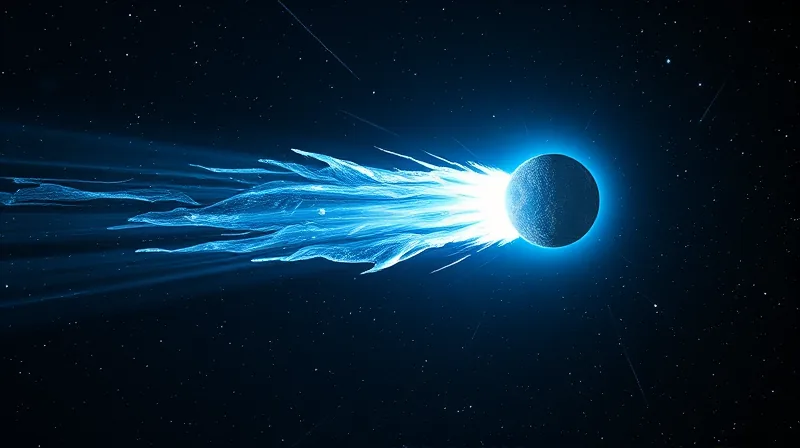
Asteroid 1998 SH2 Revealed as Hidden Comet
When A Predicted Path Fails To Match Reality
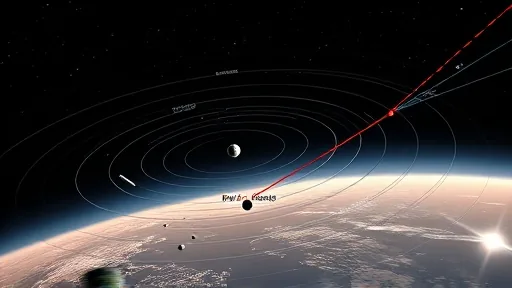
In August 2025, an object designated 1998 SH2 passed within 2 million miles of Earth, an event that initially seemed unremarkable [1] This was not remarkable by itself — many near-Earth objects make such approaches. What caught the attention of researchers at NASA’s Jet Propulsion Laboratory was what happened when they tried to find it again. The object was not where their calculations said it should be.
The tracking team had used orbital data from 1998 to 2016 They had factored in the gravitational pull of the Sun and every planet in the solar system. Yet the object had deviated from its predicted course due to an unanticipated force.
Davide Farnocchia, a navigation engineer with NASA’s Center for Near-Earth Object Studies at JPL, led the investigation. [2] The team used optical astrometry to measure the object’s position with extreme precision. They identified what they called “nongravitational perturbations” — forces acting on the object that did not come from gravity alone.
For an asteroid, such perturbations should not exist. Asteroids are inert rock. They follow paths determined solely by gravity. But comets are different. When a comet approaches the Sun, ice trapped inside its rocky material turns to gas. That gas vents into space, creating a small thrust that alters the object’s trajectory.
The researchers realized the object had a dual nature Past images had shown no obvious cometlike activity. No bright tail. No fuzzy coma of gas and dust surrounding a nucleus. The object looked like an asteroid. But its motion told a different story.
The Observational Evidence That Confirmed The Hypothesis
The close approach to Earth in August 2025 gave the team a rare opportunity to capture visible evidence of cometary activity that had eluded previous observations. They contacted astronomers at the Canada-France-Hawaii Telescope, a 3.6-meter optical and infrared telescope near the summit of Mauna Kea in Hawaii. [3]
They also reached out to the European Southern Observatory’s Danish Telescope in La Silla, Chile, a 1.5-meter instrument capable of detecting faint objects, and the European Southern Observatory’s Very Large Telescope on Cerro Paranal in Chile, an 8.2-meter telescope that can image incredibly faint objects. [5].
Olivier Hainaut, an astronomer with the European Southern Observatory and coauthor of the study, described the images: “The images we collected from these observatories showed a weak but clear tail, thus confirming that 1998 SH2 is, in fact, a comet.” [4] The tail was so faint that most observatories would have missed it entirely.
As a result of this investigation, 1998 SH2 received an additional designation: comet P/1998 SH2. The object had been tracked through two complete solar orbits without additional telescope observations between 1998 and 2016, during which venting gas had been pushing it slowly but persistently off course.
The Broader Implications For Dark Comets And Planetary Defense
The research sheds light on an even more unusual class of objects called dark comets, which exhibit significant trajectory irregularities like 1998 SH2 but show no visible evidence of cometary activity—no coma, no tail, no detectable outgassing—remaining invisible to most observational techniques.
Dark comets fall into two distinct populations: larger ones following orbits similar to Jupiter-family comets, which are short-period comets with highly elliptical orbits, and smaller ones orbiting closer to the Sun. Since the first dark comet was discovered in 2016, about a dozen more have been identified.
The paper’s authors suggest that many larger dark comets could turn out to be regular comets, requiring the right opportunity to observe them with powerful telescopes. This distinction matters for more than classification—it affects how scientists assess Earth impact risks.
“Because of outgassing, the motion of comets is more significantly perturbed than that of asteroids,” Farnocchia explained. [2] “Detecting these perturbations can be an important diagnostic tool for planetary defense that will help understand which objects may be comets rather than asteroids, how their orbits evolve, and how that influences their Earth impact risks.”
NASA’s upcoming Near-Earth Object Surveyor mission, the first space survey telescope built specifically for planetary defense, will support this effort. [6] It will seek out some of the hardest-to-find near-Earth objects, including dark asteroids and comets that do not reflect much visible light. The mission is managed by JPL and supported by NASA’s Planetary Defense Coordination Office.
The question that remains open is how many objects currently classified as asteroids are actually comets in disguise. Previous research published on arXiv in 2015 estimated that 0.3 to 3.3 percent of near-Earth asteroids with certain brightness characteristics could be dormant short-period comets, rising to about 9 percent for objects with diameters of one kilometer or larger. Continuous tracking of near-Earth objects using precision astrometry data may reveal more of these hidden comets.
Sources
1. NASA’s Jet Propulsion Laboratory
2. NASA’s Center for Near-Earth Object Studies
3. Canada-France-Hawaii Telescope
4. European Southern Observatory
5. European Southern Observatory’s Very Large Telescope