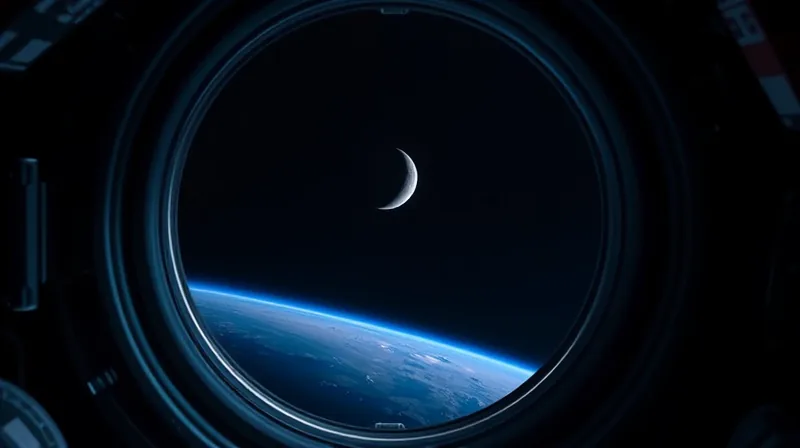
Artemis II reveals lunar science and Earth views
Tension rippled through the Orion capsule. Four astronauts, strapped into their seats, felt the rumble of the Space Launch System rocket beneath them. On April 1, 2026, the Artemis II mission launched from Kennedy Space Center. [1] The crew—NASA astronauts Reid Wiseman, Victor Glover, and Christina Koch, alongside Canadian Space Agency astronaut Jeremy Hansen—began a 10-day journey around the moon. [2] Their mission was not just to fly but to capture the experience for everyone on Earth.
The spacecraft, named Integrity, carried cameras. Two Nikon D5 cameras, a Nikon Z9, and various zoom and wide-angle lenses were onboard. The astronauts also used iPhones. GoPro action cameras were fixed to the outside of the Orion spacecraft. These tools were essential for documenting the voyage.
During the mission, the crew sent back occasional images. NASA prioritized mission-essential communications. So Earthlings saw just a few photographs during the flight. The full collection remained on memory cards inside Integrity.
After splashdown on April 10, 2026, the work began. NASA staff at Johnson Space Center started processing the data. “There’s a Herculean effort that goes on at the Johnson Space Center with the teams that actually have to take all these data and get them into the mission data infrastructure that allows us to process them and get them out,” said Kelsey Young, a planetary scientist at NASA’s Goddard Space Flight Center. [4] Young is the lunar science lead for the Artemis II mission at the agency’s Science Mission Directorate. The amount of data was huge.
On May 12, 2026, NASA published 12,217 photographs from the mission. [6] The images were posted on the Gateway to Astronaut Photography of Earth website. This site is a repository for astronaut photos from space missions. The collection includes thousands of never-before-seen views of Earth and the moon. It also includes images of the interior of Integrity.
How to Access the Artemis II Photos
Viewing the images manually requires a few steps. On the website’s search tab, scroll down to “Search Using Other Methods.” Select “NASA Photo ID Search.” Enter the code for the Artemis II mission: ART002-E. Select “Run Query.” You will then have 12,000 images to scroll through.
Much of the data has not been entered yet. For example, you can check the focal length of each shot. You can see the date it was taken. You can find the geographical coordinates. But you cannot always see the photographer or details about any features. A shortcut link is available to access the collection directly.
There is an easier way to peruse the new images. Science communicator Hank Green has built Artemis Timeline. This website displays the best Artemis II mission photos in chronological order. It offers a more pleasant browsing experience.
During the mission, the Artemis II astronauts sent back many images. Many of these were published at low resolution on NASA’s Artemis II Multimedia website. A folder called “Artemis II Lunar Flyby Gallery” contains 86 images. They can also be viewed on NASA’s Flickr page. This new trove adds many more images, and in much higher resolution.
The Journey to the Moon
The Artemis II mission was a 10-day journey. It launched on April 1. The spacecraft made its closest approach to the moon on April 6. It splashed down on Earth on April 10. The crew experienced a seven-hour flyby of the moon’s far side. During this time, they captured hundreds of images, including views never before seen by human eyes.
Among the highlights were a solar eclipse. The crew saw Earthrise and Earthset. They documented six meteoroid impacts flashing across the lunar surface. They also captured impact craters, ancient lava flows, and surface fractures. These images will help scientists study the moon’s geologic evolution.
The images were taken from the SD cards in the cameras on Integrity. The astronauts used a variety of equipment. The Nikon D5 cameras are professional-grade. The Nikon Z9 is a mirrorless camera. The iPhones provided additional flexibility. The GoPro cameras captured external views.
The Science Behind the Images
The Artemis II lunar science team has until October 2026 to publish preliminary reports. This is six months from the mission. The reports will cover science and operations. The full Artemis II dataset will also be released. This includes all mission moon images.
The images’ final destination will be NASA’s Planetary Data System. [7] This system houses data from every NASA mission relevant to planetary science. Voice recordings that the Artemis II astronauts made during their flyby of the moon will also be available there. A user’s guide compiled by the mission’s science team will help researchers make the most of the information.
The science team includes about 60 people. They were eagerly poring through mission images when Young talked to Scientific American. The team members’ first step was understanding what they had. Like any other photographers, the Artemis II crew snapped their share of blurry shots and misfires.
Next, the science team members have to orient themselves in each image’s view of the moon. They need to identify the lunar features on display. For researchers, the most important moment will be pivoting from looking at individual features to filtering those views through the top 10 science priorities for the mission.
Those science objectives include studying color and brightness. These can be clues to geological history. Observing the flashes that mark a meteoroid striking the lunar surface is another objective. Better understanding locations considered potential landing sites for future missions is also key. Analyzing the wispy atmosphere and any lunar dust it contains is another goal.
The Artemis II mission data will be fully archived in NASA’s Planetary Data System by October 2026, providing a lasting resource for lunar scientists and future mission planners As the FIFA World Cup approaches, NASA is bringing space science to soccer fans worldwide. From June 11 to July 19, 2026, NASA will host an exhibit at FIFA Fan Festival Houston. Visitors can learn how research aboard the International Space Station benefits life on Earth. They can experience missions in low Earth orbit, the Moon, and beyond through the Artemis program.
On June 20, Johnson Space Center Director Vanessa Wyche will introduce select Artemis II crew members. This follows their historic mission around the Moon. The crew will participate in World Cup activities ahead of the Netherlands-Sweden match in Houston. They will appear on the Fan Festival Houston main stage to share their experience with fans.
The connection between NASA and the World Cup goes beyond the exhibit floor. It reaches all the way to orbit. NASA spinoff technologies are innovations developed for space exploration. They go on to shape commercial products and everyday life, even on the soccer field.
For more than 25 years, research aboard the International Space Station has enabled breakthroughs. These breakthroughs are in science, technology, and human health. They advance innovations that benefit people on Earth. That work includes studies that improve understanding of the aerodynamics and physics involved in soccer ball flight.
The Physics of Soccer Balls in Space
In partnership with the ISS National Laboratory in 2019, researchers used the station’s microgravity environment. [9] They studied how a soccer ball’s internal mass affects its motion, stability, and rotation. The findings have improved understanding of how embedded technologies, including match-ball sensors, can influence performance during play. The research contributed to studies used in the development and evaluation of soccer balls for major international tournaments, including FIFA World Cup competition.
Understanding the relationship between an object’s center of mass and its geometric center is key. This relationship predicts how free-flying objects move. This includes spacecraft, satellites, and aircraft.
Since 2022, Adidas has embedded electronics inside official match balls used in major tournaments. The sensors track speed, position, and contact in real time. They support officiating and broadcast technology. But those sensors also add mass in specific locations inside the ball. Uneven mass distribution can affect how a ball moves through the air.
The space-based research has helped improve understanding of how internal mass, including embedded sensors, can influence stability and rotation in real-world playing conditions. This work builds on earlier research into how spinning objects behave in microgravity.
Engineers at NASA’s Ames Research Center in Silicon Valley, California tested Adidas’ Brazuca ball. [10] This ball was developed for the 2014 FIFA World Cup. They tested it in wind tunnel conditions at the Fluid Mechanics Laboratory. Researchers studied aerodynamic behavior. They focused on how low-spin kicks can produce “knuckling.” This is where the ball moves unpredictably due to unstable airflow across the seams. NASA engineers measured the speeds and flow conditions where this effect was most pronounced.
Adjustments in panel shape, seam depth, and surface texture can influence flight consistency. These adjustments help determine whether a ball curves, dips, or holds its line during play.
Now, NASA and Adidas are presenting that science through a STEMonstration. This experiment compares how differently balanced soccer balls spin and move in microgravity. The experiment shows how the same physics that governs motion in space also shapes the game millions watch on Earth.
Through research aboard the International Space Station and technology developed for exploration, NASA continues to demonstrate how discoveries made for space can benefit people on Earth. This includes athletes and fans participating in the world’s most popular sport.
The Future of Artemis
The Artemis program is designed as a step-by-step return to the moon. The ultimate goal is a permanent moon base. Artemis I was an uncrewed test flight. It successfully orbited the moon and returned to Earth. This was completed in 2022.
Artemis II was the first crewed mission. It flew astronauts around the moon. This was completed in 2026. Artemis III is a planned mission. It will test docking with SpaceX/Blue Origin lunar lander in Earth orbit. This is ahead of a lunar landing. It is expected in 2027.
Artemis IV is expected to deliver astronauts to the moon’s surface. It will target the south pole. This is expected in 2028–2029. Artemis V is a follow-up mission. It aims to expand lunar exploration capabilities. This is expected in 2029–2030.
The Artemis II data will be crucial for these future missions. The images and voice recordings will help scientists understand the moon better. They will inform landing site selection. They will guide the design of habitats and equipment.
The Artemis II crew’s ability to operate under pressure highlights the importance of teamwork in deep-space exploration, a principle that will guide future Artemis missions Commander Reid Wiseman revealed a skill every leader needs in 2026. This skill is the ability to manage tension. Tension rippled through the Orion capsule during the mission. The crew had to stay calm and focused.
Wiseman’s leadership was tested. He had to make decisions under pressure. He had to keep the team united. The mission required clear communication. It required trust in each other and in the spacecraft.
The skill of managing tension is not just for astronauts. It applies to leaders in all fields. In a fast-changing world, leaders must navigate uncertainty. They must keep their teams focused on the goal.
The Artemis II mission showed that leadership is about more than giving orders. It is about creating a sense of shared purpose. It is about supporting each other through difficult moments.
The Broader Impact of the Images
The 12,217 images from Artemis II are more than just photos. They are a record of human exploration. They show the beauty of Earth and the moon. They inspire wonder and curiosity.
The images also serve a scientific purpose. They help researchers study the moon’s surface. They provide data for future missions. They contribute to our understanding of the solar system.
The public can access these images. They can see what the astronauts saw. They can share in the experience. This transparency is part of NASA’s mission to engage the public.
The Artemis II mission was a work trip for the astronauts. But it was also the journey of a lifetime. The images capture that journey. They allow everyone to feel a part of it.
The Technical Challenges of Data Processing
Processing the data from Artemis II was a massive task. The amount of data was huge. The teams at Johnson Space Center had to wrangle it into the mission data infrastructure. This allowed them to process it and get it out.
The image codes run from ART002-E-168 to ART002-E-30001. This suggests there may be some 18,000 more images to come. The current collection of 12,217 may not represent the full Artemis II collection.
The data processing involves several steps. First, the images are downloaded from the memory cards. Then, they are sorted and cataloged. Metadata is added. This includes information about the camera settings and the time of capture.
The images are then made available on the Gateway to Astronaut Photography of Earth website. This site is a public resource. It allows anyone to search and view the images.
The science team also processes the images. They analyze them for scientific value. They look for features of interest. They compare them with data from other missions.
The Role of the Science Team
The Artemis II science team includes about 60 people. They are experts in planetary science, geology, and other fields. Their job is to extract as much information as possible from the images.
The team members first had to understand what they had. Like any photographers, the crew took some blurry shots and misfires. The science team had to sort through these to find the useful images.
Next, they had to orient themselves in each image. They needed to identify the lunar features on display. This required knowledge of the moon’s surface and geology.
The most important moment for researchers will be pivoting from looking at individual features to filtering those views through the top 10 science priorities for the mission. These priorities guide their analysis.
The Top Science Priorities
The top 10 science priorities for Artemis II include several key areas. Studying color and brightness is one. These can be clues to geological history. Different colors indicate different types of rock and soil. They can reveal past volcanic activity or impacts.
Observing meteoroid impacts is another priority. The crew documented six meteoroid impacts flashing across the lunar surface. These observations help scientists understand the frequency and size of impacts. They also provide data on the lunar environment.
Better understanding landing sites is also important. The images will help evaluate potential sites for future missions. This includes sites at the lunar south pole. These sites are of interest for water ice.
Analyzing the wispy atmosphere and lunar dust is another goal. The moon has a very thin atmosphere. It is called an exosphere. Lunar dust can be a hazard for equipment and astronauts. Understanding it is crucial for long-term missions.
The Connection to Everyday Life
The research from the International Space Station and Artemis II has practical applications. It benefits people on Earth. The soccer ball research is one example. The findings help improve sports equipment.
The spinoff technologies from NASA have many uses. They are used in medicine, transportation, and communication. They improve our daily lives.
The Artemis II images also have an educational value. They can be used in classrooms to teach science and engineering. They inspire the next generation of explorers.
The STEMonstration with Adidas is a great example. It shows how physics works in space and on Earth. It makes science accessible and fun.
The Public’s Role
The public can play a role in the Artemis program. By viewing the images, they can contribute to citizen science. They can help identify features of interest. They can share the images with others.
NASA encourages public engagement. The Gateway to Astronaut Photography of Earth website is designed for this purpose. It allows anyone to explore the images.
The Artemis Timeline website by Hank Green is another resource. It makes the images easier to browse. It shows them in chronological order. This helps tell the story of the mission.
The public can also follow NASA’s social media channels. They can get updates on the mission. They can see new images as they are released.
The Legacy of Artemis II
Artemis II is a historic mission. It is the first crewed mission to the moon since Apollo 17 in 1972. It marks a new era of lunar exploration.
The mission’s success is a testament to human ingenuity. It shows what we can achieve when we work together. The crew’s courage and skill are an inspiration.
The images from Artemis II will be studied for years to come. They will help shape future missions. They will deepen our understanding of the moon and our place in the universe.
The mission also reinforces the connection between space exploration and life on Earth. The research benefits everyone. The technologies improve our world.
The Artemis II photographs represent a significant step in lunar science, offering both immediate insights and a foundation for future exploration But after Artemis II, it means something more. It means the shared experience of discovery, where every image captured is a step forward for humanity.
Sources
1. NASA
4. Goddard Space Flight Center
5. Science Mission Directorate
6. Gateway to Astronaut Photography of Earth