Here is the article, written according to your instructions.
The World is on the Move: 35 Million People a Year
Imagine a city the size of Shanghai. Every year, the entire population of that city packs up and moves to a different country. That is the new reality of our planet.
Global migration has exploded. In the year 2000, about 13 million people moved across international borders annually. By 2023, that number had nearly tripled to 35 million. [2] This is not a slow trickle. It is a flood. And for the first time, we have a map that shows exactly where that flood is going.
What we knew before vs. what we know now
For decades, tracking human movement was guesswork. Demographers — scientists who study populations — had to rely on indirect clues. If a country’s population grew faster than its birth rate, they assumed people had moved in. If it shrank, they assumed people had left. It was like trying to understand a river by looking at the water level in a bucket.
The old data was also very slow. The United Nations published migration numbers only every five years. The World Bank did it every ten. A person who moved for a few years and then returned home was essentially invisible to these systems. The picture was blurry and incomplete.
Now, a new study published in Nature on June 10, 2025 has changed that Researchers Guy Abel and Thomas Gaskin trained an artificial intelligence (AI) model to fill in the gaps. [2] They fed it multiple sources: official national statistics, United Nations records, and even data from the social media platform Facebook.
The result is the most detailed map of global migration ever created. It tracks movement between 230 countries and territories for every single year between 1990 and 2023.
What the map shows
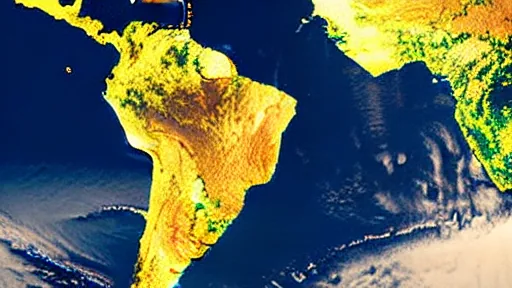
The AI revealed patterns that were previously hidden. The single largest migration event in the dataset happened in 1994. That year, nearly 950,000 people fled from Rwanda to the Democratic Republic of the Congo during the Rwandan civil war. It was a sudden, violent shift.
But the map also shows slower, steady trends. Economic change pushes people out of poor regions and pulls them into richer ones. Climate change is starting to create its own patterns, as droughts and floods make farming impossible. Policy reforms — like changing visa rules — can open or close doors overnight.
Wolfgang Lutz, a demographer in Vienna who was not involved in the study, called the new data “a much more complete picture of global migration streams than we had any time before.” He said it will be essential for planning schools, social benefits, and labor markets.
How the AI works
The old problem was a lack of data. Many countries simply do not track who leaves or arrives. The AI solves this by learning from the data that does exist and estimating the rest
Think of it like this: if you know the temperature in one city and the temperature in another, you can guess the wind between them. The AI does the same with migration. It looks at economic conditions, conflict reports, and historical trends. Then it estimates the flow of people.
This is not magic. It is a statistical model trained on real numbers. The researchers tested it against known events to make sure it was accurate. The result is a dataset that is both broad and detailed.
What this means for the future
This is not just an academic exercise. It is a tool for planning
Governments can use this data to predict where people will go next. They can build schools before the children arrive. They can prepare hospitals for new diseases. They can adjust labor laws to absorb workers.
Other researchers are working on similar problems. Some are using AI to model the spread of diseases. Others are using it to predict economic growth. The same technology that maps migration can map almost any human system.

The simple version
The data is available on the researchers’ website. It is a map of the world, colored by movement. You can zoom in on any country and see who is leaving and who is arriving.
It is not a prediction. It is a record. But it is the most complete record we have ever had. And it tells us one thing clearly: the world is on the move, and it is moving faster than ever before.
Sources
1. DOI: 10.1038/d41586-026-01796-y
2. DOI: 10.1038/s41586-026-10611-7
3. Nature
5. World Bank
6. Facebook