AI Finds 73000-Year Path to Alpha Centauri
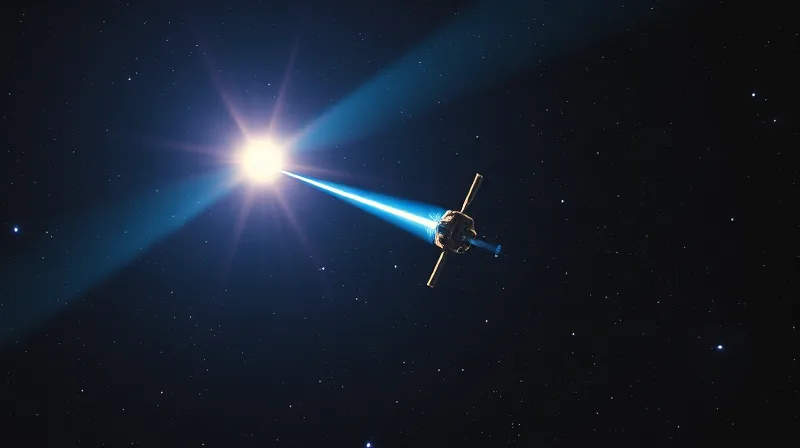
The greatest barrier between humanity and another star has never been distance. It has been the assumption that crossing 4.365 light-years demands velocities approaching the speed of light, exotic propulsion systems, or physics that does not yet exist. Fermi Explorer Mission proposes the opposite: a small spacecraft, using technology available since the early space age, that simply accepts an extraordinarily long journey. The mission’s premise is that reaching another star does not require speed — it requires patience measured in tens of thousands of years. The paradox dissolves when the scale of time, not distance, becomes the primary design constraint. Once the journey is measured in millennia rather than years, propulsion systems that seem impossibly slow become entirely adequate.
Alpha Centauri, the nearest stellar system to our Sun, is not a stationary target. The system moves through space, which means any spacecraft launched today must aim not at where Alpha Centauri is now, but at where it will be tens of thousands of years from now. Physical Superintelligence, or PSI, a newly launched AI physics laboratory backed by $58 million in seed funding led by Breakthrough Energy Ventures, calculated the optimal intercept point. [2] Their July technical report identifies a trajectory requiring roughly 73,012 years of flight time, with an acceptable range extending between 67,000 and 80,000 years at nearly identical energy costs. [2]
The spacecraft would need a heliocentric cruise speed of approximately 23.64 kilometers per second after escaping the Sun’s gravitational pull. That figure sounds modest when compared to the 20 percent of light speed proposed by other interstellar concepts. Yet it exceeds the velocity of Voyager 1, NASA’s most distant human-made object, which travels roughly 17 kilometers per second relative to the Sun. After nearly five decades of flight, Voyager 1 has covered only a tiny fraction of one light-year, illustrating just how vast interstellar space truly is. [3]
Fermi Explorer publicly describes its mission as an approximately 80,000-year journey that would pass within 2,600 astronomical units of the Alpha Centauri AB barycenter. That distance is not a close planetary encounter. It represents reaching the system’s distant cometary neighborhood, similar to how objects in our own Oort Cloud orbit far beyond the visible planets. The spacecraft would be the first human technology deliberately placed on an interstellar trajectory, even if it never performs a close flyby of any planet in the Alpha Centauri system. Reaching the system’s outer cometary shell would still represent an intentional human presence beyond our solar system.
The AI Unlocked a Path Using Repeated Solar Dives
Electric propulsion offers exceptional fuel efficiency but generates weak thrust. Solar panels present a second problem: sunlight diminishes rapidly as a spacecraft moves away from the Sun, following the inverse square law. A conventional outward spiral would exhaust its useful power supply before reaching the velocity required for an interstellar trajectory. This dual constraint has historically made solar-electric interstellar missions seem impractical.
PSI’s solution, termed multi-revolution perihelion pumping, inverts the problem. Instead of spiraling outward, the spacecraft would first use thrust to lower its orbit toward the Sun, gradually bringing its perihelion to about 0.42 astronomical units. At that close approach, solar panels receive several times the sunlight available at Earth’s distance of one astronomical unit. The craft would then fire its electric thruster strategically around each perihelion passage, taking advantage of its already high orbital velocity to maximize the energy gain from each thrust maneuver.
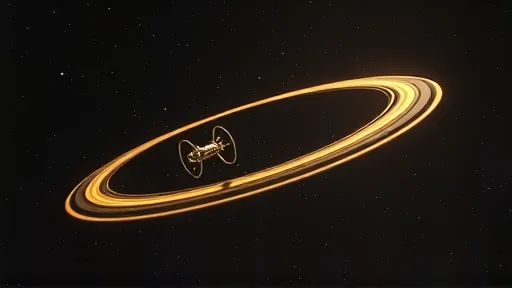
The physics underlying this approach is not new. Orbital mechanics, solar-electric propulsion, and gravity-assist concepts have existed for decades. The novelty lies in combining these established elements into a mission architecture that the Fermi team had not previously considered. PSI’s artificial intelligence system explored the vast solution space of possible trajectories and identified this repeated close-Sun pumping method as the most efficient path to interstellar cruise velocity.
The report’s best 12-year trajectory at its design thrust level required approximately 23.98 kilometers per second of heliocentric electric-propulsion delta-v — the total change in velocity the spacecraft’s engines must produce to reach its cruising speed. More than 98 percent of the overall interstellar journey would then consist of passive coasting, with the spacecraft traveling unpowered through the darkness of interstellar space. The propulsion phase occupies only a tiny fraction of the total mission duration, making the engineering challenge one of patience rather than sustained power generation.
Fermi Explorer announced its plans on September 1, aiming to launch before the end of 2029. The organization expects the vehicle to pass through Alpha Centauri’s outer reaches tens of thousands of years after everyone involved in its construction has died. This timeline fundamentally reframes what mission success means, shifting from immediate scientific return to a legacy that spans geological epochs. The mission’s value lies in what it starts, not in what its builders will live to see.
Getting Off Earth Remains the Hardest Engineering Problem
PSI’s technical analysis exposed how narrow the engineering margins truly are. The original mission requirement envisioned a roughly 100-kilogram spacecraft launched as a rideshare into low Earth orbit. Under every trajectory PSI calculated, that configuration failed to close its mass budget. The spacecraft simply could not carry enough propellant and equipment to achieve the required escape velocity from low Earth orbit while remaining within the mass constraint.
Starting from a geostationary transfer orbit changes the calculation considerably. The required Earth-escape delta-v falls from about 7.6 to 4.24 kilometers per second, a significant reduction that allows a 100-kilogram spacecraft to close with the modeled margins. PSI recommends a roughly 100- to 110-kilogram vehicle launched as a rideshare into geostationary transfer orbit, a common commercial launch destination that offers more favorable energy conditions for deep space missions.
The spacecraft would carry at least one kilogram of payload. Fermi Explorer says it plans to include scientific and artistic material, messages from Earth, and a copy inspired by the Golden Record carried aboard Voyager 1 and Voyager 2. This payload represents the entirety of humanity’s intentional message to another star system, a tiny artifact carrying the sum of human culture across tens of thousands of years.
This strategy contrasts sharply with Breakthrough Starshot, announced in 2016, which proposes using enormous Earth-based laser arrays to accelerate gram-scale lightsails to about 20 percent of light speed. [4] Such probes could potentially reach Alpha Centauri in just over 20 years, a timescale compatible with human lifespans. The $100 million initiative remains a research and engineering program aimed at demonstrating underlying technologies rather than launching a mission. Fermi Explorer accepts an almost unimaginable travel time in exchange for avoiding that technological leap. The two approaches represent opposite ends of the interstellar spectrum: one bets on future breakthroughs, the other on present capability.
Even PSI’s own assessment does not present the mission as ready to fly. The technical report states that its results underwent staged internal and independent computational checks but did not receive comprehensive human peer review. The report also labels a 2029 launch schedule as conditional on propulsion and thermal qualification work that has not yet been completed. These caveats acknowledge the gap between theoretical trajectory analysis and flight-ready hardware. The mission remains a concept study, not a committed flight program.
Cost remains another significant uncertainty. Fermi Explorer now publicly targets less than $15 million for the mission. PSI’s earlier assessment tested a $10 million requirement and estimated conventional program costs at roughly $15.7 million to $16.6 million. This budget range is remarkably modest for an interstellar mission, comparable to the cost of a single scientific satellite rather than the billions typically associated with deep space exploration.
The question of whether Fermi Explorer will be the first human technology to arrive at Alpha Centauri remains open. Faster spacecraft developed centuries or millennia from now could easily overtake it, just as a modern jet aircraft would pass a balloon launched decades earlier. The significance of Fermi Explorer lies not in being first to arrive, but in being first to depart, placing something on a deliberate trajectory toward another star using technology available near the beginning of the space age. No later mission can claim that distinction.
The spacecraft might spend almost its entire existence alone in interstellar darkness, its systems long since silent, its radio transmitters dead, its scientific instruments frozen. Yet its launch would mark the moment humanity stopped merely calculating routes to other stars and actually started down one. Whether future generations build faster ships that pass this slow pioneer, or look back at this modest beginning as the moment interstellar travel became real, Fermi Explorer will have changed the terms of the question.
Sources
3. NASA