
AI Agents Race Ahead of Human Researchers
The Race That No Longer Has a Finish Line
A single parameter has changed everything in science: whether the entity working on your problem is a person or a program. Until now, the race to a discovery was run between humans. Two labs, one question, whoever publishes first takes the credit. That model assumed a shared constraint — the speed of human thought, the length of a career, the hours in a day.
That assumption is now gone. According to reporting published by Nature on 8 October 2026, at least twice in the space of five weeks, researchers who had spent long stretches on a single research question learned that artificial-intelligence companies had either answered the question first or announced results before the researchers were ready to do the same. [1] The response has been defensive and immediate. Researchers worried that AI tools might scrape their unpublished work and scoop them are now limiting their use of those tools. This is not a philosophical objection to automation.
Geoffrey Irving, chief scientist at Resolution, an AI-safety research organization in Berkeley, California, put the shift plainly. [1] Researchers are “going to be scooped, but not because they’ve uploaded a manuscript,” he said. [2] “They’re going to get scooped because the AIs are very good at solving problems, and they’re going to get better and better.” [2] The threat is not only theft. It is superior speed.
Collisions in Mathematics and Biology
The first collision came in mathematics. On 7 September 2026, Tristan Buckmaster, a mathematician at New York University in New York City, posted online that he and a collaborator had made progress on the Navier-Stokes problem — a long-standing open question in fluid dynamics. [1] According to Buckmaster’s own account, he and Levent Alpöge, a mathematician at the AI company Anthropic in San Francisco, California, had been pursuing the problem for a year. Their collaboration was a personal project, not an institutional one. Buckmaster’s 7 September post also included a paper with the solution to a simpler version of the problem.
The next day, 8 September, OpenAI, also based in San Francisco, announced that its agents had solved the puzzle. Buckmaster publicly questioned the timing. He raised the possibility that information he and Alpöge had uploaded to an OpenAI tool could have been used to train the company’s models. OpenAI disputed this scenario. In a statement, the company said an investigation had confirmed that Buckmaster’s “prompts” in the two months before the 8 September announcement “could not have influenced the system in any way, including through training.” [2] The statement added that OpenAI’s researchers and agents “did not see any of their work through any means until they released it publicly.”
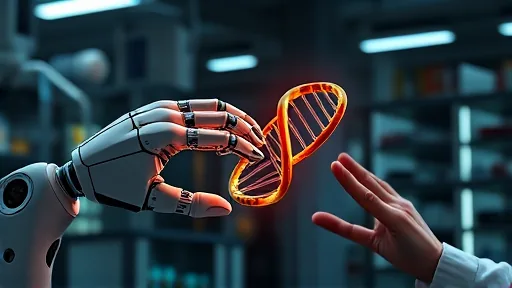
Two weeks later, a second case landed in biology. Anthropic announced that agents running on its Claude large language model had discovered that certain viruses carry a pattern of repeated DNA segments similar to the pattern seen in CRISPR gene-editing systems. After that announcement, Mario Rodríguez Mestre, a PhD student in computational biology at the University of Copenhagen, told The New York Times that he had been studying the same DNA patterns for several years, often using Claude, but had not published the work. Mestre also raised the possibility that information his team had uploaded to Anthropic’s tools could have been incorporated into Claude’s training data. Anthropic told the Times that its model was “not trained on any user transcripts.” Two companies, two denials, and two researchers left wondering whether the machine read their notes or simply outran them.
The Agent as Instrument
What made this moment possible is not a new sensor or a sharper microscope. It is the AI agent itself — a system that, as Nature reports, is improving at doing science autonomously. That capability is the instrument, and it is what turned a theoretical worry into a dated, documented event.
The practical fallout is already visible in how individual scientists work. Sandra Laurentino, a reproductive epigeneticist at the University of Münster in Germany, says she no longer trusts AI systems. She now uses AI only to check why her code fails. Before doing so, she changes all parameter and variable names to generic labels such as “group A has feature X” — a small act of camouflage designed to keep the system from learning what her experiments are about. “I am quite careful when it comes to AI,” she says, but the recent controversy has “made me even more paranoid.” Samuel Mehr, an auditory cognitive scientist at the University of Auckland in New Zealand, has gone further. The discoveries made him even more hesitant to use commercial AI models than he already was. He has created an AI-use policy for his laboratory that forbids students from uploading protected information to commercial large language models and warns against using the models for any part of the research process. “I think it’s incredibly risky to hand out your intellectual property to third parties when you don’t know what they’re going to do with it,” he says.
Not every AI researcher shares the alarm. Irving’s view is that the scooping will happen regardless, and not because of leaked manuscripts: the models will win on merit, and they will keep getting better at it.
Sources
Mentioned organisations (context, not sources)
- Nature — Organisation (homepage)
- Resolution — Organisation (homepage)
- New York University — Organisation (homepage)
- Anthropic — Organisation (homepage)
- OpenAI — Organisation (homepage)
- University of Copenhagen — Organisation (homepage)
- The New York Times — Organisation (homepage)
- University of Münster — Organisation (homepage)