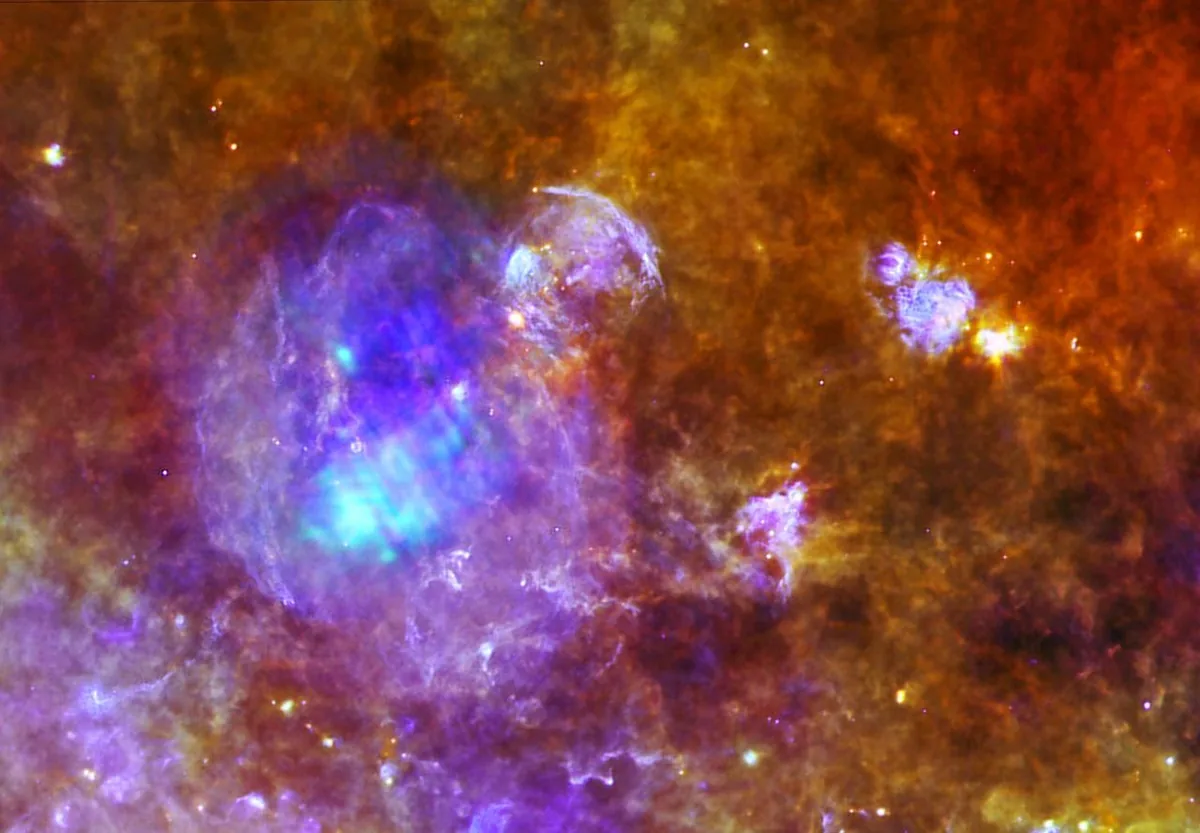
When a Nursery Grows Like a City
A single candle flame and a forest fire both burn, yet only one can be seen from orbit. Scale does not change the rules — it changes what the rules can build. Star clusters follow a similar rule: the gravity and gas that bind a modest open cluster in our own galaxy can, under different conditions, gather into a stellar association thousands of light-years wide.
The object cataloged as NGC 206 sits inside the dusty spiral arms of the Andromeda galaxy, the neighboring spiral also known as M31. It is not a single cluster in the ordinary sense. It is a stellar association — a loose, sprawling gathering of young stars — and it occupies the center of a sharp close-up view of the southwestern portion of Andromeda’s disk.
What makes NGC 206 striking is its youth, read directly from its color. Its bright blue stars signal that the association is young, and its youngest massive stars are less than 10 million years old. [1] For comparison, the Sun has been burning for roughly 4.6 billion years — so these stars are infants on a cosmic clock.
The size is where the comparison to our own galaxy turns lopsided. NGC 206 spans about 4,000 light-years. [1] The open clusters and galactic clusters of young stars scattered through the disk of our Milky Way are far smaller. One association in Andromeda thus spans ground that no single Milky Way cluster covers.
The Yardstick of Giant Nurseries
A cartographer drawing both a village and a metropolis uses the same pen. The pen does not change; the scale of what it traces does. Astronomers face the same problem when they compare star-forming regions across galaxies, and the yardstick they reach for is the giant stellar nursery.
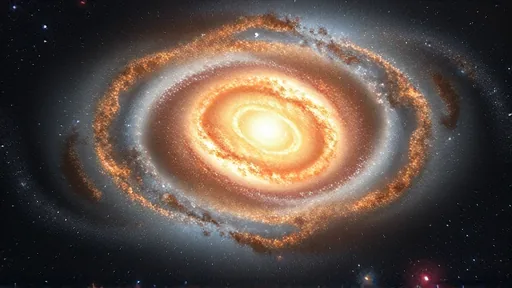
By that yardstick, NGC 206 belongs to an exclusive class. Its 4,000-light-year span is comparable in size to the giant stellar nursery NGC 604 in the nearby spiral galaxy M33, and to the Tarantula Nebula in the Large Magellanic Cloud. [1] Three objects, three different host galaxies, one shared scale.
Distance sharpens the picture. Andromeda lies a mere 2.5 million light-years away, close enough that a detailed close-up can resolve the structure of NGC 206 rather than smearing it into a blur. That proximity is why this association functions as a reference point: it belongs to a foreign galaxy, yet sits near enough to be studied in detail.
The comparison carries a lesson. A nursery the size of NGC 206 can arise in Andromeda’s dusty arms, so the modest clusters of the Milky Way’s disk are not the universal template — they are one local variant. The same gravity that builds a small cluster at home builds a sprawling association next door.
The Record Behind the Image
The record behind objects like NGC 206 is assembled from several sources. The Hubble Space Telescope, operated under NASA’s science program, has documented the gravitational relationship between the Milky Way and Andromeda — the two spirals are destined for a head-on collision, a finding that reframes every study of Andromeda’s disk as a study of a future neighbor.
Ground-based archives carry the record forward as well. The detailed close-up of Andromeda’s southwestern disk that frames NGC 206 comes from astrophotography shared publicly, while the scientific characterization of the association’s young blue stars is preserved in the peer-reviewed literature indexed through the Harvard astronomy data system.
The catalog itself is a quiet archive. Its entry is maintained through the SEDS database, a long-running student-run archive that keeps the object’s coordinates and history accessible. Tomorrow’s frame, as the daily astronomy picture series puts it, is simply pixels in space — and the machinery that turns those pixels into measured light is already in place.