The Meal That Reshapes an Organ
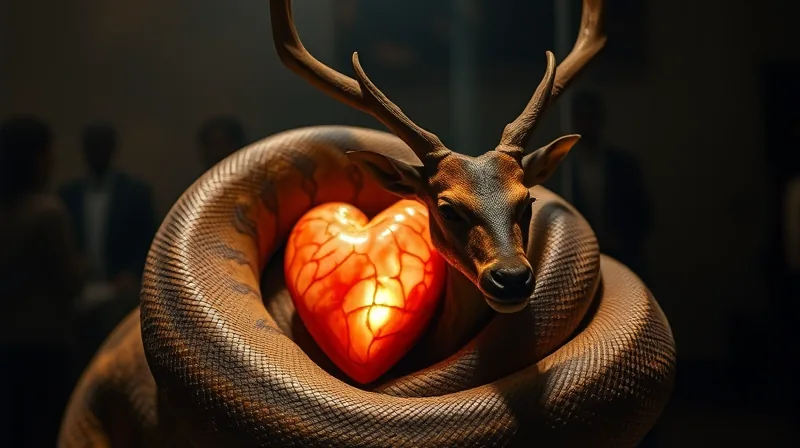
A python that swallows a meal as large as an adult deer does something no mammal can match. Within a single day, its heart balloons by up to 25 percent. [1] Researchers have tracked what happens inside that muscle, and the results read like a repair manual written by evolution. The heart does not simply stretch. It rebuilds.
Larger hearts pump blood with more force, Leinwand and her colleagues reported in 2024 in the Proceedings of the National Academy of Sciences. The researchers do not know whether that makes the snakes stronger overall.
The bigger the python’s meal, the more its heart grows. Once the meal is digested, the heart shrinks again, and snakes can go through many shrink-and-grow cycles with no ill effect.
The deeper layer is where the snake departs most sharply from us. The remodeling is not a passive stretch under the weight of a meal; the muscle actively reprograms itself, switching on the machinery of growth and metabolism while keeping energy supply in step with demand.
The Difference Between a Strong
Heart and a Sick One
A human heart can also grow, and the outcome hinges entirely on the cause. Leslie Leinwand, a molecular biologist and geneticist at the University of Colorado Boulder, says vigorous exercise makes the heart bigger in good ways. Kittleson adds that swimmers and marathon runners develop thicker, larger hearts, and that this helps them pump more blood per minute than someone with a normal-size heart. Pregnancy expands the whole organ to supply a developing fetus. Stop training, or give birth, and the heart returns to its usual size within months. Growth, in these cases, is reversible and earned.
Disease writes a different story. Untreated high blood pressure, faulty valves and some genetic conditions enlarge the heart too — but the muscle thickens while the left ventricle’s inner chamber, the room that pumps oxygenated blood to the body, narrows. More muscle, less space, weaker output. This kind of enlargement unfolds slowly, over time. It is a wall built in the wrong direction.
And then there is the sudden version. Takotsubo cardiomyopathy, also called stress cardiomyopathy or broken-heart syndrome, strikes after extreme emotion — a surprise party, a lottery win, a breakup, a lost job. A surge of epinephrine, or adrenaline, makes the left ventricle bulge into the shape of the pot Japanese fishers use to trap octopuses. Takotsubo means “octopus pot.” The chamber becomes too large to pump, and heart failure follows immediately. Michelle Kittleson, a cardiologist at Cedars Sinai Smidt Heart Institute in Los Angeles, is blunt about what rapid growth would do to a person: collapse, not superhuman strength. [1] Prompt medical care can save the patient, and the heart can return to normal size over a few months.
Size matters at the other end of the scale as well. A 2025 study led by S.J. Rowe and colleagues, published in JACC: Advances, examined medical records from more than 360,000 people in Australia and found that those with smaller-than-average hearts faced a higher risk of dying within five years than people with average or larger hearts. Kittleson offers the Grinch a diagnosis wrapped in a joke: a small heart may pump poorly, exercise becomes hard, fatigue sets in, and grumpiness follows. Or, she adds, maybe he read the study and the shortened life expectancy made him grumpier still.
What the Snake Offers the Clinic
The python’s trick is not size alone. It is the round trip. Snakes cycle through many shrink-and-grow episodes with no apparent harm, a feat no human heart manages — ours either remodels badly or, in the takotsubo case, fails outright. Leinwand hopes that studying these snakes will lead to treatments that make human hearts healthier. That is the next step the work itself points toward: not a bigger human heart, but a human heart that can enlarge on demand and shrink back without damage.
The comparison to the Grinch is where the fairy tale and the physiology part company. Dr. Seuss gave his character a heart that grew three sizes in a moment of joy and granted him the strength of ten Grinches plus two. A real heart that inflates that fast is a medical emergency, and a real heart that stays small carries a measurable mortality penalty. The python sits between the two extremes: fast, reversible, and, for now, not fully explained. Leinwand notes one behavioral side effect: her snakes, when they eat a lot, get rather aggressive. A large heart, it seems, is no guarantee of a pleasant disposition.