Syria Fuel Price Hike Exposes Broken Social Contract
A Bond Breaks, A Price Rises
In mid-September 2025, the Syrian government raised the price of all kinds of fuel, petrol and diesel alike. Diesel saw the biggest hike, rising 40 %. The energy ministry said the increase was necessary because of higher global fuel costs — Syria remains dependent on energy imports — as well as local shortages.
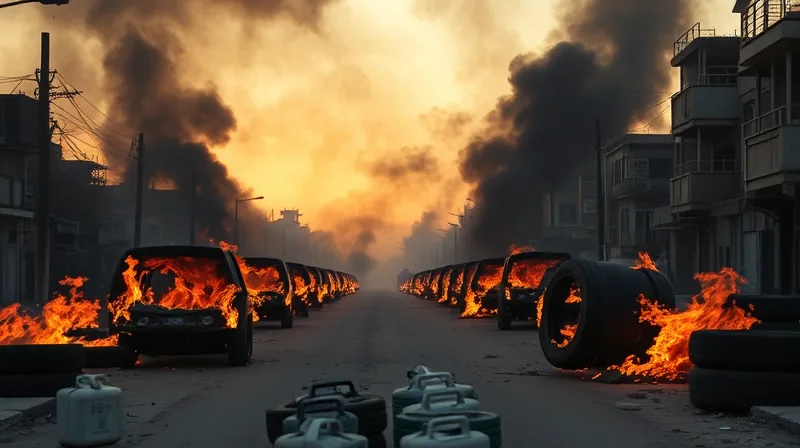
The decision produced some of the most widespread protests Syria has seen since the Assad regime was toppled in late 2024. Demonstrators burned tires, blocked roads and called for the dismissal of the politicians they held responsible. The protests then subsided after the government walked back some of the changes. It also announced plans to subsidize diesel for heating, agriculture and industry. That sequence — a price decree, a street response, a partial retreat — shows how quickly a government learns the limit of what its citizens can absorb.
This is the difference between a price and a burden. The first is printed on a sign at a filling station; the second is calculated at a table where the monthly money is divided up. The same figure can look unremarkable in one capital and unbearable in another.
The Gap Between Price and Burden
Kanan Abdullah, a driver in Damascus, said the fuel increases have made it difficult to make ends meet. “You’re left with almost nothing at the end of the day,” he said. [1] He described the trap precisely: enough to buy another tank of gas, but nothing left for food, and nothing for the repair when the car breaks? His passengers face the mirror image of his problem. Kamar Kasoum, a mother of three in Damascus, said people are starting to worry about how they will get to work and get home, because transport alone is costing them half their pay.

Alaa Sndyan, an architect in Damascus, put the structural point plainly. “There is no sensible correlation between the income an individual earns in Syria and the prices they’re paying,” she said. [1] Kasoum added that the household budget has already been cut to the bone, and that people can no longer describe their cuts as trimming non-priorities. “It’s like, let’s just stick to eating and drinking,” she said. “Nothing else.”
Against this, the aggregate numbers look like a different country. Speaking at the Arab Media Summit in Dubai, Syrian President Ahmad al-Sharaa predicted that Syria’s economy would be worth around $50 billion this year, up from around $20 billion in 2024. [1] That is a claim of more than doubled output in two years. Both statements can be accurate at the same time, and that is the whole problem.
Who Gets the New Skyline
Sndyan said it is hard to tell who benefits from the development now being announced. “With a lot of the projects being announced now, we don’t see anything happening on the ground, there’s no impact on the real world,” she argued, adding that the projects appear aimed at a specific demographic: the affluent class. She said she is not sure these projects are actually for the people, and that those who lost everything during Syria’s civil war risk being forgotten amid the grand plans. She also called for more transparency and better communication from the government about what it intends to build, and for whom.
The Syrian think tank Etana argued in an analysis this week that as certain pre-existing forms of corruption and extraction change, new channels of privilege are emerging — “albeit with new winners and losers.” More extreme anti-government activists have pointed to the luxury watches some Syrian politicians appear to be wearing. They accuse the government of “crony capitalism” and suggest that funds are being diverted into the military to secure its own power. None of those accusations are verified. There is, however, criticism from more moderate quarters as well. Critics say the neo-liberal style reforms the government is currently committed to will only worsen this problem and, in the longer run, cause the same kinds of social problems that sparked Syria’s revolution in 2011.
Patience is measurable, and it has been measured. Monthly polling by the magazine Syria in Transition found that by April this year the most serious deterioration was in attitudes toward the economy. Only 13 % of respondents believed the government was doing enough to tackle soaring energy and food prices. 66 % said its efforts were insufficient. Sam Heller, an analyst with the New York-based think tank Century International, wrote in Foreign Affairs that the country’s new leaders have undertaken a shock therapy program of economic liberalization without, it seems, fully accounting for the acute vulnerability and poverty of most Syrians. Shock therapy is a term borrowed from medicine, and it implies a patient who is expected to survive the dose.
Joseph Daher, a researcher and expert on Syria’s political economy, argued in an analysis for the online bilingual outlet Syria Untold that in countries emerging from conflict, “success” cannot be measured solely by fiscal surpluses — governments taking in more than they spend — or by price stability. True success, he wrote, is measured by the ability of fiscal policy to rebuild citizenship, justice, institutional capacity and public trust. Karam Shaar, director of Karam Shaar Advisory, a New Zealand-based consultancy for Syrian economic affairs, said in an online interview last week that some of what the new authorities have done was necessary given the post-war situation. He conceded that necessity while adding that more transparency, expertise and better governance are now required. “I think they are starting to realize that and I continue to have a bit of hope that this will indeed happen,” Shaar concluded. Set beside a $50 billion projection, a diesel price and a fare to work shrink to rounding errors in a national accounts table. Then the vantage tilts back to the household, where those same small numbers are the entire economy — and where the distance between a ministry circular and one family’s evening is all that “success” has yet to cross.
Sources
1. Usnews — Quote source (original article)
Mentioned organisations (context, not sources)
- Syria in Transition — Organisation (homepage)
- Foreign Affairs — Organisation (homepage)