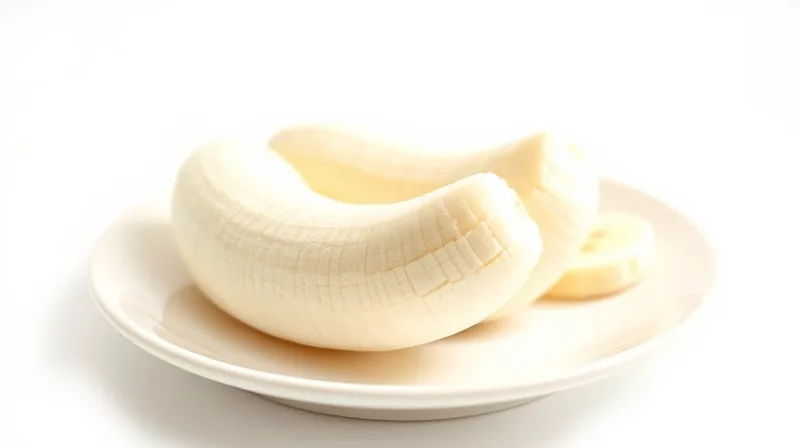
Gene-edited non-browning banana awaits UK approval
Meta commentary - no external expert source; basis: Theguardian (2026-09-28). #MetaEconPol
If Every Peeled Banana Stayed Yellow
Tropic, an agricultural-biotechnology firm based in Norwich, has developed bananas it says keep their freshly peeled colour long after they are cut.
Tropic says the fruit could cut food waste: a banana discarded for a minor bruise or a black mark was never inedible, only unappealing.
Tropic claims its bananas have the same taste and texture as the ordinary kind, but stay “fresh, yellow and appetising” long after peeling and slicing. [1] Gilad Gershon, the chief executive of Tropic, said the flesh resisted browning for an extra day or two — and longer if chilled. He added that the innovation could make it easier to add bananas to prepackaged products such as fruit salads and breakfast pots, as well as reducing waste.
Tropic puts figures on the prize: it says the non-browning bananas could cut food waste and CO2-equivalent emissions — a way of adding different greenhouse gases into one number using their warming strength — along the supply chain, the sequence of firms handling a product from farm to shop, by more than 25 %, and by over 9m tonnes a year in the banana export market alone.
Three Copies of One Browning Gene
The mechanism is narrow, and the narrowness is the point. Tropic used a gene-editing technology called Crispr-Cas9 — a molecular tool that cuts DNA at a chosen spot so a single gene can be switched off or altered; gene editing changes an organism’s own DNA without adding genes from another species — to alter all three copies of a single gene inside the fruit. That change reduces the banana’s production of polyphenol oxidase, the enzyme in the fruit that turns it brown when cut. Fewer working copies of the gene means less enzyme, and less enzyme means less brown. That is the entire intervention.
The same lever has been pulled elsewhere in the produce aisle. A similar approach has proved effective in reducing browning in other produce, including mushrooms, and researchers have used gene editing to develop sweeter-tasting strawberries, disease-resistant crops, and tomatoes that are more compact or high in vitamin D.
Tropic is not waiting for Britain to make up its mind. Gershon said the company had gained regulatory approval for the non-browning bananas in 10 other countries, including Japan, Brazil and the Philippines, and that the fruit is already being grown in Latin America. [1].
The Two Doors Before the Shelf
In Britain in 2026, the fruit is one step closer but not through the door. The Department for Environment, Food and Rural Affairs (Defra) has approved a marketing notice for the bananas — Defra’s formal confirmation of a product’s precision-bred status, the regulatory label for an organism whose genetic changes could have been produced by conventional breeding, and one of two steps needed before sale. That status is one of two important requirements for them to be placed on the market. The second is a market authorisation — the Food Standards Agency’s approval to place a food on the market in England — and so far no precision-bred organism has been granted one for sale in England.
The definition behind that status is set by the Food Standards Agency, which grants precision-bred status only if the genetic changes made could have been achieved through traditional breeding methods. This is different from genetic modification, because precision-bred organisms do not contain DNA from unrelated species. A single sentence of definition, in other words, sets the height of the hurdle.
The rules also stop at a border. Regulations for precision-bred plants came into effect in November 2025 and apply only to England. The FSA notes that precision-bred foods authorised and placed on the market in England can be sold in Wales and Scotland, provided they are not processed further, with similar rules for Northern Ireland.
Then comes the queue. Prof Cathie Martin, a project leader at the John Innes Centre in Norwich, who has worked on gene-edited tomatoes, said the next stage for all crops that had received marketing approval — including the new bananas — was a review by the FSA to ensure the safety of the products. [1].
The government’s own case for the technology is broad. A Defra spokesperson said precision breeding offers huge potential to boost food security — reliable access to enough affordable food — cut pesticide use, increase crop yields and enhance disease resistance, and called the non-browning banana a great example of how innovation could help to reduce food waste and improve the sustainability of the food system while keeping world-leading standards in place.
Sources
Mentioned organisations (context, not sources)
- Tropic — Organisation (homepage)
- Department for Environment, Food and Rural Affairs — Organisation