
Attribution usually arrives quickly. When word reaches a desk that something has exploded near the Strait of Hormuz, the reflex is to wait a few hours for a name — a navy, a state, a militia — because a name is what turns an incident into a price. That reflex has failed repeatedly this autumn. The strikes keep multiplying; the authorship does not. Two things hold at once: the physical facts of these attacks are documented to the minute, and the question of who is responsible remains open. UKMTO has not attributed the attacks to Iran, the United States or any other party, so the commercial damage has to be read from behaviour rather than from accusation. The pattern is a run of attacks on commercial vessels in and around the Strait of Hormuz, and its defining feature is not the weapon but the silence that follows each one.
The Coordinates Are Clear, the Shooter Is Not
Late on Thursday, Sept. 10, 2026, four unidentified projectiles struck two vessels about four nautical miles (roughly 7.4 kilometres) west of Khasab, on Oman’s Musandam Peninsula. [1] One of the ships caught fire. The condition of the second was not immediately known. The incident was logged as Warning 133-26, issued at 1910 UTC — 11:10 PM Gulf Standard Time (UTC+4) that evening. [1] The master of another vessel, standing roughly six nautical miles away, reported seeing the projectiles reach and hit both ships. [1] A master at that range can confirm that something arrived and struck; he cannot confirm what it was or where it was launched. No attribution followed. UKMTO has not attributed the incident to Iran, the United States or any other party. Commercial vessels are being urged to exercise extreme caution. The warning carries a number and a timestamp, not a conclusion. What is missing is the single line that would end the guessing: a named author.
Khasab is not the strait itself. It sits on Oman’s Musandam Peninsula, immediately south of the waterway through which one of the world’s most important energy corridors runs, and it is close enough that an attack four nautical miles off its coast belongs on the same risk map. Shipping there has already been disrupted by the escalating conflict between Iran and the United States. Around Khasab itself, the UK Maritime Trade Operations (UKMTO), which circulates numbered warnings to merchant shipping, has logged a string of recent incidents. Some involved vessels struck by unknown projectiles. Others involved explosions near ships. On Sept. 9, the day before the Khasab strike, several merchant vessels were subjected to disabling fire in the northern Arabian Gulf and in the Gulf of Oman. The events spread across the northern Arabian Gulf, the Gulf of Oman and the Khasab approaches — the geography of a widening problem. Several vessels disabled in a single night is a different order of event from one hull on fire. Fire that disables and fire that sets a hull ablaze are different entries in a log, and the difference matters when a campaign is reconstructed from warnings. Nothing in the public record yet assigns those events to a single hand.
The advice attached to the warning is the thinnest protection available at sea: extreme caution. It is what a warning system says when it cannot say who is firing. Incidents can be checked against coordinates and timestamps; intentions require a named author. Verification in a case like this runs through what is fixed — where, when, how many — while the missing variable is the one that would make the rest meaningful.
The Danger Zone
Begins at the Doorway
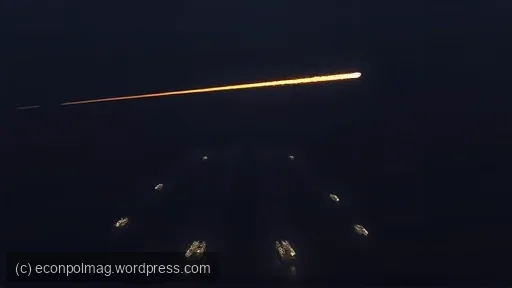
The pattern continued into the autumn with the same signature, and the incidents multiplied. On Oct. 21, 2026, an oil product tanker named AL Dasma was struck by an unknown projectile eleven nautical miles west of Bukha in Oman, near the southern side of the strait. The vessel is Kuwait-flagged. It caught fire immediately. Specialised teams later brought the blaze under control, though the extent of the damage has not been established. The ship was carrying 21 Indian seafarers, all of whom were safely evacuated. India’s Minister of Ports, Shipping and Waterways, Sarbananda Sonowal, announced the evacuation in a post on X; in that post, the government and relevant authorities are described as monitoring the situation and as being in contact with the ship management company to ensure the seafarers’ well-being. In the beginning of October, three more vessels were targeted with drones or projectiles in the same area: the Panama-flagged motor tanker On Peace, the motor tanker Petro Dolphin, and the Marshall Islands-flagged motor tanker Valthera. Those attacks also put Indian seafarers at risk. On Oct. 16, 2026, the crude oil tanker ST3, with 15 Indian crew members aboard, was hit by a projectile in Hormuz. Across the incidents the weapons vary — drones or projectiles — while the crews are counted precisely. The spread of flags — Kuwait, Panama, the Marshall Islands — is the ordinary condition of merchant shipping, and it is why a single attack becomes several governments’ problem. On Oct. 30, an outbound vessel transiting the strait was on fire after an incident 25 nautical miles north east of Khasab. The cause of that fire was unknown, and so were the status of the crew, the extent of the damage and the environmental impact.
Twice in recent weeks the damage has gone beyond fire. The container ship GFS Pride sank after catching fire, and all 21 of its crew members were rescued. The cargo ship Cape Dao, previously struck by a projectile, also sank, and one crew member was killed in the initial attack. Two wrecks now sit in or near the approaches, and the cause of the first is already contested: the IRGC said the GFS Pride struck a sea mine, while maritime sources cited an unidentified projectile. Video circulating on social media appeared to show cargo floating in the water near the strait, including mobile phones and luxury goods, with people in small boats collecting the items; multiple international media outlets published the footage, but it could not be independently verified. The same period produced a second kind of incident, defined by what a ship switches off. A tanker caught fire in the Gulf of Oman after entering what Iran’s navy described as a prohibited zone with its tracking systems disabled. Iran’s navy said monitoring teams patrolling the eastern sector of the Strait of Hormuz had detected the tanker ablaze in the restricted area. The name, flag and crew condition of that vessel were not immediately known, and neither was the cause of the fire. It was the second such case within 24 hours; the night before, another tanker had caught fire after it too switched off its tracking equipment.
The regulatory layer arrived in September, when the Islamic Revolutionary Guard Corps declared the waters leading to the strait a prohibited zone. The declaration followed remarks by Mohsen Rezaei, secretary of the Supreme National Security Council. The zone, as described by IRGC spokesman Hossein Mohbi, covers part of the Gulf of Oman and part of the Arabian Sea along the approach to the strait. Ali Azmayi, commander of the IRGC naval force, said Tehran exercises “smart control” over the strait and that all vessels seeking to transit the route must obtain permission, in response to US statements that the waterway remains open and under Washington’s control. A warning has gone out to shipping companies and operators that using unauthorised routes, or taking American assistance to cross, could result in the vessel being attacked by the Iranian navy. Tehran has said vessels violating the rules in the area face penalties. Iran declared the Strait of Hormuz closed in late February, at the start of the war with the United States, and Washington answered with its own naval blockade of the waterway. The zone was declared in September, the same month as the first of the Khasab strikes. That sequence is worth holding in view: a closure declared, a zone declared, a permission regime declared, and — out on the water — projectiles whose owners are never declared. A zone entered only with permission is a different legal object from a waterway that anyone may use, and for now both descriptions are in circulation.
Who Pays for a Passage Nobody Can Quote
The first measurable consequence is price. Brent crude, the benchmark against which much of the world’s oil is priced, has been pushed above $100 a barrel by the maritime confrontation. The second is volume: shipping through the chokepoint has been sharply reduced, and traffic through Hormuz stays 75 % lower. A chokepoint is a passage that a large volume of trade cannot avoid, and there is no alternative route that costs nothing. The third consequence sits between those two, and it decides individual voyages: the price of insurance. Volume and price are the numbers visible from outside the strait; insurance is the one that sits between them. Deterrence, understood this way, is not a decision taken once. It is a toll collected incident by incident.
Two governments describe the same water in incompatible terms. Washington has kept its blockade on Iranian ports and holds that Hormuz is an international waterway open to all countries — the opposite of the position taken in Tehran. Behind both positions sits an exchange of blows already under way, with Iran and the United States attacking oil tankers and Iran threatening further restrictions around Hormuz. For an owner, the practical choice is not between two legal theories. It is between being stopped for routing without permission and being attacked for taking American help. India, whose citizens crew many of the ships, has taken the narrower route. Its Ministry of External Affairs has raised concerns over the safety of Indian seafarers, condemned the continuing attacks, and called for immediate de-escalation to ensure freedom of navigation through international waterways and to uphold maritime law and security. That is a position on law rather than on blame. It is what a state says when it needs the route open more than it needs the argument settled. The ships keep moving in reduced numbers, which is the only vote counted daily.
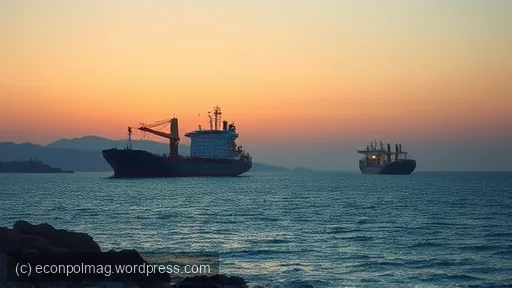
The identity of the attackers remains open; so does whether attribution still moves the price of passage. A market can carry unexplained violence as a cost of doing business for a while, and the weeks since September have tested where that limit sits. If insurers, owners and charterers are already pricing the risk without a named author, then naming one later will not restore the old cost of a transit. Whoever eventually claims the attack will have an interest in being believed, and that claim will be weighed against coordinates that have been public since the night of Sept. 10. Nothing in the record yet answers the narrower and harder question: what would have to be established, and by whom, before the reduced traffic begins to return.