Saudi Pipeline Strike Cuts Oil Flow and Raises Pump Prices
The Bypass That Was Supposed to Hold
For years the oil market’s working assumption was that Saudi Arabia’s East-West pipeline sat outside the reach of the Gulf’s wars.
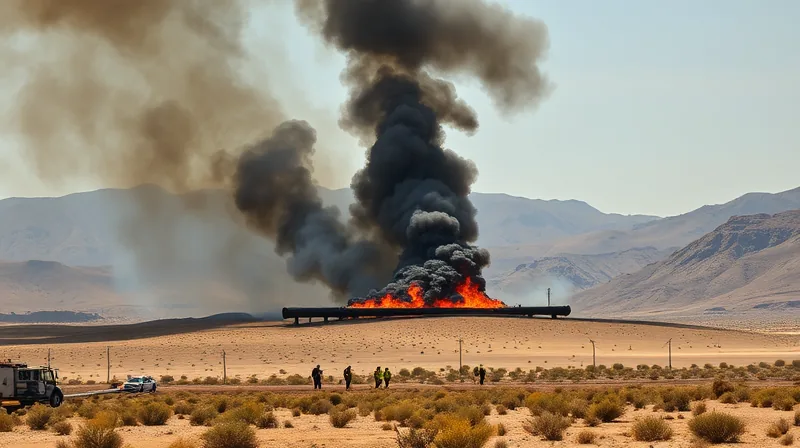
Last Friday, a suspected Iran-aligned Iraqi militia attacked it, and the assumption came down with the steel.
The pipeline is the one artery that carries Saudi crude overland to the Red Sea rather than through the Strait of Hormuz.
Its function is to serve as a bypass for disrupted Hormuz traffic, and until now it performed that job.
A chokepoint is a passage narrow enough that a small force can throttle a large share of world trade, and Hormuz is the most consequential one in oil.
Jim Krane, a fellow in Middle East Energy Studies and co-director of the Middle East Energy Roundtable at Rice University’s Baker Institute for Public Policy, called the line “a godsend for Saudi Arabia and a key piece of infrastructure that’s kept fuel prices much lower than they would be otherwise.” [1]
Krane attached a blunt condition to that assessment.
A closure of the East-West Pipeline is a serious problem for the world, American drivers included.
A simultaneous closure of the Strait of Hormuz would be worse.
That second condition is no longer hypothetical, and that is what turns a single strike on a single pipeline into a global pricing event rather than a local repair job.
The volume explains why.
Ed Hirs, a lecturer specializing in economics and energy at the University of Houston, calculates that the disruption is reducing the flow of Saudi oil to the market by roughly seven million barrels a day, measured against the pipeline’s maximum reported capacity.
Seven million barrels a day is not a rounding error.
It is a quantity large enough to move the price of a commodity traded everywhere on earth.
Saudi Arabia has put the repair timeline at roughly three to six weeks and has transferred some trade to Oman’s Sohar port.
The repair schedule, though, is the less troubling half of the news.
Strikes launched from the south by Ansar Allah, also known as the Houthis, against various Aramco sites, together with this attack, have demonstrated that energy facilities on land are no more immune to this war than the tankers Iran targets at sea.
The Kingdom now faces pressure on multiple fronts from Iran and the network of allied militias known as the Axis of Resistance.
American consumers are set to absorb the next round of that pressure at the pump.
The Arithmetic of a Couple Million Missing Barrels
In January, oil traded at around $56 per barrel.
After the United States and Israel launched their war against the Islamic Republic late the following month, Iran’s blockade of the Strait of Hormuz disrupted around 10 million barrels per day.
Iranian attacks that caused extensive damage to Qatar’s LNG facilities — the plants that liquefy natural gas for shipment — removed an additional 1.5 to 2 million barrels per day of liquid hydrocarbons.
Then came the buffers, which are finite by design.
U.S. releases from the Strategic Petroleum Reserve — the emergency crude stockpile the federal government holds — have amounted to around one million barrels per day.
The planned 172-million-barrel release announced in March is nearing completion, with no further commitments behind it.
Multinational releases coordinated by the International Energy Agency have totaled around 400 million barrels, and they are approaching their limit as well.
Relief has arrived from a different direction: reduced Chinese imports and increased oil flows from Venezuela, Guyana, Kazakhstan and the United Arab Emirates.
It has not been enough.
Hirs, doing the subtraction, finds the market “roughly a couple of million barrels a day short,” a gap he takes to around $100-plus a barrel. [1]
That conversion from barrels to dollars runs through one number, and the number is small.
Hirs puts the price elasticity of demand for oil at roughly -0.047, meaning demand barely contracts when supply tightens.
The implication, on his figure: a 1 % drop in the oil market leads to a price hike of around 25 %.
Refined products are where the shortage bites hardest.
Diesel has been trading between $175 and $190 per barrel and has spiked to $200 per barrel, or roughly $5 per gallon.
Part of that, Hirs says, traces to ExxonMobil chartering two tankers to export gasoline and diesel to Asian markets, buyers with which American consumers now compete directly.
“We’re seeing impact, that’s where it’s come,” he said.
When the Chokepoint Map Got Crowded
The next constraint is not a pipeline but a strait.
Ansar Allah now controls the Bab el-Mandeb, the waterway that links the Gulf of Aden to the Red Sea and so provides the gateway to the Suez Canal.
A blockade on that front could choke off an additional 8.1 million barrels per day.
Put differently, that is roughly 10 percent of the world’s seaborne oil trade.
With leverage over both maritime chokepoints, Iran may get to decide what comes next.
“The ball is in Iran’s court right now,” Krane said. [1]
Will Tehran keep Hormuz blocked to inflict maximum pain on oil markets?
Or will it stand down, even temporarily, while the pipeline is repaired?
Either way, the outage hands Iran a short burst of extra leverage.
Krane sets the episode inside a wider pattern that includes Russia’s war on Ukraine.
Both wars have been tough on energy, fossil fuels in particular, because power plants, tankers, pipelines and refineries are suddenly military targets.
The results show up at every corner gas station.
“Weaponizing energy has been a disaster for the global economy,” he said.
Damage of this kind does not unwind on a political timetable.
Even a war that ended tomorrow would leave its effects behind for some time — and there is little indication it will end tomorrow.
Qatar is already looking at four to five years to restore its damaged LNG facilities, Hirs notes.
Higher fuel prices in the United States could be felt for at least two to three years to come — which, as he points out, is barely enough time to build a new refinery.
Import-dependent countries have drawn their own conclusions from watching fuel prices feed inflation and transport costs.
They want more self-sufficiency in energy, Krane said, and that often means electrification, because power prices tend to be way more stable than fuel prices and power can usually be generated with less exposure to oil and gas markets.
The mix varies — renewables, nuclear and even coal — but the motive is the same: reduce the risk exposure.
For buyers who can afford one, an electric vehicle provides immediate insulation from geopolitical risk.
“If you want to drive to work without worrying about pipeline explosions in the Middle East, drive an EV,” Krane said. “They’re immune to these sorts of risks.”
That is the realization waiting at the end of this chain of barrels: seven million barrels of Saudi crude, a strait off Yemen and a diesel price near $5 a gallon are not three separate stories but one connected sentence, and the only exit from it that any driver controls is the one that stops buying the fuel.
Sources
1. Newsweek — Quote source (original article)
Mentioned organisations (context, not sources)
- Rice University — Organisation (homepage)
- Baker Institute for Public Policy — Organisation (homepage)
- University of Houston — Organisation (homepage)