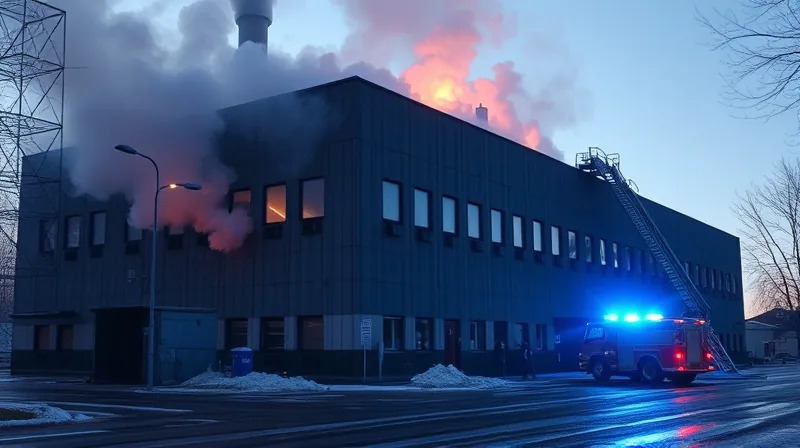
Estonia Accuses Moscow of Tallinn Arson Sabotage
From a Lasnamäe Blaze to a State Accusation
On 18 August 2026, police in Latvia detained a third person in connection with a fire in Tallinn. Two other Latvian citizens had been taken into custody the day before. They are suspected of setting a building alight in a neighbouring country.
Before that night, the case was a fire, and nothing more. On the night of 15 August, a blaze broke out in a building used by the defence industry company Milrem Robotics on Betooni Street, in Tallinn’s Lasnamäe district. Emergency services responded immediately. The fire was brought under control quickly. No lives were in danger.
What made the address matter was the tenant. Milrem Robotics develops unmanned military systems — machines built to operate without a crew on board — and those systems have been deployed in Ukraine since 2022. Estonia’s population is 1.2 million, and the country borders Russia to the east.
Authorities opened an investigation into a deliberate attack and possible Russian involvement. On 17 August, two Latvian citizens suspected of carrying out the arson were detained in Latvia; a third suspect was detained on 18 August. Searches of locations associated with the suspects in Latvia produced numerous data storage devices and items that may have been used to set fire to the building. On 17–18 September, Latvia handed all three suspects over to Estonia.
What began as a fire is now an accusation between two states, and the two capitals tell it in opposite directions. Estonia’s Internal Security Service concluded, after what it described as a thorough assessment of the information it had gathered, that the arson was an act of sabotage — damage done deliberately, here to a building, so that it serves an enemy’s aims — commissioned by the special services — a state’s secret intelligence and security agencies — of the Russian Federation. The criminal investigation into the exact circumstances of the incident is continuing, but the preliminary information gathered so far in the proceedings also indicates that the attack was commissioned. The suspects believed to have directly carried out the arson have been apprehended and taken into custody and, in the Estonian government’s summary of the case, no longer pose a threat.
Tallinn States It, the Kremlin Rejects It
Estonia’s prime minister, Kristen Michal, framed the finding in terms that leave little room for retreat: “Today, we can state with full confidence that the arson attack on Milrem in Estonia on the night of 15 August was an act of sabotage commissioned by the special services of the Russian Federation. The Estonian Internal Security Service has reached this conclusion after a thorough assessment of the information it has gathered.” [1]

The diplomatic machinery followed the same day. Estonia’s Foreign Ministry summoned the chargé d’affaires of the Russian embassy — the diplomat who runs an embassy when no ambassador is in place, and the standard channel for a formal protest between states that have not severed relations. Michal called the operation “absolutely unacceptable and irresponsible” and read it as a sign of Moscow’s growing desperation over the war in Ukraine.
Moscow’s answer was categorical. For Kremlin spokesman Dmitry Peskov, the Estonian accusations were unfounded and not to be taken seriously. The Kremlin’s compressed version of its position is that the charge is “unfounded, ill-considered and not to be taken seriously.” [1] Germany’s foreign minister, Johann Wadephul, pledged Germany’s “full solidarity” with Estonia and wrote on X: “Russia’s reckless hostilities will not divide us. They only strengthen our resolve to bolster NATO deterrence and support Ukraine.” [1] NATO deterrence here means military strength and readiness meant to stop an opponent from attacking in the first place.
Allies Agree on Support, Not on the Threat
Michal’s reading of the case reaches beyond a single building. In a post on X, he placed the arson inside a pattern: “This is part of Russia’s broader campaign across Europe to intimidate us and weaken our support for Ukraine. It will not work. Our response will be the opposite: stronger security at home, more support for Ukraine and greater pressure on Russia. We will not be intimidated.” That claim of a spreading campaign is not matched by agreement about how imminent the danger actually is. NATO Secretary General Mark Rutte urged allies to keep calm and carry on supporting Ukraine, saying Russia is failing to undermine the alliance’s support for Kyiv despite a growing number of sabotage and drone incidents against NATO. Lithuania’s prime minister, Mindaugas Sinkevičius, pushed back against recent warnings from Denmark, Poland and Germany about a potential imminent threat, saying there is no evidence of Russia getting ready to act against the region.
The war that gives the Tallinn case its meaning has not paused. In Tallinn, Russia’s war against Ukraine is seen as a direct threat to national security — a judgment that turns a factory fire in Lasnamäe into a question about alliance credibility. The three suspects are in Estonian custody, the Kremlin denies the charge, and the investigation into the exact circumstances is still running.
Sources

Mentioned organisations (context, not sources)
- Milrem Robotics — Organisation (homepage)
- Estonian Internal Security Service — Organisation (homepage)
- Estonian government — Organisation (homepage)
- Estonia’s Foreign Ministry — Organisation (homepage)
- Russian embassy — Organisation (homepage)
- Kremlin — Organisation (homepage)
- NATO — Organisation (homepage)