Coral Records Reveal Stronger El Nino Events
A Thousand Years in the Skeleton
There was a Pacific before the satellites, and almost nobody was counting. Until the 1980s, when satellite observation began, the surface temperature of the ocean was not measured in a way that scientists today regard as truly reliable. Everything before that — the whole span in which industrialization and the burning of fossil fuels remade the atmosphere — sits in the dark. How El Niño behaved then is not a matter of record; it is a matter of reconstruction. The gap is not spread evenly across the map, either. It falls exactly where El Niño is born. For anyone born after the satellites went up, that earlier ocean is a place they have never visited.
El Niño is a natural climate phenomenon, and it keeps a rhythm. It occurs every two to seven years, toward the end of the year, but it comes in various different strengths, depending on the prevailing conditions. [1] The range runs from barely noticeable to world-shaping. An El Niño is considered strong if the surface temperature of the water off the west coast of South America is more than 1.5 °C above average. [1] That single figure is the line between an ordinary event and one that changes the weather across the globe.
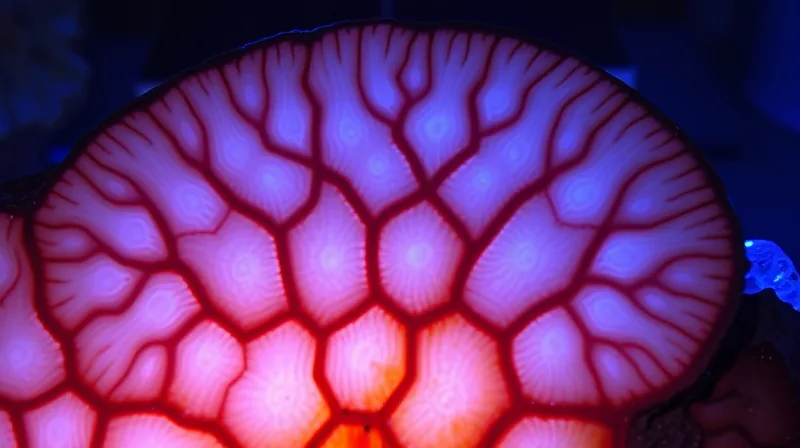
To say anything about the years before 1980, researchers need a different kind of witness, and corals offer one. Corals grow between one and two centimeters per year, and in doing so they form a structure similar to growth rings on trees. They are living creatures that build external skeletons through calcification — the laying down of hard mineral material — adding a band of new growth each year with calcium carbonate precipitated from the surrounding water. Over decades and centuries, those bands accumulate into entire reef systems. A coral is a slow instrument that writes down what it lives through. Each band is also a chemical record of the water in which it formed.
The record works because the skeleton does not take up its ingredients evenly. Other chemical elements are incorporated during calcification — strontium, for example — and sometimes more is deposited, sometimes less, depending on the temperature of the water. In colder temperatures, the skeleton absorbs more strontium; in warmer temperatures, less. The ratio of strontium to calcium in the skeleton therefore provides information about changes in temperature. Specific isotopes of oxygen carry the same kind of signal: the rare oxygen-18 and the common oxygen-16 are taken up in a ratio that reflects temperature, with more oxygen-18 absorbed in colder conditions than in warmer ones. Julia Cole, a climate scientist and paleoclimatologist at the University of Michigan — a paleoclimatologist being a researcher who rebuilds past climates from physical remains rather than from instruments — and her team used exactly these properties. They examined fossilized and living corals around the Galapagos Islands off Ecuador in the eastern Pacific, and published their study in the journal Science. Using the age of the corals to place each band in time, the researchers reconstructed changes in ocean temperatures over the past 1,000 years.
Warm Water, Stronger El Niño, Dying Reefs
What the corals showed points to a clear conclusion. The analysis concluded that El Niño events have become markedly stronger compared to the pre-industrial period. Cole’s team had been circling that question for years. “We’ve known for a long time that the last 40 or 50 years has really strong El Niño events,” she says. “It’s been hard to say whether the recent strong El Niño that we’ve had is part of a natural cycle, or if it’s something a little bit unusual related to being in a warmer than normal world.” The coral analysis, on this reading, answers it: unusual, not normal. The distinction she draws is between a cycle and a shift.
The reconstruction does not stand alone. Jens Zinke, professor of paleobiology at the University of Leicester in England, says the developments correspond to the predictions of leading climate models. Those models predict a quantifiably higher likelihood of extreme eastern Pacific El Niño events in the 2030s. [4] Then there is the present tense of the ocean. In July of this year, the US National Oceanic and Atmospheric Administration was already observing temperature increases of greater than three degrees Celsius in the eastern and central Pacific. The German Meteorological Service believes this could in all likelihood develop into one of the strongest El Niño events since records began. [1]
A strong El Niño is not a local event, even though its epicenter is the Pacific. In countries like Ecuador and Peru it can cause heavy rains and flooding. Australia and Indonesia may experience a lack of rain, leading to drought and wildfires. El Niño also causes global temperatures to rise for a while. The distance matters: the same Pacific water that floods Andean roads can leave Indonesian fields dry enough to burn. The links form a chain: a world warmer than normal, models that expect extreme eastern Pacific events to become more likely in the 2030s, a Pacific already more than three degrees above average in July, and rain or fire delivered to continents far from the water.
Heat has a second cost, and it is paid in the water. Thomas Felis, who leads the research group on coral paleoclimatology at the MARUM Center for Marine Environmental Sciences at the University of Bremen and has conducted a similar study to Cole’s, draws the line forward. [2] If the predictions prove right and this El Niño does in fact become a Super El Niño, the coming year will probably be another of record heatwaves, he says. [2] A year of record heat “will very probably lead to another global coral bleaching.” It has happened before, in 2023-24 and 2015-16, both also El Niño years. [2] Corals get their characteristic colors from certain algae with which they live in symbiosis, a partnership in which the algae supply, through photosynthesis, the energy the corals need to live. If the temperature of the ocean is too high, the algae start to produce toxins, and the corals end the partnership. The coral remains, in its skeleton. That breakup is what the term bleaching describes. It can survive like that for a few weeks, and if the temperature drops again, the algae return. “But if this state, with abnormally high summer temperatures, goes on for too long, the coral becomes so sick that it eventually dies,” Felis explains. [3] Worldwide coral death would mean not just the end of a unique ecosystem, but the destruction of an archive that preserves the history of the oceans.
The Limits of the Record
Not everyone reads the record with equal confidence, and the sharpest caution is not about the past at all. A recent article by the Max Planck Institute for Meteorology states that whether strong El Niño events will intensify as a result of climate change “remains the subject of ongoing research.” [4] That caveat concerns the future; the corals concern the past. The two statements answer different questions, and only one of them has a thousand years of skeleton behind it.
Andreas Fink, professor of meteorology at the Institute for Meteorology and Climate Research in Karlsruhe, is more circumspect about the evidence itself. [5] “Coral data does achieve a high temporal resolution — monthly to seasonal — but its accuracy is dependent on local conditions, meaning that direct comparisons with modern measurement data are fraught with uncertainty,” he says. [5] In his view, the significance of the study is also undermined by its regional limitation to the eastern Pacific. [5] El Niño’s effects are global, but the reconstruction that measures it is anchored in one basin. The archive is precise in time and narrow in space, which is the reverse of the satellite data it is meant to complement.
Cole is also aware of her study’s limitations. “Our data does fill a gap, but I want to be clear that our record isn’t continuous,” she says. What the corals around the Galapagos preserve is a millennium of ocean history, read from bands of calcium carbonate one year at a time. What they do not preserve is the rest of it. The conclusion rests on the years that were sampled, and no method can supply the years that were not. “We don’t have every single year over the last millennium,” she says. “We have a little bit under half of the years covered.”
Sources
1. German Meteorological Service
2. MARUM Center for Marine Environmental Sciences
4. Max Planck Institute for Meteorology
5. Institute for Meteorology and Climate Research in Karlsruhe