The Socket and the Spreadsheet: Reading France’s 42.5 Billion Euro Investment
Day
What our own tape printed first
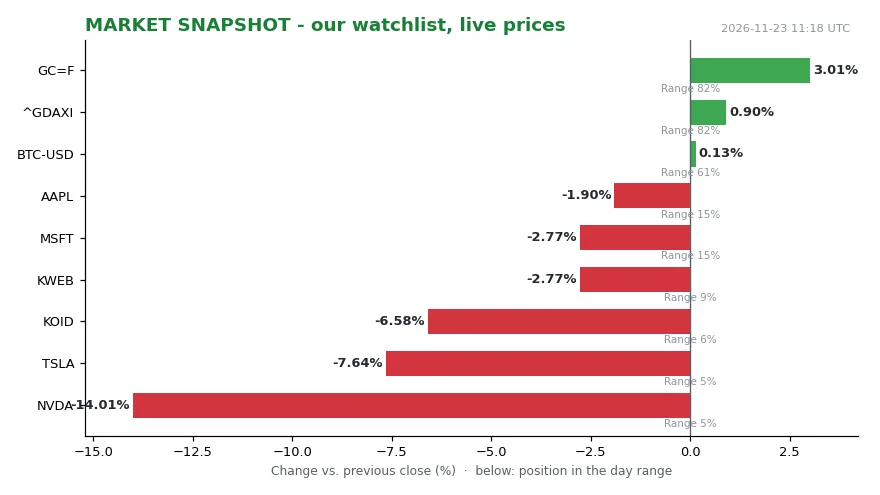
At 11:14 UTC our watchlist showed NVIDIA at 125.53 dollars, down 14.01 % against the previous close and sitting only 5 % of the way up its daily range — in other words, near the low. Tesla printed 345.82, down 7.64 %, also at 5 % of range. Microsoft traded at 484.52, down 2.77 %, in the bottom 15 % of its range, and Apple at 342.56, down 1.90 %, in the bottom 15 % as well. Three of the nine instruments we track were higher on the day. They were gold futures at 3,622.40, up 3.04 % and 83 % of the way up the range, the German DAX at 25,018.76, up 0.87 % and 78 % of the way up, and Bitcoin at 61,276.74, up 0.19 %, mid-range at 63 %. KWEB (a China internet exchange-traded fund) was at 20.72, down 2.77 % and 9 % of the way up its range; KOID (an exchange-traded fund) at 28.68, down 6.58 % and 6 % of the way up its range [M].
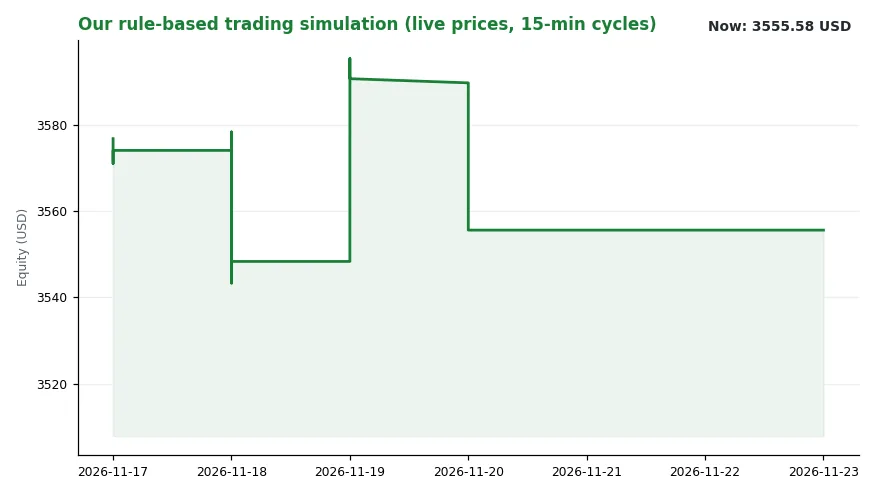
That distribution is a rotation, not a single verdict. Bids are appearing in gold and in European large caps while the US technology complex trades at the low end of its range. Our regime reading (our model’s label for the current market state) says trend=falling with a level of 3.63, and the busiest signal channel of the day is central banks, with two events [M]. The rule-based sim portfolio (a simulated, non-real-money portfolio run on fixed rules) stands at 3,555.58 USD, unchanged versus the same time yesterday, holding 1,798.25 USD in cash, with the latest decision logged as WATCH KWEB [M]. That is the honest state of our measurement: defensive, unresolved, no strong signal.
What this tape cannot do is speak about France. There is no French single name among the nine instruments, and the DAX is a German index. Our numbers describe the weather over global risk assets, not the harvest in a French press release. The object that connects the two is unglamorous: a wall socket.
Why the headline number misleads
On Monday 23 November, around 250 business leaders from CAC 40 companies (the benchmark French stock index of the 40 largest listed companies), small and medium-sized firms, mid-cap companies (companies of medium stock-market value) and start-ups are due at the Cité internationale universitaire de Paris, alongside Industry Minister Sébastien Martin and Economy Minister Roland Lescure [1]. It is the second “France edition” of the Choose France summit, and 273 industrial projects from French companies are being presented, the Elysée announced on Sunday evening [1]. The projects represent 42.5 billion euros of investment, including 14.9 billion in new investment, spanning a range of sectors [1]. A year ago, at the first edition, the government highlighted 30.4 billion euros across 151 projects [1].
On the raw comparison, that reads like a leap. It looks less like one once the envelope is opened. Two programmes alone account for 17.5 billion euros, more than 40 % of the announced package [1]. The first, valued at 9.5 billion, is led by the ADP group, which runs the Paris airports and has launched a major investment plan for its infrastructure, financed largely by the fees charged to airlines [1]. The second, put at 8 billion, comes from RTE, the operator of the electricity transmission grid, which sits at the heart of France’s electrification efforts [1]. Both are long capital programmes, one financed largely by airline fees, the other by a regulated grid operator. They are real investment, and they are also a different animal from a start-up signing a lease.
Another point follows close behind: that a summit is a single event with a single message. The backdrop is less celebratory: behind the figures lies a dynamic marked by uncertainty [1]. The pipeline is bigger than last year, and the economic weather around it is worse.
Who actually pays for the pipeline
Around 30 % of the projects receive public support, notably through the “France 2030” plan [1]. That is a substantial share of projects and a minority of them at the same time, and it is a project count rather than a euro count. Stated plainly: most of the projects listed do not lean on the state, and roughly a third do. Neither number settles whether the money would have been spent anyway.
The audience is the next question. Choose France is described as an annual economic gathering usually aimed at foreign investors [1]. This edition is the domestic mirror: the goal is to highlight French companies that are investing in the country [1]. President Emmanuel Macron’s day follows the same logic, starting at Airbus in Toulouse, described as the cradle of the aerospace industry, and ending with a dinner at the Elysée bringing together several ministers and more than 150 bosses of companies large and small, from Danone to Urgo [1].
How a press conference fails to move a discount rate
The first channel is the cost of capital. Rising interest rates are weighing on credit, and at the end of October Insee, the national statistics office, reported that business investment had fallen for the fourth quarter in a row [1]. A press conference does not change a discount rate (the interest rate used to convert future cash flows into today’s value); a central bank does. That is why the busiest channel in our own signal layer today is central banks rather than industrial policy [M].
The second channel is fiscal. The draft budget law now before parliament provides for an increase in various levies on companies in 2027 [1]. A tax change alters the after-tax return on exactly the kind of multi-year project that dominates this package, and it does so with a lag that outlasts the news cycle.
The third channel is demand. A squeeze on household purchasing power is weakening consumption [1]. Domestic consumption is the revenue line that many of the smaller projects on the list will eventually depend on, and it is not something a summit can announce into existence.
The fourth channel is pipeline credibility. The reason a grid programme of 8 billion euros matters more than its press release is that electricity transmission capacity is an input to almost every other electrification decision. Capital that is committed to wires and substations is a precondition, not a stimulus.
Who wins, who pays, who decides
The deciders are visible: the Elysée sets the framing, Bercy (the French finance ministry) supplies the sectoral detail, and parliament holds the 2027 levy question. The detail provided by Bercy puts the headline projects mainly in energy, space and health, driven mostly by small and medium-sized enterprises in Île-de-France, Nouvelle-Aquitaine and Normandy [1]. At local level, Lyon-based SME Elyse Energy will present a planned aviation biofuel production plant in the Pyrénées-Atlantiques, valued at 1.6 billion euros, which the company has confirmed [1].
The beneficiaries are similarly concrete. Suppliers to airport infrastructure and to the transmission grid are likely to sit closest to the two largest programmes. The airline passenger sits on the other side of the ADP ledger, because that plan is financed largely by the fees charged to airlines [1]. The counter-trend is explicit in the figures: with growth prospects more favourable abroad and dark clouds gathering over the French economy, many very large companies are instead looking to reduce the share of France in their turnover [1]. A domestic investment summit and a corporate re-weighting away from France can coexist in the same quarter — that is the tension the numbers contain.
What to watch next
Three verifiable things, in order of information value. First, the budget law: whether the 2027 levies survive parliament in the form drafted [1]. Second, the Insee investment series: a fifth consecutive quarterly fall would tell us more about the direction of French capex (capital expenditure on long-lived assets) than any single announcement day. Third, conversion: whether the 14.9 billion euros of new investment shows up as disclosed, dated capital spending rather than as an intention [1].
None of that is a forecast about France, and we will not dress it up as one; it is a list of things that can be checked.
The socket
The wall socket is the place to look. Before today it was a piece of plastic with two holes in it. After reading the RTE line — the transmission-grid programme at the heart of the country’s electrification efforts [1] — it is the last mile of a capital programme, the point where a multi-year investment decision becomes a kettle boiling. That is an interpretation of the mechanism, not a claim from the source. That is what an investment summit actually trades in: not headlines, but the physical preconditions that make the next ordinary action possible. The socket will not look different tomorrow. It will simply be harder to see as neutral.
This article is educational analysis, not investment advice. Figures marked [M] come from our own market measurement as of 2026-11-23 11:14 UTC; [1] refers to the cited report.
Sources
Mentioned organisations (context, not sources)
- NVIDIA — Organisation (homepage)
- Tesla — Organisation (homepage)
- Microsoft — Organisation (homepage)
- Apple — Organisation (homepage)
- Cité internationale universitaire de Paris — Organisation (homepage)
- Elysée — Organisation (homepage)
- ADP group — Organisation (homepage)
- RTE — Organisation (homepage)
- Insee — Organisation (homepage)
- Airbus — Organisation (homepage)