
The Silence at the Top of a Four Percent Day
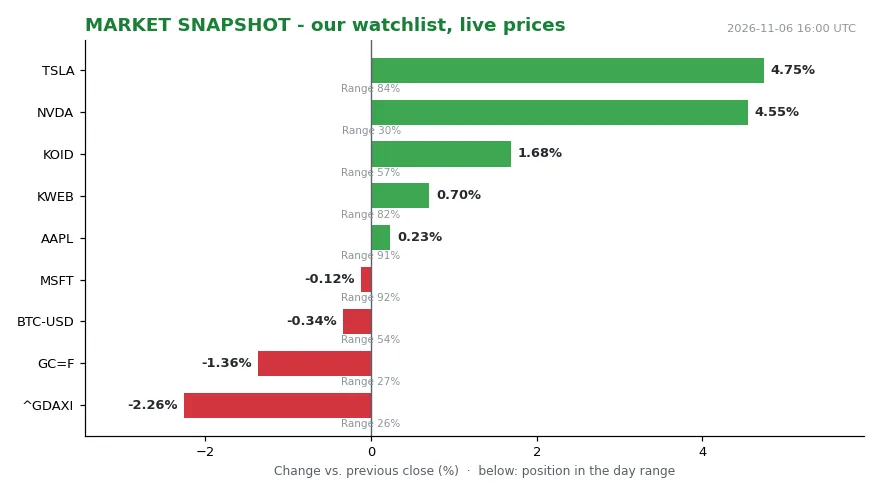
Nvidia printed 189.26 in our 15:56 UTC snapshot on 6 November 2026. That was up 4.22% against the previous close. It was also close to the day’s low, at just 21% of the intraday range, meaning where the price sits between the day’s lowest and highest trade. Tesla told a different story: 359.01, up 4.46%, and near the day’s high at 77% of range. Apple sat at 344.49, up 0.09%, holding 85% of its range. Microsoft eased 0.22% to 534.76 and still occupied 87% of its range. Four US technology names, four different shapes on the same session. The pattern in our data is a rotation, not a rescue.
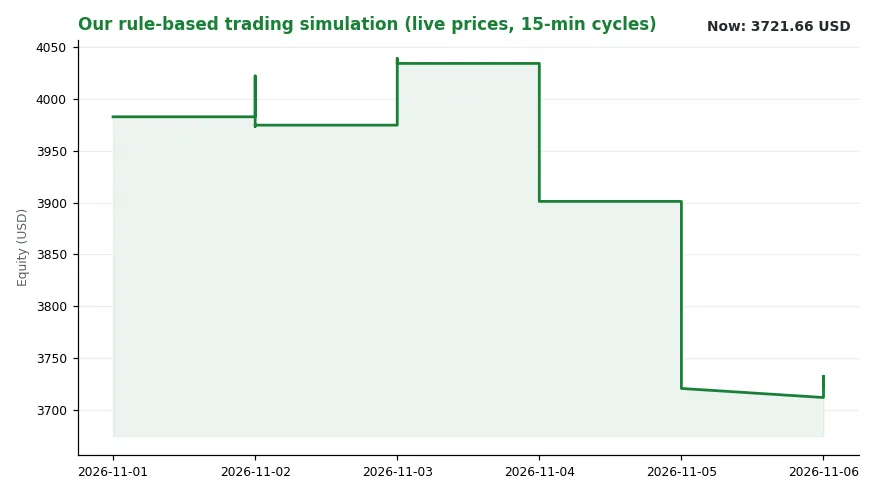
The rest of the board sharpens that reading. The DAX stood at 25,743.21, down 2.21% and in the lower part of its range at 28%. Gold traded at 4,058.70, off 1.33% and also low in its range at 29%. Bitcoin was at 75,622.46, down 0.47% and mid-range at 46%. KWEB, an exchange-traded fund tracking Chinese internet companies, gained 0.65% and sat near its high at 79% of range. Our simulated book, a paper portfolio traded by rules, not real money, held 3,717.51 USD, down 0.08% versus the same time yesterday, with 2,208.19 in cash. The last logged decision was to watch KWEB at 0.00 and do nothing. The regime reading (our internal indicator of whether the trend is rising or falling) showed trend falling, level 3.63, and the busiest signal channel (the category into which our system files a trading signal) of the day was “other” with five events.
A rebound in which the largest AI name fades from its high while European equities and gold give ground is not a market that has settled its argument. It is a market changing seats. And there is a particular silence on a desk when a stock is up more than four percent and the seller is still there at the top of the range.
What actually happened
That silence has news behind it, and the news is political before it is financial.
The sell-off in the US on Thursday was most dramatic on the Nasdaq, the index that houses Alphabet, Nvidia, Meta and Apple. It followed sweeping gains by the Democrats in this week’s mid-term elections, which gave the party full control of Congress. A number of leading Democrats had campaigned against the unhindered expansion of data centres, the physical substrate on which artificial intelligence runs. Fears of tighter AI regulation appear to have sparked the investor reaction.
The trigger was electoral. The underlying anxiety was older. Concerns about the industry’s prospects had been building for months before any ballot was cast.
The history matters here. The release of ChatGPT by OpenAI in late 2022 is widely seen as the moment that generated mass public and corporate interest in practical AI. It also started a modern gold rush. Investors poured money into chipmakers, into networking infrastructure, into data centre construction, into the power generation that feeds those halls, and into the model developers themselves. The value of technology companies soared.
The boom continued into this year. Research by Goldman Sachs puts expected AI investment at $1 trillion in 2026 alone. The sector has scooped up so much available cash that other industries have seen their own borrowing costs increase as a result. That is a mechanism, not a mood: when one sector absorbs the available capital, the price of money rises for everyone else.
The channel: regulation, discount rates, and the local bill
Three transmission lines connect an election result to a share price.
The first is regulatory risk. If data centre construction, energy consumption and AI deployment face new restrictions, the expected cash flows behind current valuations change. Nandini Roy Choudhury of Future Market Insights thinks investors will assess whether the political shift could result in restrictions on data centre construction, energy consumption and the deployment of AI technology. She adds there is unlikely to be an immediate widespread recovery in tech stocks, as traders are likely to be more selective, favouring firms with stronger balance sheets — the statements of what a company owns and owes.
The second is the discount rate, the rate used to shrink a future dollar of earnings to today’s value, applied to distant earnings. Tudor Brown, co-founder of the British-based technology firm Arm Holdings, frames the arithmetic plainly:
“stock values are based on future earnings not present earnings” [1]
— Tudor Brown, co-founder, Arm Holdings (BBC source)
If the rewards are not likely to be as great as expected, some investors will choose to sell.
The third is local. Objections to data centres have centred on water and electricity consumption, on the fear that household bills rise to pay for them, and on noise, land use and general disruption. This is permitting politics (the local approval process that decides whether a project may be built), and permitting politics sets the timeline for every gigawatt (a unit of power, roughly the output of a large power station) a data centre needs.
The actors
A Gallup poll published in May showed 71% of Americans would oppose the building of a data centre in their community. [1] The figure for a nuclear power station was 53%. A data centre polled worse than a reactor.
James Talarico, who won the Senate race in once staunchly Republican Texas, was one of those to tap into this scepticism:.”
“We must protect Americans and establish clear, consistent laws for businesses.” [1]
— James Talarico, Democratic Senate winner, Texas (BBC source) Texas’ Democratic governor-elect Gina Hinojosa campaigned against data centres, pledging a moratorium — a formal pause on new construction — on the building of new facilities. Her win could put her in opposition to Elon Musk, who has moved large parts of SpaceX and Tesla’s operations to the state. The Tesla boss had spent nearly $450 million to back Republican campaigns in the midterms.
On the other side sits the Trump administration, which has been all-in on AI, or “super intelligence” in the president’s phrasing. With control of both houses of Congress, Democrats are now expected to challenge the president’s technology agenda more vigorously, while introducing legislation which could curb the expansion of the industry.
Losing side and winning side are not the same as wrong side and right side. Brown thinks the impact will be limited. Share valuations, he thinks, were inflated by expectations of “almost infinite AI growth”, which have been followed by “a bit of a panic”:
“There is a natural floor to this” “After that it will reflect I think that actually there’s still a lot of money being made in these companies”
— Tudor Brown, co-founder, Arm Holdings (BBC source)
What we watch next
Our own tape leans toward the first reading without confirming it. A 4.22% gain in Nvidia that sits near the day’s low in our 15:56 UTC snapshot is froth coming off, not a floor being built. A 2.21% fall in the DAX alongside it says the money moved rather than vanished.
What we can list as observable are markers, not forecasts. The text of any data centre legislation. Whether state-level moratorium pledges survive contact with a budget. The gap between 71% opposition to a local data centre and 53% to a nuclear plant, and whether that gap widens or narrows as electricity prices move. The $1 trillion AI investment figure for 2026 from Goldman Sachs research, and whether it is revised. Further public comments from AI researchers casting doubt over the safety of AI, which have been grabbing headlines and fuelling speculation that a clampdown could lie ahead.
That is the landscape. Somewhere in it, staffers draft statutes, utilities queue interconnection requests (the queue slots developers ask grid operators for), and analysts re-run discounted cash flows (valuing companies by adding up future earnings, discounted) with a new political variable. The work is ongoing. Our next snapshot will tell us only where the seats changed, not who is right.
This article is educational analysis, not investment advice.
Sources
Mentioned organisations (context, not sources)
- Nvidia — Organisation (homepage)
- Tesla — Organisation (homepage)
- Apple — Organisation (homepage)
- Microsoft — Organisation (homepage)
- Nasdaq — Organisation (homepage)
- Alphabet — Organisation (homepage)
- Meta — Organisation (homepage)
- OpenAI — Organisation (homepage)
- Arm Holdings — Organisation (homepage)
- BBC — Organisation (homepage)