Gold-and-Silver-Selloff-Was-a-Rate-Driven-Rotation
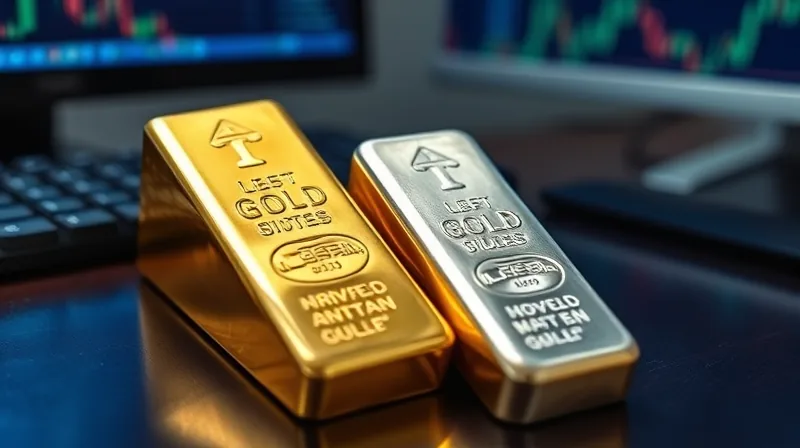
Gold and silver fell sharply on September 7, 2026. The data show a more nuanced picture.
The tape on September 13
The watchlist snapshot was taken at 03:11 UTC on September 13, 2026. Gold futures GC=F printed 4408.90, up 0.04 percent versus the previous close. That is a mid-range position, sitting at 68 percent of the day’s range. This is not a market in free fall. This is a market that has stopped falling.
Contrast that with the tickers around it. NVDA traded at 218.29, down 0.03 percent, pinned near its day lows at just 4 percent of range. KWEB traded at 24.60, up 0.65 percent, but also near day lows, again at 4 percent of range. The German index ^GDAXI sat at 25568.56, up 0.82 percent and at 93 percent of range, near day highs.
The pattern is a rotation, not a panic. AAPL gained 1.75 percent and sat mid-range at 60 percent. MSFT added 0.65 percent at 48 percent of range. TSLA rose 0.52 percent at 54 percent. BTC-USD was essentially flat at -0.02 percent, mid-range at 55 percent. KOID rose 1.47 percent at 57 percent.
Read together: equity risk appetite is intact, European equities are strong, and gold is flat. Capital is not fleeing to cash. It is moving sideways.
The sim-equity book stood at 3972.01 USD, unchanged from the same time the previous day, with 1991.34 USD in cash. The last logged decision was to observe KWEB without adding exposure. The stated reason was that the market was closed, so the position was left untouched. Not every day demands a move.
The regime classification reads Trend=falling, Level=3.63. The most active channel on September 7, 2026, the day of the selloff, was central bank, with two events. That points to where the pressure originated.
Why would gold fall when the world looks more dangerous?
The puzzle is why gold would fall precisely at the moment the world becomes less safe?
What the wire actually said
Gold and silver prices fell on MCX on September 7, 2026. Gold October futures declined to 1,52,315 rupees per 10 grams, a drop of 0.30 %. Silver December futures fell to 2,36,885 rupees per kilogram, down 0.33 %. On international markets, US gold futures for December fell 0.75 percent to 4,436.49 dollars per troy ounce, and spot gold slid to 4,405 dollars an ounce in a sharp sell-off. The drivers cited were strong US jobs data, interest rate expectations, rising crude oil prices, and geopolitical tension.
Safety has a price set by interest rates
The answer is not that gold stopped being a safe haven. The answer is that safety has a price, and that price is set by interest rates.
Gold pays no coupon. It pays no dividend. It pays no interest. That is not a flaw. It is the entire design. When a bond yields a comfortable return, holding a metal that yields nothing carries an opportunity cost. When yields fall, that cost shrinks and gold becomes attractive.
So the mechanism runs like this. Strong US employment data, with job growth firm and unemployment steady at 4.1 percent, reduces the case for rate cuts A labour market that is holding up does not need emergency support. The expectation shifts toward the Federal Reserve keeping rates higher for longer. Higher-for-longer rates raise the opportunity cost of holding non-yielding assets. Investors rotate toward instruments that pay. Demand for gold and silver softens. Prices fall.
That is the channel. It is not sentiment. It is arithmetic.
How oil feeds the rate story
The US-Iran conflict has stretched longer than most expected. The intuitive reaction would be a rush into gold. That is not what happened.
Instead, the prolonged tension pushed energy prices up. WTI crude oil prices rose. Energy feeds transport, manufacturing, and nearly every supply chain. Higher crude means higher costs across the economy. Higher costs mean faster inflation.
Now the loop closes. Rising inflation risk pushes the Fed further toward holding rates steady or higher. That again raises the cost of holding gold. So the very conflict that should have driven investors into precious metals ended up pushing them away from them.
This is uncomfortable, and it is worth pausing on. Geopolitics does not always move gold in the direction the textbook promises. It depends on which channel dominates.
The technical layer, with a warning attached
Price data show MCX gold has dropped below its 21-day Exponential Moving Average and is trending toward the 55-day EMA. A move below key moving averages can signal weakness in the trend.
One caution belongs here. Technical indicators identify trends. They do not predict prices. Treating an EMA crossover as a forecast is a category error, not an analysis.
Who wins, who loses, who decides
The losers in this move are holders of physical and futures gold and silver, at least on paper, and especially those who bought near the recent peak. Indian households entering the festive season are the most visible group here, and for them falling prices are a mixed blessing: cheaper to buy, harder to have already bought.
The relative winners are holders of interest-bearing assets and, more subtly, anyone whose costs are not energy-linked. A stronger US dollar adds a further layer of pressure on dollar-denominated metals.
The decision-maker is the Federal Reserve. Nobody on the MCX floor sets this price. The Fed’s reading of the labour market does. Secondary actors are the oil market, which transmits inflation risk, and the geopolitical situation, which transmits uncertainty. Gold is the receiver, not the sender.
What to watch next — and what we honestly do not know
Three things are worth watching. First, the next US employment release, because a softening labour market would flip the rate expectation and with it the opportunity cost. Second, crude oil, because WTI above 92 dollars keeps the inflation channel open. Third, the US dollar, because a stronger dollar mechanically pressures metals.
One point deserves emphasis. The regime reading says Trend=falling, Level=3.63. That is a description of the current state, not a forecast. Gold on September 13 was 4408.90, up 0.04 percent, mid-range. Six days after a sharp sell-off, the metal was flat.
That flatness is the honest data point. It does not confirm a crash. It does not confirm a recovery. It confirms that the market absorbed the news and paused.
Volatility cuts both ways. A big jump is as possible as a continued slide, and neither is written anywhere in advance. Anyone claiming otherwise is selling certainty they do not own.
The word we should redefine
Gold is called a safe haven, and that label is assumed to mean it is always safe — but safe only ever described what gold protects against, never what it costs to hold while it does.
This article is for informational and educational purposes only. It is not investment advice, and it is not a recommendation to buy or sell any asset. Gold and silver prices can fluctuate due to market conditions.