
The Name Is Disinflation. The Receipt Tells a Different Story.
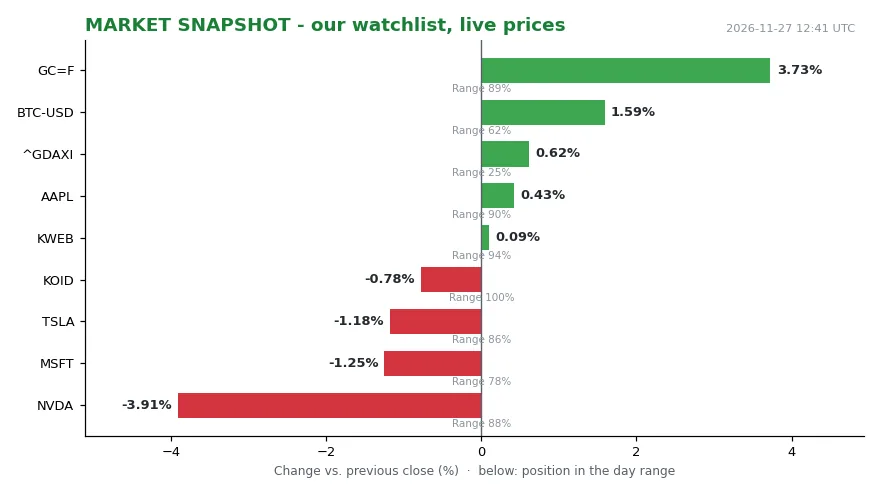
Gold at 3,697.60 dollars an ounce, up 3.73 % and parked at 89 % of its daily range, is where our own tape starts at 12:39 UTC on 27 November 2026. Nvidia trades at 149.30, down 3.91 % versus the previous close. It still sits near the top of its range, at 88 %. Apple prints 355.58, 0.43 % higher, at 90 % of its range. Microsoft is at 489.93, 1.25 % lower, at 78 %. Tesla shows 380.14, down 1.18 %, at 86 %. The DAX stands at 25,364.45, up 0.59 % but stuck at 20 % of its range, close to the day’s low. Bitcoin at 61,498.85 is up 1.66 % and mid-range at 64 %. KWEB at 21.17 is essentially flat at 0.09 % and pinned to 94 % of its range. KOID at 30.62 is 0.78 % lower and marks the very top of its band at 100 %.
Read together, those lines form a pattern. Most names sit near the upper end of their own intraday band; the DAX at 20 % and bitcoin at 64 % do not. That includes the ones that are red on the day. Negative against yesterday’s close and positive against today’s low describes a session where sellers arrived first and buyers did the recovering. Gold is the exception. It is up strongly and near its high; in our reading, that is what a hedge looks like when someone is buying it rather than renting it.
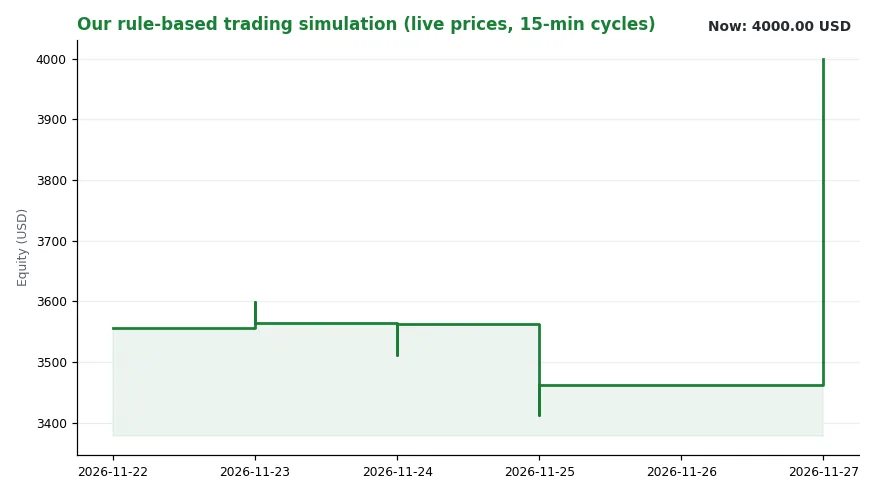
Our rule-based simulation adds no conviction to that read. It closed the interval at 4,000.00 dollars, entirely in cash, with a logged gain of 15.51 % against the same time yesterday. Its only recorded decision was WATCH KWEB at 0.00. The busiest signal channel of the day was “central banks”, carrying a single event. The regime reading shows trend=falling at level 3.63. A model that holds cash and watches has found nothing worth pressing, and nothing here is a recommendation.
Into that indifferent tape comes a number with a name: disinflation.
What the release actually says
Insee, the French national statistics institute, reported on Friday that consumer prices fell 0.7 % in November. [1] In October the same index had risen 0.4 %. Annual inflation slowed to 2.9 %. [1] Two numbers and one month produce a label that travels faster than the detail beneath it.
The detail is the point. Insee attributes the slowdown largely to energy. Energy prices are still up sharply year on year. The pace decelerated from 24.1 % in October to 19.2 % in November. [1] The institute highlights a marked fall in petroleum product prices. Gas tariffs, by contrast, continue to rise. That is not the same thing as cheaper energy. It is a slower climb, with one component descending while another still ascends.
Services tell a similar story of deceleration rather than decline. Service inflation eased to 2.3 % year on year from 2.6 %. Insee links that to a sharp slowdown in accommodation and transport prices. Food went the other way. Food prices rose 1.3 % over the year after 1.2 % in October. Fresh products did the pulling, accelerating to 9.4 % from 8 %.
The mechanism: base effects, not relief
Disinflation is a change in a rate of change. When October’s energy comparison was brutal and November’s is merely severe, the headline falls while the price level does not. The channel that carries this into household behaviour is real income, and the income data in the same release is thin. Purchasing power of gross disposable income per consumption unit rose 0.2 %, after a fall of 0.5 %. The household saving rate held at 17.4 % of disposable income in the third quarter.
Spending on goods stabilised in November after declines in September and August. Inside that flat total, energy consumption dropped 2.9 %. Consumption of manufactured goods rebounded 1.3 %. Food consumption slipped 0.1 %. A household paying more at the fresh counter and less at the pump can post an unchanged total and a changed month - that is our reading of the composition, not a figure Insee states.
The second channel is expectations. A policy reader looking at French prices sees a headline that fell for a mechanical reason and an underlying picture that fell much less - in our reading, that is the distinction that matters for rate expectations.
Who wins, who loses, who decides
The winner in this release is the driver with a fuel tank. Petroleum products fell markedly, and that shows in the 2.9 % drop in energy consumption. The relative loser is the shopper at the fresh counter, where prices ran at 9.4 % year on year. Food as a whole rose only 1.3 %. Fresh produce did the work inside that average.
Labour is a separate ledger. Salaried employment was stable at 0.0 % in the quarter, or minus 12,200 jobs. The previous quarter showed minus 0.1 %, or minus 26,100 jobs. The year-on-year comparison has now fallen for a fifth consecutive quarter. The level nonetheless remains above the pre-health-crisis mark of late 2019. That gap is 4.8 %, or 1.2 million jobs. Both statements are true at once, and they answer different questions.
Output answers a harsher one. French GDP fell 0.2 % in volume in the third quarter of 2026. The previous quarter had been stable. The growth carry-over for 2026 stands at 0.1 %. That number sits underneath everything else in the release, and it is not a disinflation story.
What to watch next
Three lines on the December print deserve attention. The first is whether energy’s deceleration continues or reverses. Petroleum and gas are moving in opposite directions. The annual rate depends on which one dominates the base. The second is services at 2.3 %. Accommodation and transport were named as the drivers, and travel prices are seasonal. One month is weak evidence. The third is fresh products at 9.4 %, the one item accelerating while everything else slows.
Then the harder data. Fourth-quarter GDP arrives after a 0.2 % contraction in the third quarter. Salaried employment faces a sixth consecutive quarterly year-on-year decline if the pattern holds. Neither outcome is certain. A single month of prices is a snapshot. The release mixes a good headline with a soft output number, and that mixture is the honest description.