
The Heist Nobody Owns: Pyongyang Rejects the $6.3bn Binance Verdict
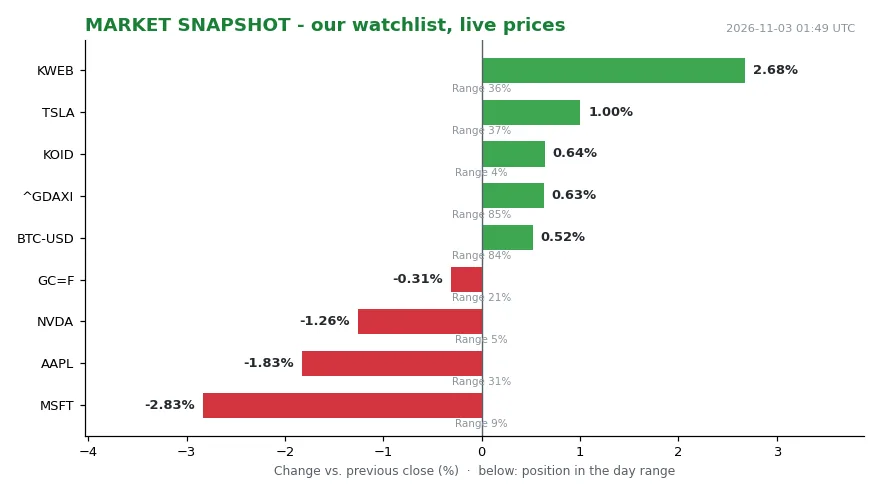
At 01:45 UTC our tape carried a paradox in four lines. Microsoft printed 507.12, down 2.83% and sitting in the bottom tenth of its daily range. Nvidia traded at 202.06, off 1.26%, within 5% of its session low. Apple stood at 338.32, down 1.83% but mid-range, roughly a third of the way up. And bitcoin, hours after the largest crypto heist in history was pinned on a state, was up 0.37% at 76,968.02, holding the middle of its range at 65%.
The rest of the watchlist filled in the shape. The DAX in Frankfurt traded at 25,981.09, up 0.63% and 85% of the way up its range. The KWEB China internet basket was the day’s clear outperformer at 23.35, up 2.68%. Gold was near flat at 3,960.00, down 0.24% and mid-range.
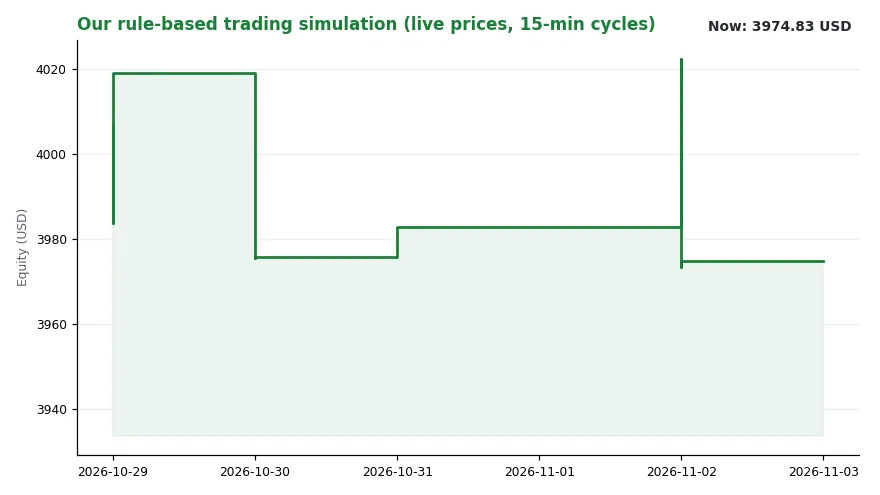
That is rotation, and it is legible: the largest US technology names are being sold while European equity and Chinese internet exposure catch a bid. Money is leaving the largest US technology names and turning up in European equity and Chinese internet exposure. Our regime reading — trend falling, level 3.63 — says the drift is still downward even while individual pockets catch a bid. The busiest channel in our signal layer on 2 November was “central banks,” with one event logged. Our simulated book stood at 3,974.83 USD, unchanged against the same time yesterday, with 2,010.81 in cash and the latest rule-based decision logged as WATCH KWEB.
We now set the news against that tape. The record theft from Binance — 6.3bn dollars, or 4.7bn pounds — has been attributed by the FBI, the US Secret Service and a cohort of cyber analysts to North Korea [1]. A state is named, a figure is quoted, and the asset at the centre of the story does not break. That gap between headline and tape is the reason the denial matters more than it might appear.
The denial, in its own words
On Tuesday Kim Yo-jong, a top official of the Democratic People’s Republic of Korea and the sister of leader Kim Jong Un, rejected the accusation outright [1]. She described the allegations as “absurd rhetoric” and as another “sinister attempt” by the US to damage her country’s public image [1]. Kim, who is the director of North Korea’s General Affairs Department, put it this way: “The US has made a trite provocation of linking it with the Democratic People’s Republic of Korea again” [1].
She went further, turning the attribution itself into the offence: “It is a grave political provocation against the DPRK that the US misleads the international public opinion as if all the cyber crimes in different parts of the world are our deeds” [1]. Then the standing position: “it is the consistent policy stand of the DPRK government to resolutely oppose all sorts of malicious acts in cyberspace” [1].
Against that, the technical case. Blockchain analysts and the FBI say the operation was run by a state-backed group called TraderTraitor, also known as the Lazarus Group [1]. The FBI has asked industry partners to help block transactions involving cryptocurrency accounts tied to that group [1]. The same unit was blamed for the 1.5bn dollar theft from the Bybit exchange in 2025 — a record at the time, and one the Binance figure has now eclipsed [1]. Pyongyang has been blamed for a string of major cyber attacks over the years and has denied them consistently [1].
Research groups including the S Rajaratnam School of International Studies have described a systematic build-out: promising students are recruited from universities and sent into hacker units overseen by North Korea’s intelligence agency [1]. The country has been accused of leaning on cyber-crime to help finance its economy [1]. That accusation is the room in which every new attribution lands.
The mechanism: where a hack becomes a market event
The transmission channel here is not interest rates. It runs through custody, liquidity and compliance.
We start with the freeze. After the breach, Binance worked with issuers to freeze assets affected by the hack, and trading in major cryptocurrencies resumed [1]. Freezing is the point where a criminal haul stops being a liquid position and becomes a disputed claim. The FBI’s request to block accounts tied to TraderTraitor is aimed at exactly that set of exit routes [1].
Then the withdrawal channel. Binance said on Sunday that customers pulled more than 3.6bn dollars of assets as the exchange reopened, having suspended all transactions in the wake of the hack [1]. That is a demand-side shock inside a single venue, and unlike attribution it is measurable.
Then the balance-sheet channel. The company has repeatedly said it would cover all losses linked to the attack [1]. It says it has so far covered around 95% of the assets stolen in the breach [1]. That 95% is the number that converts a security incident into an accounting question, and it is the number to hold on to.
Then the political channel. A public attribution by the FBI and the Secret Service is itself an instrument [1]. It steers compliance departments, exchanges and analytics firms toward specific wallets [1]. Kim’s statement reads that instrument as pressure on her country’s image rather than as a technical finding [1]. Both readings can hold at the same time.
One caveat. The accused state rejects the attribution in explicit terms [1]. Our tape shows what markets did with the claim; it does not adjudicate who is right.
Who wins, who loses, who decides
Binance carries the operational cost and the reputational one. Its public statements have concentrated on the technical nature of the breach and its response [1]. Its own account is that an engineer’s laptop was compromised, enabling an attacker to make unauthorised withdrawals [1]. The BBC has contacted Binance for comment [1].
The FBI and the Secret Service decide how far the blockade extends [1]. Industry partners decide whether they act on it [1]. Kim Yo-jong, as a prominent public voice on the file, decides how the denial is framed [1]. The hackers, if the attribution holds, set the timing of the next attempt.
And the market decides what any of it is worth. At 01:45 UTC the answer on our tape was: not much, yet.
What we watch next
Three things, all checkable.
First, the remaining slice of stolen assets [1]. Coverage moving from 95% to 100% would tell us how much of the haul is recoverable rather than merely written off.
Second, the freeze [1]. We watch whether the blocked accounts multiply or stall. A widening blockade is evidence that the attribution is operationally usable, not just declaratory.
Third, the rotation in our own data. KWEB at 2.68% and the DAX at 85% of range against Microsoft near its lows is a small move, not a verdict. If that spread persists while crypto holds mid-range, the market is treating exchange risk as a venue problem rather than an asset-class problem — and that is a distinction worth testing rather than assuming.
There is a historical echo here, and it does not flatter anyone. The sequence ran: a record falls, a unit is named, a denial follows, trading continues. That sequence has now completed twice, with the same group at the centre both times [1]. What it predicts is modest and uncomfortable. The institutional response grows with each iteration, and so does the number. Whether there is a third is not something this tape can tell us.
Sources: [1] BBC News report and agency summaries on the Binance hack and the DPRK statement; [2] MSN News, “North Korea denies being behind record $6.3bn Binance hack”; BeInCrypto, “North Korea denies Binance hack”; our own market measurement, 2026-11-03 01:45 UTC. Educational analysis only — not investment advice.
Sources
Mentioned organisations (context, not sources)
- Microsoft — Organisation (homepage)
- Nvidia — Organisation (homepage)
- Apple — Organisation (homepage)
- Binance — Organisation (homepage)
- FBI — Organisation (homepage)
- US Secret Service — Organisation (homepage)
- Bybit — Organisation (homepage)
- S Rajaratnam School of International Studies — Organisation (homepage)
- BBC News — Organisation (homepage)