
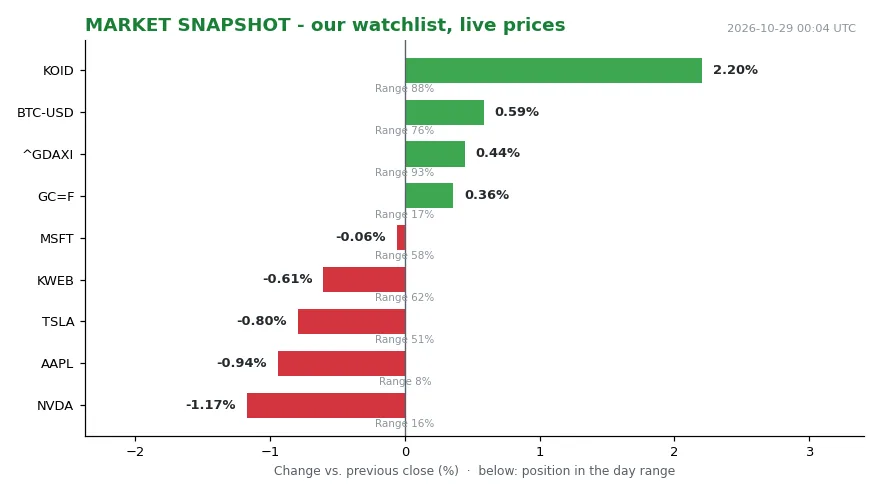
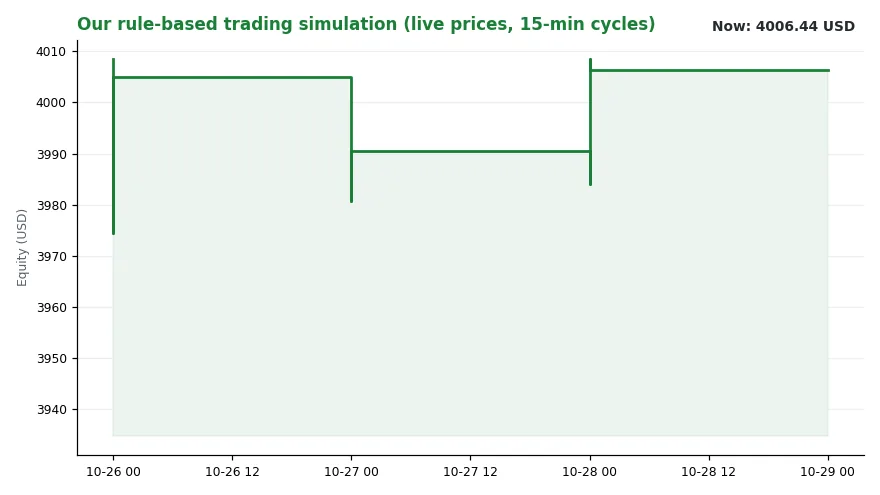
Our own tape, fetched at 23:59 UTC on 28 October 2026, shows no single broad market-moving force — it shows money moving from one market segment to another. NVDA printed 215.38, down 1.17% and sitting near the day’s low, 16% of the way from its low to its high; AAPL closed at 343.83, off 0.94% and even closer to its low, 8% of the way from its low to its high. Against that, ^GDAXI stood at 25,704.02, up 0.44% and near its high, 93% of the way from its low to its high, while gold (GC=F) at 4,068.00 (+0.40%) and BTC-USD at 81,266.25 (+0.58%, 76% of the way from its low to its high) leaned firm. KOID at 35.25 (+2.20%, 88% of the way from its low to its high) was the strongest line on the sheet; KWEB at 22.99 (-0.61%) sat in the middle of its range. Our simulated portfolio held 4,006.44 USD, unchanged on the day, with 2,003.41 in cash and a monitoring note on KWEB. The busiest internal signal category was “central banks” with four events; our internal model’s market-state label is trend=falling, level=3.63.
The pattern reads as caution in US megacap technology paired with demand for European and defensive assets. Our watchlist carries no UK domestic exposure, so the British fiscal statement is not directly priced on this sheet. The nearest read-across is the German index, and there was buying demand.
What the statement put on the table
Chancellor John Healey’s Budget, published on 28 October 2026, is a bundle of small, targeted measures rather than one large instrument. For an 18-to-20-year-old on the minimum wage, pay rises 3.9% from next April, to 11.27 pounds an hour. For over-20s the floor becomes 13.21 pounds. That gap is the story. Labour had promised to abolish “discriminatory age bands” — different minimum-wage rates by age — so that all adults would be entitled to the same minimum wage; Healey reversed course on the approach his predecessor Rachel Reeves had been pursuing. [1] Because younger workers now receive the same percentage increase as older ones, the ratio between their pay rates is preserved and the cash gap widens; the source only says the disparity will remain.
There is a second-order effect buried in the arithmetic. A 21-year-old working full time at the minimum wage, holding a student loan taken out after 2023, now earns enough to cross the 25,000-pound repayment threshold — and from there repays 9% of earnings above it. The Plan 2 loans that many fear they will never repay were taken out between 2012 and 2023. A pay rise, in other words, can arrive alongside a new deduction.
On housing, the Budget contained plans for a “First Time Buyer Isa”, to be introduced in 2029 as a replacement for the Lifetime Isa (a UK savings account for a first home or retirement). The state tops up contributions of up to 4,000 pounds a year with a 25% bonus. The 450,000-pound property cap stays, but savers who withdraw ineligible funds lose only the government’s contribution, not their own capital; the exit penalty on existing Lifetime Isas (UK savings accounts for a first home or retirement) is being lowered too. That sits next to the previously announced 4.7bn-pound “Your First Home” scheme for England, aimed at 70,000 individuals and couples: a 2.5% deposit on a new-build, supported by a loan worth 20% of the property’s value, capped at 110,000 pounds outside London and 140,000 pounds in the capital.
For young founders in England, a “Young Entrepreneurs Allowance” will be piloted, with living costs partly covered by the government during a business’s first year. The detail is thin; the rollout is described only as “shortly”.
The mechanism, and the three doors left shut
Three transmission channels matter. First, the wage floor: a 3.9% annual increase in the wage floor raises the cost base for employers concentrated in hospitality, retail and care, and the decision not to converge the different minimum-wage rates by age keeps that cost lower for young hires than full equalisation would have.
Second, housing demand: a 2.5% deposit plus a 20% loan secured against a share of the property’s value lifts purchasing power for new-builds specifically. Demand-side support without a matching supply response tends to show up in prices and in builders’ future sales orders before it shows up in affordability.
Third, savings: a 25% top-up is a subsidy to deposit-saving, and moving the penalty away from savers’ own money changes how savers weigh the risk of locking cash away.
What the Budget left out matters as much as what it put in. More than a million 18-to-24-year-olds are not in employment, education or training. The chancellor acknowledged the scale of the crisis but said solutions would not come yet; ministers are waiting on recommendations from Alan Milburn, who has warned Britain is “at risk of a lost generation” and argued a “round of ammunition” is needed rather than a silver bullet. [1] His report lands later this year. Student loans were the other door left closed: Plan 2 borrowers (on a UK student-loan repayment plan) got no action, and Chief Secretary to the Treasury Emma Reynolds said the repayment system is “under review”. [1]
Who gains, who waits
Clear gainers: 18-to-20-year-olds on the floor, young savers with a deposit ambition, first-time buyers of new-builds in England, and founders who will be able to cover part of year one. Those left waiting: young people not in employment, education or training, Plan 2 borrowers (on a UK student-loan repayment plan), and anyone whose deposit target sits above the retained 450,000-pound cap. The payer is the UK Treasury, through the 25% bonus and the loans secured against a share of the property’s value; the deciding actors are the Treasury, Milburn’s review, and — indirectly — whoever sets rates.
What we watch next
Milburn’s recommendations later this year; the April annual increase in the wage floor as it lands in actual payslips; the 2029 ISA launch and whether the cap moves; and whether wage-floor costs surface in price growth in services rather than goods. A Budget of small measures rarely reprices a market on day one, so the test is whether these channels show up in wages, deposits and builders’ order books over the coming quarters.
The number that carries the Budget: 11.27 pounds an hour for a 20-year-old, against 13.21 for the colleague one year older.