Twenty years after the Stern review taught economists to count future lives, the tape still prices the next quarter and discounts the next century. Our own measurements show the split.
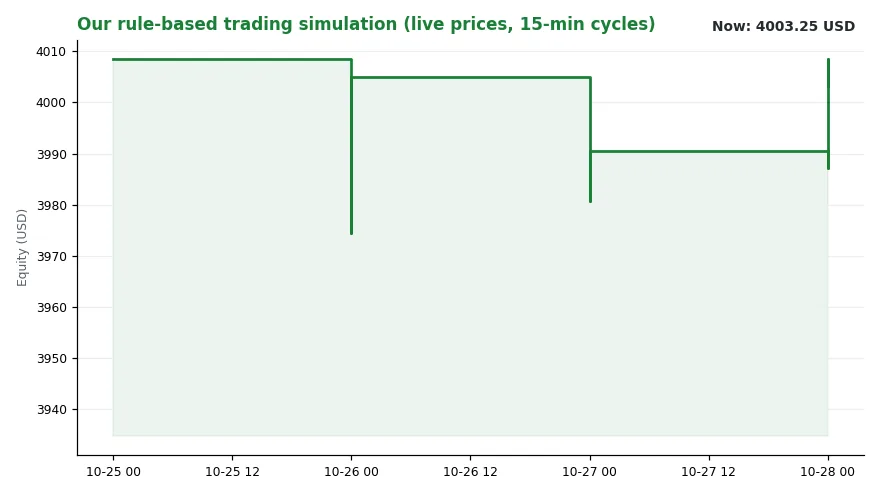
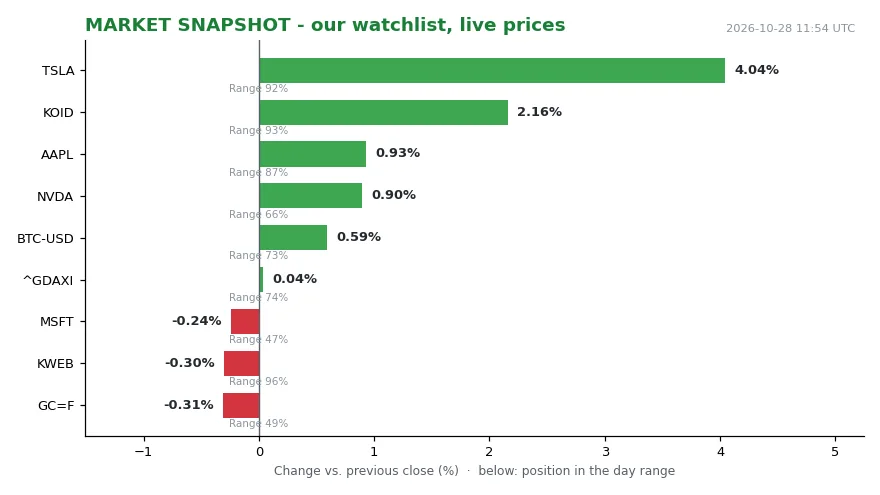
At 11:51 UTC on 28 October 2026, our watchlist showed Tesla at 407.46, up 4.04% on the previous close and sitting at 92% of its daily range; Apple at 347.10, up 0.93% and pressed into the top of its range at 87%; and KWEB at 23.13, down 0.30% yet still pinned near the day’s high at 96% of range. Nvidia traded at 217.94, up 0.90%, mid-range at 66%. Around those single-name moves, the macro benchmarks barely stirred: gold at 4061.70, off 0.32% and dead centre at 49% of range, Microsoft at 531.33, down 0.24% at 47%, the DAX at 25595.03, up 0.02% at 68%, bitcoin at 81275.52, up 0.59% at 73%. Seen as a pattern, this is a two-speed tape — idiosyncratic equity risk bid, macro flat, the traditional hedge unmoved. Our regime reading puts trend at falling with level 3.63, and the busiest signal channel of the session is central banks, with four events. The simulated book stands at 4003.25 USD, up 0.32% against the same time yesterday, with 2377.34 in cash and a latest decision to watch KWEB at 0.00. Nothing in that snapshot is a view on the coming decades. It is a market pricing the next few quarters — which is precisely the habit this week’s anniversary is about.
One reaction runs wherever gas is burned: CH4 + 2O2 → CO2 + 2H2O. The bond that breaks in the methane releases energy that is monetised today, in a quarterly report, at a price on a screen. The molecule that forms — two oxygen atoms locked to one carbon — has no invoice attached to it. It drifts, and its cost is delivered to someone else’s ledger, decades later. Climate-economy models are, at bottom, decisions about how to weigh the two halves of that same reaction: the energy that is paid for now and the bond that is paid for later.
The news this week is that one such model turned twenty. A review titled The Economics of Climate Change, running to 700 dense pages of graphs and data, was published two decades ago by Nicholas Stern, a former chief World Bank economist turned adviser to Gordon Brown [1]. [1] Its conclusions were, at the time, radical, and there were three of them: that the costs of inaction on the climate exceed the costs of action; that the climate crisis is a market failure; and that economic growth is compatible with cutting greenhouse gas emissions [1]. That third point is the one that broke the old settlement. Environmental policy had been sold for years as a tax on growth. Stern’s arithmetic said it was a repair bill.
The mechanism that made the difference was not a new dataset. It was a number called the discount rate. Traditional economics mistrusts anything that happens in the future and applies a discount to it: likely future profits are reckoned lower in value than present ones, and likely future losses likewise [1]. For a company’s accounts this is prudence, a guard against optimistic projection. Applied to the climate, the same arithmetic silently assigns less value to future lives, which makes spending money now to protect children when they grow up appear uneconomic [1]. Stern’s pivot was to treat future generations as having as much claim to being born as the present one — and to build the review on that premise using standard tools that other mainstream economists could follow [1].
The contrast is sharpest against the work that preceded it. William Nordhaus, formerly of Yale, whose modelling had set the standard for climate economics, asserted in the early 1990s that countries should budget for “moderate” global heating of roughly 3C to 4C above preindustrial levels, because below that threshold the cost of cutting emissions would outweigh the damage avoided [1]. [1] His work rested on exactly the discounting of future damage that Stern set out to contest [1]. The earlier framework survives in the primary literature. The 1993 Science paper introducing the DICE model — an intertemporal general-equilibrium model of growth and climate — concluded that “a modest carbon tax would be an efficient approach to slow global warming, whereas rigid emissions- or climate-stabilization approaches would impose significant net economic costs” [2]. [2] That sentence assumes a measured price, calibrated against a damage function, applied to a slow-moving physical system — the DICE model’s own intertemporal general-equilibrium framing of growth and climate [2]. It also leaves to the discount rate how much that damage is worth.
The reaction from the profession was not polite: the vitriol poured on Stern by fellow economists, including Nordhaus, was intense, with traditionalists fuming that the discount rate — a central tenet of Treasury forecasting around the world — could be meddled with [1].
Two decades on, the review’s analysis has held up, and in one direction the error ran the other way: Stern arguably underestimated both the speed of heating and its economic consequences, while overestimating what renewable energy would cost [1]. The older approach did not disappear, either. In 2018, after a body of science indicating that 3C of heating would submerge coastal cities and turn swathes of farmland to desert, Nordhaus published a paper estimating that 3C would cut global GDP by 2.1%, and that even 6C would cost 8.5% [1]. [1] In the same year he received the Nobel prize, with his climate work prominent in the citation and the prize lecture [1]. Economists are still trained in those traditional growth models in universities around the world, and forecasts that the climate crisis shaves a few percentage points off GDP remain in use among governments, businesses and international institutions [1].
That is the transmission channel, and it is not abstract. A discount rate sits inside every valuation: it sets the hurdle rate a project must clear, the price an insurer puts on a tail risk, the number a finance ministry writes into a budget line. If the model says the future loss is small and far away, the rational move is to build the asset that pays today. It also reaches the part of the capital market that is supposed to be the enforcer of probity: many insurers, supposedly the enforcers of probity in capital markets, are alleged to knowingly be fudging their figures to massage climate risk away, as the Guardian revealed this month [1].
Who gains and who loses follows from that. A model that discounts the future heavily flatters assets whose costs are deferred and penalises those whose costs are paid up front, which is the definition of a low-carbon retrofit. Incumbents with long-lived fossil assets are the accounting winners for as long as the discount holds; anyone underwriting thirty-year physical risk, or holding coastal property, or farming marginal land, is on the other side. The deciding votes, though, are not cast in economics departments. They are cast in budget offices that choose a discount rate, in courtrooms where laggard administrations are increasingly challenged, and at the ballot box [1].
What to watch next is therefore specific rather than atmospheric. First, whether Stern’s own revision gains traction: he would now give more weight to nature, on the argument that the collapse of biodiversity is a key economic and national security threat that has been grossly underestimated and consequently neglected [1]. That means natural capital appearing in models that at the time treated a glacier as functionally worthless and counted a tree only once it was cut down [1]. Second, whether climate litigation and disclosure requirements force the tail risk into published numbers faster than the discount rate can bury it. Third, the physical side, where a supercharged El Nino is described as threatening trillions of dollars in damages [1] — a reminder that the damage function is being re-estimated by the atmosphere, not by a committee. Against that, our own regime reading of a falling trend at level 3.63, with central banks dominating the signal flow, suggests the near-term driver of prices remains monetary policy rather than carbon arithmetic. That could change, and we do not know when.
The honest summary is that the argument was won on paper and is still being lost in spreadsheets: governments refuse to act, markets over-value fossil fuel companies, and investors punish businesses that dare to prepare for a low-carbon world [1]. Success, if it arrives, will look unremarkable: a budget in which the cost of inaction is entered above the cost of action; a carbon price modest enough to be an efficient approach to slowing global warming rather than a rigid emissions- or climate-stabilization approach that would impose significant net economic costs [2]. And a discount rate applied to a child’s future that is no harsher than the one applied to next quarter’s earnings. The bond forms in the air either way. The only open question is which ledger it lands in.
Educational analysis, not investment advice. Market data are our own measurements as of 2026-10-28 11:51 UTC and are quoted for illustration only. Sources: [1] Fiona Harvey, “The climate crisis will destroy our economies — we learned this 20 years ago. When will we act?”, The Guardian, 28 October 2026 (commentisfree). [2] W. D. Nordhaus, “Optimal Greenhouse-Gas Reductions and Tax Policy in the ‘DICE’ Model”, Science 259 (1993) — abstract, primary source for the carbon-tax finding.
Sources