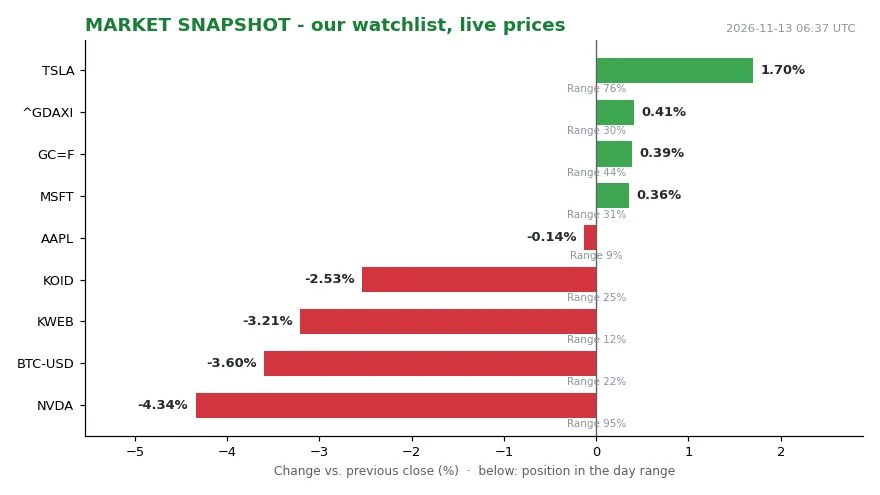
A number can hide a turn. NVDA closed at 166.19, down 4.34% against the previous close — and yet it finished at 95% of its day’s range, near the high. The percentage alone reads as damage. The position inside the range reads as a close near the day’s high. AAPL told the opposite story: 354.88, down just 0.14%, but parked at 9% of its range, near the low. Two mega-caps, two directions of travel, one session. That is not a stampede. It is a sorting.
The rest of our watchlist confirms the read. MSFT traded at 523.00, up 0.36%, mid-range at 31%. TSLA at 397.45, up 1.70%, and at 76% of its range. Gold at 3,903.80, up 0.48%, sitting at 51% — the middle of nowhere, which is roughly where gold sits when nobody is panicking. The DAX at 26,771.88, up 0.41%, at 30% of range. The leaks were elsewhere. BTC-USD at 68,821.47, down 3.57% and at 23% of range. KWEB at 22.91, down 3.21% and at 12%. KOID at 33.57, down 2.53% and at 25%. Crypto beta and China beta near the floor, AI hardware near the ceiling of a red day, Europe quietly green.
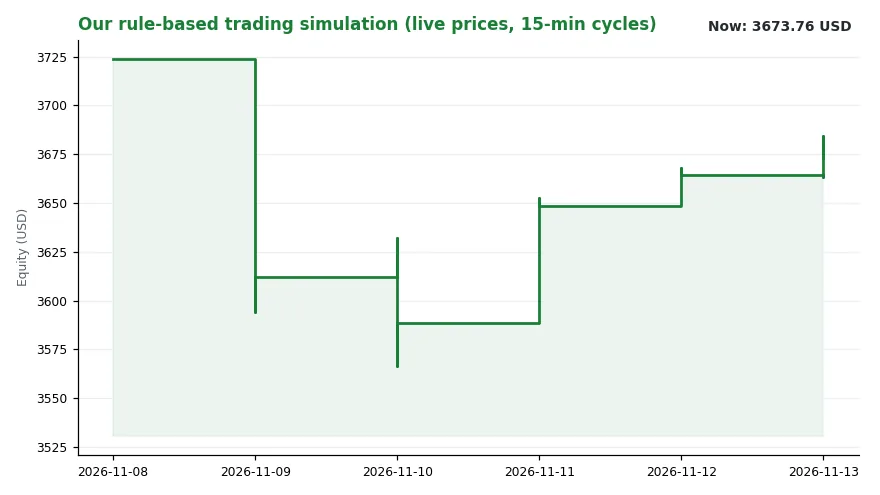
Our rule-based book mirrors that caution. Sim equity stood at 3,673.76 USD, up 0.26% versus the same time yesterday, with 1,839.73 in cash. The latest logged decision was to watch KWEB rather than act on it. The busiest signal channel on 12 November was “central banks”, with two events. The regime reading was trend=falling, level=3.63. A falling trend at a moderate level is a tape that punishes conviction and pays patience.
What actually landed
Into that tape came the release. UK GDP grew 0.7% in the three months to September [1]. Economists polled just months earlier had expected 0.1% [1]. The Office for Budget Responsibility had effectively pencilled in 0.3% at the Budget only three weeks before the number appeared [1]. Outside the pandemic, growth has not exceeded this rate since 2017 [1].
The vocabulary shifted with the data. Economists tracking the release reached for “Top gear” and “strikingly strong” [1]. Both are upgrades on “solid” and “resilient”, and a world away from “hardest hit by the Iran War” [1]. For scale: UK growth averaged less than 0.1% across the four July-to-September quarters since the pandemic [1].
The expectation gap is the story
Markets do not price the number. They price the number against the number they had already agreed to expect. A consensus of 0.1%, a fiscal forecaster at 0.3%, an outcome of 0.7% — the upside surprise was larger than the entire forecast. The report argues the figure should reset some of the “swirl of self-reinforcing negativity” around the UK [1].
That negativity had a rational basis, and the base has not vanished. The quarter was delivered against the largest disruption to global energy flows in the current cycle and against rising market borrowing costs [1]. The counterfactual — what the economy would have done without the Iran War, or with rate cuts instead of the recent rise — is unavoidable and unanswerable [1].
Where an Energy Bill Becomes a Mortgage Rate
Trace the mechanism. Energy prices feed household bills, petrol, and inflation expectations. Inflation expectations feed the rate path. The rate path feeds gilt yields, mortgage costs, and the discount rate every UK investment case is priced against. That is why the same release can call 0.7% impressive while flagging rising borrowing costs as the constraint [1]. Growth and the cost of money are pulling in opposite directions.
One gauge of external standing has already moved: sterling reached post-Brexit-referendum highs last week [1]. And beneath the headline, the quality signals improved. Productivity and investment look stronger after recent revisions, with the most encouraging figures in private-sector business investment [1].
Then there is the AI channel. Spending on AI and technology drove the surprise upside over the year, and the report warns that the data-centre boom may turn to bust at any point [1]. Our own tape shows that ambiguity in real time: NVDA down 4.34% but closing near its high, AAPL pinned near its low. The same outlet that carries the GDP story carries a headline about global stocks plunging as fears of a US AI slowdown spread to Asia and Europe [1]. The growth engine and the risk being repriced are the same engine.
Who wins, who loses, who decides
On our reading, the chancellor wins the week. The OBR’s 0.3% looks cautious. The UK’s own manufacturers get something harder to measure: a better backdrop for the investment decisions the report describes. At Nexeon in Oxfordshire, a battery maker is searching for a UK factory site for its EV technology [1]. In Maidenhead, British watchmakers are carving a niche against the Swiss [1]. Neither is built by a quarterly print, but both are easier to finance when the trend stops being downward.
Consumers are the swing actor, and they are already turning. Consumer confidence has fallen as petrol and domestic energy prices start to rise again [1]. The report names significant cost-of-living pressure in the coming months [1]. Construction and private house building remain depressed [1]. Households carried the third quarter; they are not obligated to carry the fourth.
The losers are the obvious ones and the quiet ones. Anyone whose mortgage resets against a rate path that has been rising rather than falling. Anyone whose business case needs cheap energy. And, at the margin, the credibility of a consensus that had grown comfortable with 0.1%.
What we watch next
Four things to watch, each genuinely uncertain.
First, the fourth quarter. The report is blunt that this may not last [1]. Household momentum is fading into the fourth quarter, and construction remains a drag. One quarter is data; two quarters is a trend.
Second, the Gulf. The Iran conflict remains the big unknown, and the question is whether a durable end to it is possible after the US midterm elections [1]. Some oil and gas production there is starting to normalise, which could pull down petrol prices, energy bills, government borrowing costs and mortgage costs together [1]. Downing Street is expected to invest heavily in a settlement, which the chancellor told the BBC is the “best economic policy” [1]. The energy channel is the one that sets what those central banks can do.
Third, the AI capex cycle. If corporate technology spending is a genuine investment wave, it supports growth and productivity. If it is a data-centre bubble, it flatters the growth numbers on the way up and subtracts on the way down [1]. Our regime reading — trend falling, level 3.63 — says the market has not made up its mind.
Fourth, the range positions. The close matters more than the move relative to yesterday. KWEB at 12% of range and BTC at 23% say risk appetite is still leaving the edges. NVDA at 95% of range says someone was buying the dip in the largest AI name on a red day. Those two facts can coexist for a while. They cannot coexist forever.