Nvidia’s CEO admitted an affair with a woman US intelligence suspected of being a Chinese asset. Our watchlist shows the market priced a governance problem, not a systems problem.
The tape came first
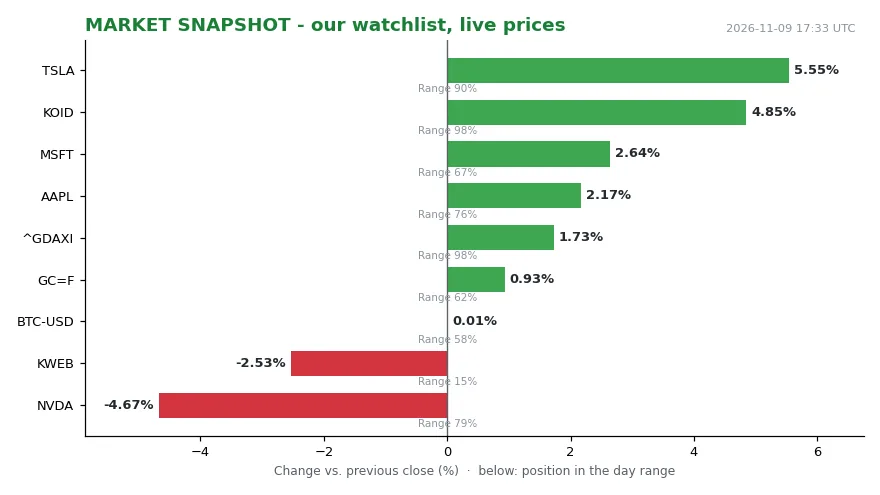
NVDA printed 177.42, down 4.94% on the day. It closed at 74% of the day’s low-to-high range. MSFT gained 2.57%, closing at 63% of the day’s low-to-high range. AAPL rose 2.19% and sat at 77% of the day’s low-to-high range. TSLA added 5.48%, near its high at 89% of the day’s low-to-high range. The DAX climbed 1.73% and finished at 98% of the day’s low-to-high range. KWEB fell 2.55% and ended at 13% of the day’s low-to-high range, close to the day’s low.
That is not a broad move out of risky assets. Gold added 0.98%, at 65% of the day’s low-to-high range. Bitcoin was flat at -0.05%, at 56% of the day’s low-to-high range. No safe-asset buying appeared, not in metals and not in crypto. The market treated this as a governance event at one company. It did not treat it as a systemic shock. The China leg said something separate. KWEB fell while US tech rose.
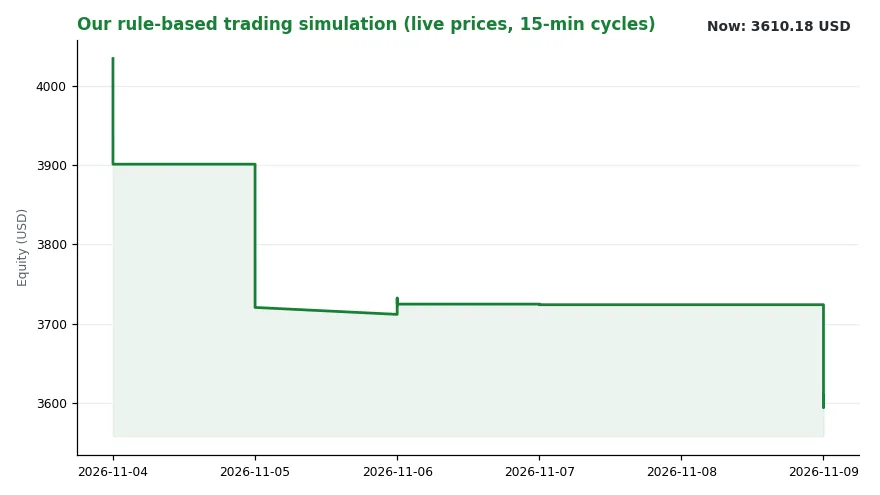
Our rule-based simulated portfolio stood at 3610.18 USD. That is down 3.06% against the same time yesterday. Cash was 1803.44 USD, roughly half the book. The latest logged decision was a BUY of MSFT at 541.23, against a live price of 544.24. It is time-stamped 16:38:49 on 2026-11-09. “Central banks” was the busiest signal channel, with two events. Our regime reading showed trend=falling at level 3.63. A half-cash book and a rotation into a non-Nvidia large-cap company is the same shape the watchlist shows.
The photograph and the timeline
There is a photograph from a June evening in Taipei. It was taken in a bar, after a technology trade show in 2024. It shows two people drinking whisky. One is Jensen Huang. The other is Alice Huang, a Megaspeed executive. Then it looked like a trade-show snapshot. Now it sits inside a board inquiry and a foreign-intelligence investigation.
The story did not begin on Sunday. Concern about Megaspeed was first reported last year. Megaspeed is a little-known Singapore-based datacentre company. It buys Nvidia chips. US officials worried it might be helping Chinese firms bypass export restrictions. The specific worry was rerouting of semiconductors to America’s chief AI rival. Nvidia’s line then was different. It called the CEO’s interactions with the Megaspeed executive “not unusual or unexpected”. It said Megaspeed had received “zero information relevant to national security”.
The turning point came last month. The New York Times reported a “close relationship” between the Megaspeed executive and the Nvidia boss. That executive was Huang Le, a Chinese citizen also known as Alice Huang. She is no relation to Jensen Huang. US intelligence worried she was a Chinese asset funnelling information to Beijing. Then came Sunday. Huang admitted the affair in a message to company employees. He wrote: “I was unfaithful to my wife. My actions hurt her and our children. There is no excuse for what I did. I am deeply sorry.” [1] Nvidia said it was initiating an independent investigation. It covers reporting that founder and CEO Jensen Huang has been the target of a foreign intelligence effort. The statement added: “While the board has no reason to believe that either national security or Nvidia secrets were compromised, the board’s inquiry will examine all available information.” Huang said he would “cooperate fully”. He added: “I love our country and our company”.
How the shock travelled through three channels
The first channel is governance. Nvidia is worth $4.5tn. Its chips underpin systems such as ChatGPT. Its CEO owns roughly 3.6% of the company. The Bloomberg billionaire index puts his fortune at $155bn, ranking him among the world’s ten richest people. Dan Ives said the scandal would result in “multiple congressional inquiries”. He also flagged removal risk. His words: “There is clearly risk that Jensen could be removed as CEO depending on the board investigation and this will add risk to the stock as he is so important to the Nvidia story and strategy globally.” That is the risk that one indispensable person’s departure damages the company, priced as a discount.
The second channel is government restrictions on technology sales. The Chips Act of 2022, a set of sweeping export controls, banned most advanced Nvidia chips from China. Under Trump the policy became more focused on cutting deals than on coherent export controls. Nvidia’s H20 chips were first banned, then allowed. The far more advanced H200 chip was later allowed too. Washington took a cut of the revenue. Nvidia’s Grace Blackwell chips remain banned. Megaspeed sits on that fault line: it buys the chips that Washington restricts.
The third channel is sentiment. US tech had a shaky start to the month. Anti-datacentre candidates did well in last week’s midterms. Neil Wilson described the transmission: “Nvidia is huge and at the heart of the AI supply chain, so what happens to this stock matters to the rest of the market. There is the potential for this story to knock sentiment, which is already pretty fragile.” Today’s tape keeps that damage inside one name.
Actors: who decides, who carries the cost
The board decides. In our reading, its inquiry is the largest single swing factor for the shares. Trump was reportedly briefed on US intelligence concerns about Nvidia a year ago, according to the New York Times, and did not act. He does not regret it: “No, I don’t think so. I think — you know, he’s an honourable guy. I think he probably has an excuse for it. You have to hear it.” Asked whether Huang stays as CEO, he said: “I think so. Oh yeah, sure.”
Xi Jinping is in the frame too. Trump is expected to meet the Chinese president next week. The Nvidia file may come up there. Megaspeed has retained outside counsel for an internal investigation. It says it has notified the US government that it is “fully committed to cooperating”. Its public position is unchanged: “Megaspeed is a Singapore-based company, operating fully in compliance with all applicable laws, including US export control regulations.” Investors are split in public. Bill Ackman called Huang an “incredible human”. Then he added: “I am hoping for a simple affair, not a risk to our national security.” Elon Musk replied “I agree” to a post by Sequoia’s Shaun Maguire. Maguire wrote that Huang “did something incredibly dumb” and that it was “bad for America”. He also wrote: “Jensen is irreplaceable for America’s AI leadership”.
The backdrop is a long history of US-China tech friction. The Center for Strategic and International Studies, a US think tank, has tracked hundreds of reported espionage cases. US companies have filed more than 1,200 intellectual property lawsuits. US tech has at times opened itself to this, as Apple’s heavy reliance on Chinese manufacturing partners shows. The Nvidia file is a new chapter in an old argument about industrial espionage.
Outlook: what we watch next
Three things are observable from here. First, what the board publishes, and whether the inquiry stays on governance or reaches national security. The board has said it sees no reason to believe secrets were compromised. That is current knowledge, not a conclusion. Second, whether Congress actually opens inquiries, and what they demand. Third, whether the Trump-Xi meeting touches government export restrictions in a way that moves the chip complex.
Our measurement supplies the frame. NVDA at 74% of the day’s low-to-high range after a 4.94% drop means selling was absorbed during the session. KWEB at 13% of the day’s low-to-high range means the China side was not absorbed. That gap is the story. One session cannot separate governance risk from espionage risk. We will keep marking the price gap between NVDA and the other large-cap stocks. We will also mark the price gap between US tech and KWEB.
The photograph from that Taipei bar has not changed. What surrounds it has. The market has begun to price that change. It did so one ticker at a time.
Quellen / Sources
[1] Jensen Huang, message to Nvidia employees, Sunday, via Guardian explainer. Nvidia board statement, via Guardian explainer. Neil Wilson, Saxo UK, via Guardian explainer. Dan Ives, tech analyst, via Guardian explainer. Bill Ackman, on X, via Guardian explainer. Donald Trump, remarks to press, via Guardian explainer. Shaun Maguire (Sequoia) and Elon Musk, on X, via Guardian explainer.
Megaspeed statement to Bloomberg, via Guardian explainer. Nvidia statement from the prior year, via Guardian explainer. Megaspeed statement to the New York Times, via Guardian explainer. Jensen Huang, via New York Times memo as cited in Guardian explainer. New York Times reporting, via Guardian explainer. [Own] Live watchlist and rule-based sim log, as of 2026-11-09 17:27 UTC. Educational documentation, not investment advice.
—