
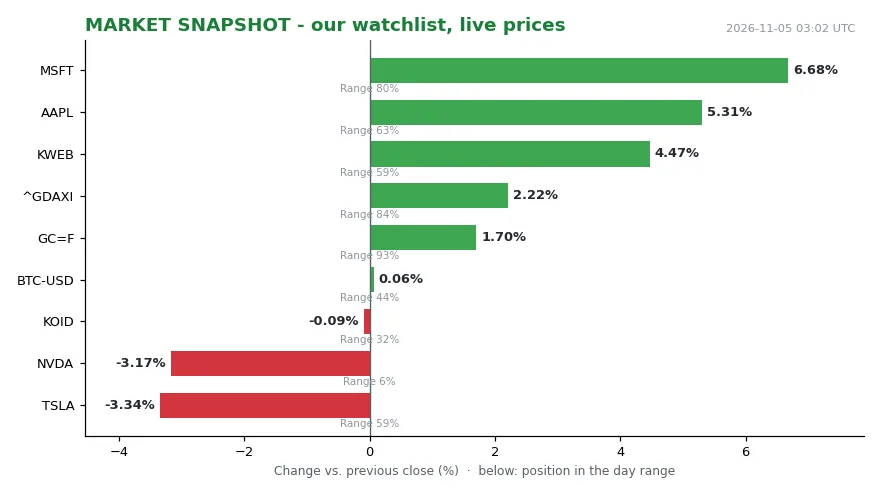
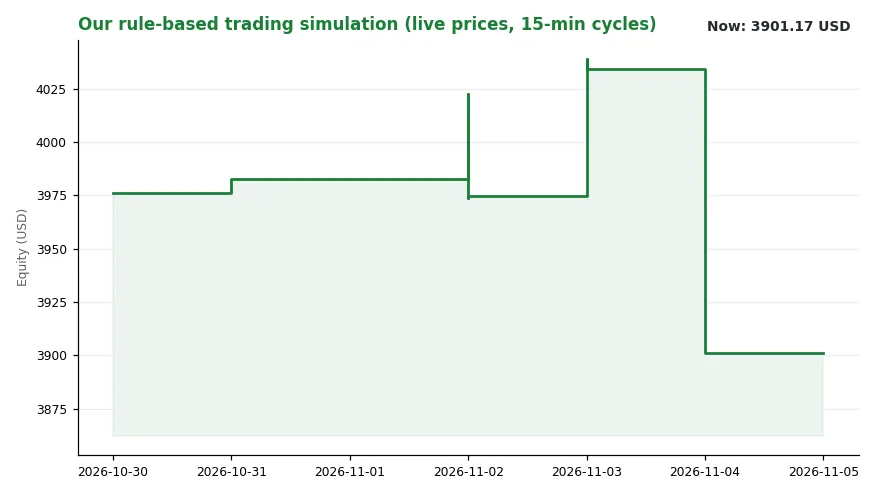
At 02:58 UTC on 5 November 2026 our watchlist showed a market that could not agree on what it was afraid of. NVDA printed 200.13, down 3.17% against the previous close and stuck in the bottom 6% of its daily range. TSLA fell 3.34% and stalled at 59% of its range. AAPL gained 5.31% and held 63% of its range. MSFT added 6.68% and pressed to 80%, near the day’s high. Gold, GC=F, traded at 4,147.10, up 1.82% and pinned at 99% of its range — the top of the session. Reading those five lines together, the pattern is rotation, not conviction: money leaving the chip and EV complex, money arriving in large software and in the metal that pays no coupon. Our simulated book stood at 3,901.17 USD, flat against the same time yesterday, with 1,963.91 parked in cash. The latest rule-based decision was a WATCH on KWEB at 0.00. The busiest signal channel was “central banks”, with a single event. Regime reading: trend falling, level 3.63. Not one of those figures measures how hard anyone works. That is precisely why the story underneath them is so difficult to price.
The Report and the Number That Moved
The Resolution Foundation has published a report arguing that the “quiet quitting” phenomenon — workers delivering the basic requirements of a job and refusing to do more — may be more than a social-media mood. Its survey of 4,656 adults found that the share willing to go the extra mile for their employer fell from 69% in 2015 to 55% in 2025. [1] That is a 14-percentage-point slide in a decade. The same survey found that the share of respondents not even “fairly” satisfied with their role has sunk to one in four, the lowest level on record. Only 63% describe their job as interesting, down from 74% ten years earlier. The report’s own summary of the trend is blunt:
“Workers today are indeed a little less committed to their employers, and a little less intrinsically drawn to work in general, than workers were a decade ago.” [1] — Resolution Foundation report
The think tank links this to the post-pandemic productivity slump. Output per hour already slowed after the financial crisis and weakened again after 2020, and the report argues the engagement shift “may have contributed” to that weakness. Hannah Slaughter, principal economist at the Resolution Foundation, framed it as a loss on both sides of the ledger:
“This is self-evidently bad for workers, but it also doesn’t bode well for productivity and labour supply, both of which are vital for lifting living standards in the years ahead.” — Hannah Slaughter, principal economist, Resolution Foundation
The Mechanism: Effort Has No Ticker
Productivity is output per hour worked. Hours are countable, contracts are written, wages are invoiced. Discretionary effort — the extra hour, the unanswered email at 21:00, the colleague helped without being asked — is none of those things. It is granted, not purchased, and it therefore never appears in a price. That is the channel the report proposes: if the marginal unit of effort becomes rarer, output per hour grows more slowly than investment and headcount alone would suggest. The report is careful with causality. It says its findings are “consistent” with quiet quitting rather than proof of it, and it locates the shift in material conditions rather than character. Workers are more focused on pay than a decade ago, which the report calls “perhaps unsurprising… given the flatlining living standards of the past decade”. The trend itself was popularised on social media shortly after the pandemic, in posts urging people to stop helping with additional tasks and to focus on “acting your wage”. A talking point became a measurement, and the measurement now has an economic interpretation attached to it.
Who Wins, Who Loses, Who Decides
Workers gain boundary protection in the short run and lose something harder to see in the long run, if Slaughter’s reading holds and weaker productivity and labour supply translate into weaker living-standard growth. Employers lose unpaid discretionary labour first and face a higher bar on recruitment and retention second. Governments and central banks lose the most convenient assumption in any forecast: that a given number of hours produces a predictably rising amount of output. The report’s co-editor pushes back explicitly against the cultural reading that has attached itself to the data. Sir John Curtice, politics professor and co-editor of the report, argues the analysis does not mean young people have “become more ‘work-shy’, nor have workers in general become more reluctant to change jobs”. His conclusion points at the employer’s side of the contract:
“But if workers are to be fully engaged in their work, it has seemingly become more important for employers to provide jobs that are both financially rewarding and have flexible work hours.” — Sir John Curtice, politics professor and co-editor of the report
That reframes the issue from a moral one to a pricing one. Engagement is not a personality trait that a cohort either has or lacks. It is a response to what a job offers in money and in time. Nothing on our tape this morning reflects that argument: NVDA sitting at the bottom of its range and gold at the top of its range tells us where risk appetite went today, not what British workers think about their managers.
What We Watch Next, and What We Do Not Know
Three things are observable from here. First, the next wave of the same survey: if the willingness-to-go-the-extra-mile figure keeps sliding from its current 55%, the “consistent with” hedge gets harder to maintain. Second, the productivity data that the report is trying to explain — a single quarter will not settle a decade-long trend, and the report dates the start of the slowdown to the financial crisis, with a further weakening after the pandemic. Third, wage settlements and the spread of flexible-hours arrangements, because Curtice’s argument predicts that employers who move on those dimensions should see engagement hold up better than those who do not. The honest caveats are large. This is a survey of 4,656 adults reporting their own attitudes, not a payroll audit. Attitude and effort are not the same variable. And “may have contributed” is a hypothesis about a national accounting residual, not a measured coefficient. Our simulated book is a documentation exercise, not a recommendation, and nothing here is investment advice.