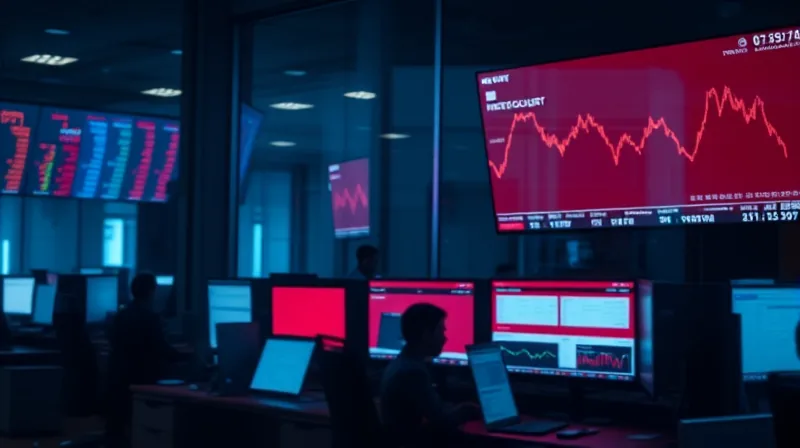
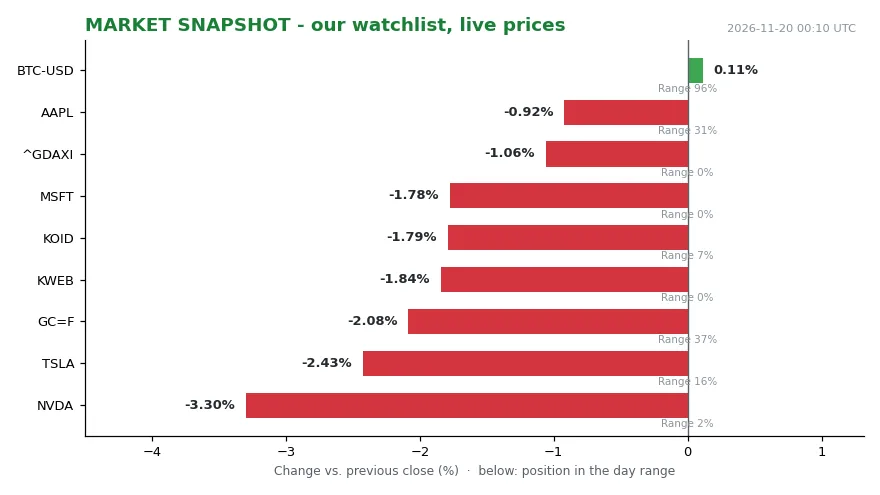
At 00:07 UTC on 20 November 2026, our watchlist read like one trade copied nine times. Nvidia stood at 145.98, down 3.30% against the previous close and pinned in the bottom 2% of its daily range (the distance between the day’s lowest and highest price). Microsoft printed 498.30, down 1.78% and sitting at exactly 0% of its range — the session low. The DAX was at 25,463.81, down 1.06%, also at 0% of range. KWEB, at 21.31, was down 1.84%, again at 0% of range. KOID at 30.70, down 1.79%, held in the bottom 7% of its range. Eight of the nine lines we track were lower. Only bitcoin was up, at 62,000.18, plus 0.15% and mid-to-high in its range at 75%. Gold, the usual hiding place, was down 2.13% at 3,607.00, mid-range at 33%. Our rule-based book carried 1,798.25 USD in cash against 3,589.70 USD of equity — a shade under half in dry powder, or cash held back and ready to be invested — and its last logged decision was a WATCH on KWEB, taken at 01:03:55.
The pattern in those numbers is breadth, not rotation — money moving out of one group of stocks into another. Many names, one direction, most of them closing near the floor of their own range and none of the classic hedges bid. That is the tape — the running record of prices during a session — that Anthropic’s first day as a public company walked into, and the coincidence of timing is what makes the session legible.
What actually happened
On the same day the wider technology sector fell 2.4%, the company behind the Claude AI chatbot closed 17% higher at $97.17 a share [1]. That gave Anthropic a market valuation of roughly $1.77 trillion, after the stock briefly carried a valuation above $2 trillion during trading [1] Three numbers, then, and each of them slightly awkward. A 17% first-day gain is a strong debut by any standard. A $1.77 trillion close is a valuation that puts the company among the largest listed firms in the world on day one. And a 2.4% fall in the wider tech sector on that same day means the enthusiasm was not ambient — it was specific to this name.
Three readings of a 17% pop
The first school reads the debut as conviction. Buyers were told what Claude does, what Anthropic earns, and what the AI build-out costs, and they still marked the shares up 17% from the offer. On this reading, public markets have just ratified the private-market view that frontier AI is a durable earnings story rather than a research project with a burn rate (how fast a company spends cash relative to what it earns).
The second school reads it as rotation. Money that had been parked in incumbent technology names found a new pure-play — a company whose business is a single theme, so its shares are a direct bet on that theme — and moved. The supporting evidence sits in our own data: Nvidia down 3.30% and within 2% of its range floor, Microsoft down 1.78% at 0% of range. The problem with this reading is that rotation usually leaves something bid. It rarely produces eight declines out of nine, and it does not normally drag gold down 2.13% at the same time.
The third school reads it as a novelty premium — the extra price paid for a new listing’s novelty rather than for its earnings. A company that trades above $2 trillion intraday on its first session and closes at $1.77 trillion has not been priced by fundamentals yet — it has been priced by attention. On this reading, the 17% is a first print — the first traded price/valuation of a new listing — rather than a verdict, and the interesting number is not the close but whatever the stock does once the debut tape stops running.
Which evidence wins? Honestly, ours cannot adjudicate between them, and anyone who claims otherwise is over-reading a single session. What our measurement does do is weaken the cleanest version of the rotation story and complicate the cleanest version of the risk-off story. A uniform drawdown across equities, with gold falling and bitcoin flat-to-firm, is not a textbook flight to safety. It looks more like a market trimming exposure broadly while one new listing absorbed a great deal of attention and capital on its own.
The mechanism, stripped down
Three channels carry a listing like this into the wider market.
The first is supply and demand for capital. A company valued at $1.77 trillion is large enough that it changes the arithmetic of any broad equity allocation.
The second is expectations. A debut is a public referendum on a thesis, and the thesis here is AI capital expenditure. When the debut pops 17% while the sector it belongs to falls 2.4%, the market is being asked a question it will have to answer repeatedly over the coming quarters: is this a new earnings stream, or a new valuation layer on top of an old one?
The third is the discount rate. Our signal layer — our internal label for the event channels in our book — recorded “central banks” as the busiest channel on 18 November, with three events.
Who gains, who pays, who decides
Anthropic and its existing shareholders gained, on paper, and gained a great deal: a 17% first-day move on a trillion-dollar base is an extraordinary amount of value created in a few hours of trading [1]. The company also gained something less quantifiable — in our reading, a public currency for future financing.
The incumbents on our watchlist lost, at least on the day. Nvidia’s 3.30% decline and Microsoft’s 1.78% decline both finished at or near the bottom of their ranges, which in our reading is the signature of selling that persisted into the close rather than a morning wobble that got bought. Tesla fell 2.43% and also finished in the lower part of its range, at 16%. Apple’s 0.92% decline was the mildest of the group and sat mid-range at 31% — both figures from our own watchlist, not from the debut coverage.
Whether that selling was positioning ahead of the listing or something broader is the next question the tape has to answer.
Our own book did not participate. The simulation holds roughly half its equity in cash, is down 0.03% against the same time yesterday, and chose to watch KWEB rather than act. That is a description of a rule-based process, not a recommendation — nothing here is investment advice, and this article is education, not a call to buy or sell anything.
What we watch next, and by when
The deadline is the US session of Friday, 20 November 2026, the first trading day on which Anthropic is no longer a debut. By the close of that session the novelty premium has to start earning its keep, and we will have a cleaner read on three things.
First, whether Microsoft climbs off the 0% of range floor and Nvidia off its 2% floor. A rebound would suggest the selling was positioning ahead of the listing; a continued slide would suggest something broader. Second, whether gold keeps falling while equities fall. That pairing is unusual and, if it persists, it says more about liquidity than about AI. Third, whether bitcoin holds the upper part of its range, currently 75%, as the one asset in our list that refused to join the retreat.
We hold these readings loosely. Nine tickers, one session, and a rule-based book that is essentially flat — that is a very small sample, and it would be dishonest to dress it up as a forecast. What the data does establish is narrow and useful: the debut absorbed attention while the broad tape sold off, gold failed to act as a hedge, and our own book stayed in cash rather than chase either side. New York Times live coverage of the Anthropic IPO, 19 November 2026. Our own market measurement, quotes fetched 20 November 2026, 00:07 UTC.