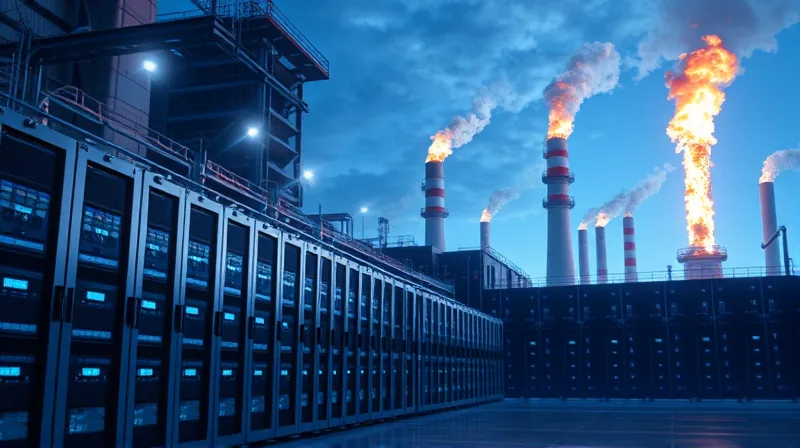
AI Data Centers Drive Surge in Natural Gas Consumption
The promise was elegant: artificial intelligence would optimize everything, including energy. Data centers would run leaner, smarter, cooler. The machines would think so we could consume less. Instead, in 2026, the AI race has done something almost comically opposite. It has turned the humble data center into one of the fastest-growing consumers of natural gas on American soil — a fuel source the tech industry once treated as a legacy problem, not a growth strategy.
The Forecast That Kept Doubling
BloombergNEF projected that U.S. data centers would consume about 18 billion cubic feet of natural gas per day by 2035. BloombergNEF That figure alone was staggering. Then came the revision. Nine months later, the same analysts nearly doubled their estimate. The reason was not a surge in AI capability or a breakthrough in model architecture. It was a simple admission: not every announced data center will actually get built, but enough will to blow past earlier assumptions. The forecast grew because the pipeline of projects is larger than the grid can absorb, not because the technology delivered something new.
The Onsite Power Illusion
Meta, Microsoft, Google, and Amazon have all announced plans for natural gas power plants built directly on data center campuses — bypassing the electric grid entirely, according to BloombergNEF. The move is framed as self-reliance, a way to avoid utility bottlenecks and keep AI training runs uninterrupted. By 2035, these onsite plants alone are expected to burn 2.9 billion to 3.4 billion cubic feet of gas per day, according to BloombergNEF That is roughly equal to what every data center in the country consumes today, including the gas burned to generate grid electricity. In other words, the “off-grid” solution does not reduce demand. It multiplies it, then hides the multiplication behind a fence line.
The Grid Is Not Spared
Onsite generation is the headline, but it is a rounding error compared to what happens on the grid. BloombergNEF predicts that grid-connected data centers will drive an additional 15 billion cubic feet per day of natural gas consumption by the power sector by the middle of the next decade, according to BloombergNEF That is five times more demand growth than every other grid-connected sector combined. The AI industry is not just building its own power plants. It is pulling the entire utility system into its appetite, forcing gas plants to run harder and longer to keep the servers humming.
The Price Nobody Voted For
For years, stable natural gas prices made this buildout look affordable. Analysts at Noreva now call that stability a false hope The combined pressure of data center demand and rising LNG exports could send prices soaring. Tech companies with trillion-dollar balance sheets can absorb the shock. Utility ratepayers cannot. The same households that never asked for an AI chatbot will pay more to heat their homes and run their appliances, subsidizing a technology that promised to make everything cheaper. The deception here is not malicious. It is structural. The cost is real, but it lands on someone else’s bill.
The Climate Math Is Brutal
Burning one cubic foot of natural gas releases the equivalent of 60 grams of carbon dioxide, counting extraction, processing, and distribution, according to the IEA The added demand from data centers will generate roughly 1 million metric tons more greenhouse gas pollution every day, according to IEA estimates. That is about 12% of total U.S. greenhouse gas emissions today — added on top of what already exists, not replacing anything. The AI industry’s climate rhetoric has always leaned on efficiency gains and renewable energy credits. But gas plants built to power AI do not care about credits. They burn molecules. The atmosphere does not distinguish between a training run and a transatlantic flight.
The Tool That Stopped Being a Tool
There was a moment — recent enough to remember — when AI was described as a tool. A calculator for language, a search engine that could think. Tools are supposed to reduce effort, lower costs, free up human time. But somewhere in the past few years, the tool became an infrastructure. It stopped being something you pick up and put down. It became something that must run continuously, at scale, consuming fuel around the clock. The moment a technology stops being a tool is the moment its costs stop being optional. AI crossed that line, and the gas bill is the receipt.
Efficiency That Increases Consumption
Every efficiency gain in AI has been met with a corresponding increase in usage. Smaller models, faster chips, better cooling — none of it reduced total energy demand. It only made more AI applications economically viable, which drove more demand. This is not a new phenomenon. It is the oldest story in energy economics: efficiency lowers the cost per unit, and lower cost per unit increases total consumption. The AI industry has reproduced this pattern with unusual speed. It markets efficiency while building gas plants. The two are not contradictory. They are the same strategy.

What the Buildout Actually Reveals
The frenzy is not a sign of confidence. It is a sign of fear. Companies are racing to build before competitors, before regulations tighten, before public patience runs out. The gas plants are not a long-term energy strategy. They are a hedge against uncertainty, a way to lock in power before regulators or utilities say no. The deception is not that AI is useless. It is that AI’s promoters have sold a story of weightlessness — cloud computing, virtual intelligence, dematerialized value — while the physical reality is pipelines, turbines, and emissions. The cloud, it turns out, is made of gas.
The Moment of Clarity
Understanding does not require a solution. It requires seeing the gap between the claim and the consequence. AI promised to optimize the world. Instead, it is optimizing its own consumption, at a scale that reshapes energy markets and climate math. The gap is not a bug. It is the design. A technology that appears to run on thought actually runs on fuel. The clarity is this: when a tool becomes infrastructure, it stops being neutral. It starts making demands. And right now, the demand is 18 billion cubic feet of gas per day — and rising.
Sources
1. BloombergNEF
2. Noreva
3. IEA