The Quiet Removal of the Human Archivist Role
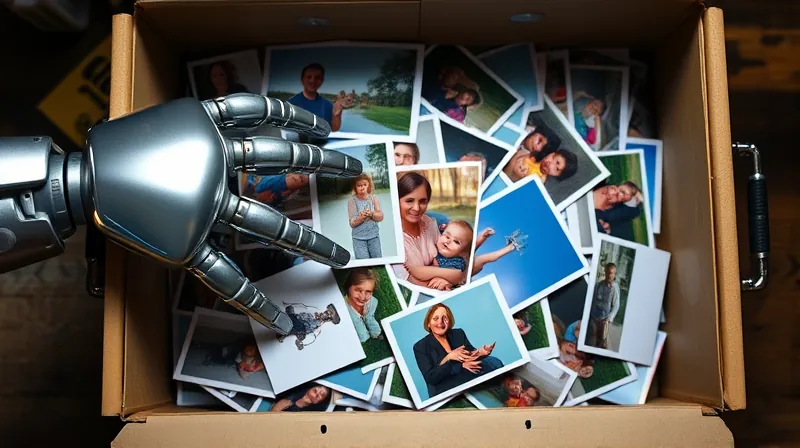
The announcement that Gemini Spark can now manage a Google Photos library is not really about photo albums. It is about the quiet removal of a human role that most people never noticed existed: the role of the family archivist, the person who curates, sorts, and decides which moments deserve to be kept. Google’s new capability, which lets its AI agent edit images, build shared albums, and even convert concert flyers into calendar appointments, performs this labor in seconds. The company frames it as convenience, but the deeper story is about how AI is systematically absorbing the small, judgment-heavy tasks that once required a person’s taste and attention.
The Invisible Work of Curation
Curation has always been a form of judgment. When someone sits down with thousands of photos, they are not just organizing files — they are making decisions about what matters, what gets shown to others, and what gets quietly forgotten. This is emotional work disguised as a chore. Google’s integration, announced by Photos lead Shimrit Ben-Yar, treats this process as a series of executable commands: edit, curate, share, schedule. The company’s own announcement frames these as time-saving tools, yet the underlying assumption is that algorithmic sorting can substitute for personal discernment The subtext is that human discernment in this domain is a bottleneck, not a value. By automating the archivist, the system declares that the skill of selecting meaningful moments is no longer a skill worth paying for.
The timing of this feature is telling. The broader AI industry has struggled to articulate why these tools matter beyond surface-level convenience, a gap that critics have repeatedly noted in recent coverage of major model releases Google’s response is not to tell a larger story about transformation, but to ship incremental features that solve problems people did not know they had. Making an album is not difficult, as the coverage of this launch notes. The difficulty was never the mechanics — it was the emotional labor of deciding which memories to elevate. By outsourcing that decision to an algorithm, Google is betting that efficiency will outweigh the subtle loss of personal authorship.

When a Task Becomes a Transaction
Consider what happens when a person asks Gemini Spark to create a shared album of “favorite shots.” The word “favorite” implies a history of context, inside jokes, and private significance that no prompt can capture. The AI will likely default to technical quality — sharpness, exposure, the presence of smiles — rather than the blurry photo of a grandmother laughing that means everything to one family. This is not a failure of the technology; it is a structural feature. The system must reduce judgment to a formula, and formulas cannot hold the weight of why a particular image matters. The role of the human archivist, once a quiet but essential keeper of narrative, becomes a transaction between user and interface.
The competitive pressure in the AI industry accelerates this shift. Companies cannot wait to announce a coherent vision; they must promote every integration, no matter how small, to stay relevant. The rollout to U.S. subscribers of Gemini AI Pro and Ultra follows this pattern, presenting a checklist of new tasks rather than a coherent vision of how these capabilities change daily life There is no broader narrative about how AI has improved the software, only a list of tasks it can now perform. The absence of a story is itself a story — the industry is so focused on demonstrating utility that it has forgotten to explain why utility should replace human effort in the first place.
The Unspoken Cost of Convenience
The real cost of this feature is not the subscription fee. It is the gradual erosion of the belief that personal judgment has value. When a machine can assemble a photo album, the act of assembling loses its status as a meaningful human activity. This is how roles disappear — not through dramatic layoffs, but through the quiet absorption of tasks into automated systems. The family historian, the person who remembered to take the photos and later chose which ones to print, becomes an optional participant in their own memory-keeping.

The integration with Google Photos is a small step in a larger pattern. Each new capability — editing images, curating albums, turning flyers into appointments — chips away at a different human skill. None of these tasks individually seems revolutionary on its own. Together, they paint a picture of a future where the question “What should I keep?” is answered by a prompt, not by a person reflecting on their life. The industry calls this progress. The unspoken implication is that progress has a direction, and it points away from the messiness of human choice.
What remains unsaid in this launch is perhaps its most telling feature. There is no acknowledgment of what is lost when an AI decides which moments are worth sharing, nor that the act of sorting through photos is often how people process their own histories. The feature is presented as a utility, like a dishwasher or a vacuum cleaner. But memory is not dishes, and the decision of what to remember is not a chore. It is a definition of self. The AI does not just manage photos — it manages the story a person tells about their own life, doing so without being asked to understand what that story means.
Sources
1. Google
3. Gemini AI