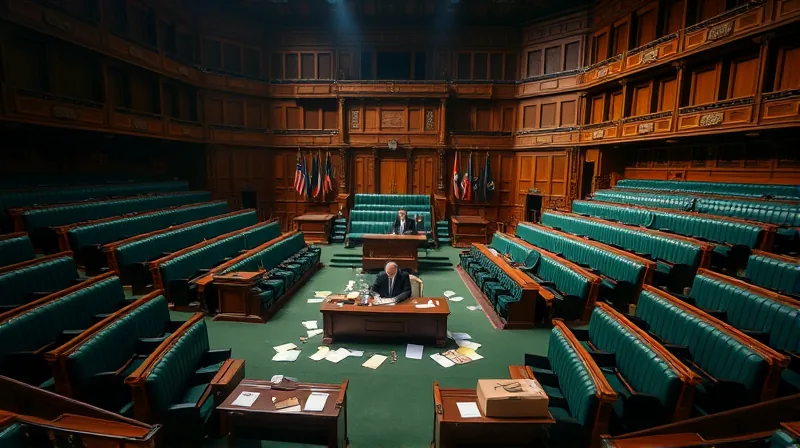
AI writes 15% of UK parliamentary statements without disclosure
There is a specific kind of deception that does not announce itself. It does not wear a mask or tell a lie with bold confidence. Instead, it hides in plain sight, dressed in the ordinary language of competence. By 2026, roughly 15% of UK parliamentary statements contained at least one AI-generated paragraph, according to the researchers, and the most unsettling part is not the presence of the technology. [1] It is the silence around it. Not one flagged document disclosed its use, which means the deception was not an accident of oversight but a systemic feature of how modern governance now operates.
The gap between what AI appears to do and what it actually does has never been wider. On the surface, these tools seem to offer efficiency, a helpful assistant drafting routine correspondence and legislative motions. In practice, they have become invisible co-authors of democratic deliberation, shaping the very text that becomes law without ever appearing on a ballot. The deception is structural: the technology presents itself as a neutral tool while quietly eroding the chain of accountability that connects voters to their representatives. When a citizen reads a parliamentary statement, they assume a human mind shaped every argument and weighed every word. That assumption, it turns out, is increasingly false.
The Numbers Don’t Creep – They Sprint
Sweden’s trajectory tells you everything about how fast this is moving, and the pace should alarm anyone who believes institutional change happens slowly. In 2022–23, a mere 0.1% of Swedish motions were fully AI-written, while 1.7% contained AI-assisted paragraphs. Those figures felt like curiosities, statistical footnotes that could be dismissed as early-adopter experiments. By 2025–26, the landscape had transformed: 6.5% of motions were fully AI-written, and 9.4% — roughly 300 motions — contained at least one AI-assisted paragraph. The growth did not creep; it sprinted, doubling and redoubling within a single parliamentary cycle.
The United Kingdom tells a parallel story with its own troubling accents. By 2026, 2.1% of texts were classified as predominantly AI-written, a figure that might seem modest until you consider what it represents in human terms. Fifteen percent of parliamentary statements contained at least one AI-generated paragraph, which means nearly one in six documents carried language that no elected official actually composed. The researchers from Chalmers University of Technology in Sweden and Edinburgh Napier University scanned 13,565 Swedish parliamentary motions and 4,209 British statements filed between 2021 and April 2026, and their finding was not merely that AI is writing laws. [1] The discovery was that zero flagged documents carried any disclosure of AI involvement, a perfect record of non-transparency that speaks to either profound negligence or deliberate concealment.
“Regardless of the extent to which AI has been used, there may be risks associated with a lack of transparency,” said Minerva Suvanto, lead researcher at Chalmers University of Technology. [1] That cautious academic phrasing masks a deeper problem: the deception is not just about who wrote the words but about whether anyone can verify the reasoning behind them. When a politician submits a motion they did not fully compose, they are essentially signing a document they cannot defend line by line. The technology promises assistance and delivers substitution, and the difference between those two outcomes is where democratic accountability quietly dies.
The Detection Method That Caught the Ghost
Understanding how researchers identified this hidden influence requires examining the detection method itself, which is as clever as it is revealing. The team trained custom AI detectors — separate models for Swedish and English — on pre-ChatGPT parliamentary texts versus LLM-generated political content, then applied them to documents from 2021 onward. The approach avoided the naive trap of looking for suspicious vocabulary or telltale phrases, because such linguistic fingerprints rarely survive contact with sophisticated language models. Instead, the system read statistical patterns across whole passages, detecting the subtle rhythms and probability distributions that distinguish machine text from human composition.
The detectors registered only one false positive per country on pre-AI material, a remarkable accuracy that lends credibility to the findings. Chalmers professor Mattias Wahde notes that “individual words are not AI words,” meaning the system does not flag a document because it contains “delve” or “moreover” or any of the clichés that once marked machine writing. Modern language models have grown too sophisticated for such crude detection. The statistical signatures are now embedded in sentence length variation, clause complexity, and the predictable ways ideas transition from one to the next. It can show where AI influence appears, but cannot identify which tool produced the paragraph, leaving a forensic gap that will only widen as models improve.
The public admissions from political leaders reveal a strange disconnect between voluntary transparency and routine practice. Swedish Prime Minister Ulf Kristersson openly admitted in August 2025 that he uses ChatGPT and French chatbot LeChat as a “second opinion” on political questions, presenting himself as a modern leader embracing useful technology. Green Party MP Jan Riise said he was not surprised by the study, confirmed his party uses AI for research, and called for mandatory labelling. These high-profile confessions create an illusion of openness, suggesting that AI use in politics is a matter of individual choice and public discussion. The reality, as the data shows, is that anonymous AI drafting happens routinely inside legislative documents, buried beneath layers of procedural formality where no one thinks to look.
The Real Risk Is the Polish
Well-written AI text does not just slip past readers; it can slip past the politicians who submitted it, which makes the deception doubly effective. Suvanto warns that AI-generated passages are “often very well-written and persuasive,” meaning errors “will not even be spotted by the writers themselves.” This is a specific kind of danger, one that inverts our usual assumptions about machine failure. We tend to worry about obvious mistakes, the garbled sentence or the nonsensical claim that exposes the algorithm’s limitations. The real threat is polished prose that looks authoritative while concealing flawed reasoning or factual gaps, prose so smooth that it disarms the critical faculties of everyone who encounters it.
The persuasive quality of AI text creates a feedback loop that amplifies the original deception. A politician receives a draft that reads beautifully, with arguments that flow logically and language that sounds confident and informed. Because the text appears competent, the politician submits it without the careful scrutiny they would apply to a colleague’s rough draft. The document enters the parliamentary record, becomes part of the official discourse, and shapes policy debates with reasoning that no human actually vetted. Europe’s AI regulatory frameworks are still catching up to this reality, and the researchers note the problem extends far beyond parliamentary motions into broader democratic processes.
When elected representatives’ voices blend imperceptibly with a language model’s output, the question is not just who wrote the speech but whether anyone is accountable for what it says. Traditional democratic theory rests on the assumption that representatives can be held responsible for their words and votes, that constituents can evaluate the reasoning behind decisions and punish or reward accordingly. That assumption dissolves when the words emerge from a statistical pattern-matching system that no one fully understands and no one can interrogate. Until disclosure requirements, audit trails, or watermarking standards arrive, voters have no reliable way to find out whether their representatives are speaking their own minds or reading machine-generated scripts.
The Accountability Vacuum
The historical context makes this moment particularly fraught, because parliamentary language has always carried an implicit promise of human authorship. When the UK Parliament began publishing its proceedings in the nineteenth century, the act of recording speech carried an assumption that the words belonged to the speaker, that they reflected genuine deliberation and considered judgment. That assumption persisted through radio broadcasts, television coverage, and digital publishing, surviving every technological shift because the underlying relationship remained intact. AI has broken that chain in a way that earlier technologies never did, because it does not merely transmit human speech but replaces it with something that mimics human speech without any human intention behind it.
The deception operates at multiple levels simultaneously, which is what makes it so difficult to counter. At the surface level, AI text deceives readers who believe they are reading a human author’s considered thoughts. At a deeper level, it deceives the politicians who submit it, convincing them that the text represents their own views when they may not have examined every implication. At the deepest level, it deceives the entire political system, which continues to function as if accountability mechanisms still work when the inputs to those mechanisms have been fundamentally altered. Each layer of deception reinforces the others, creating a structure that resists correction because no single actor has both the incentive and the ability to expose the whole.
The researchers’ findings suggest that this is not a problem that will solve itself through technological improvement, because the technology is improving in ways that make detection harder rather than easier. Each new generation of language models produces text that is statistically closer to human writing, reducing the signals that current detectors rely on. The window for establishing transparency standards is closing, and the political will to act seems inversely proportional to the urgency of the problem. Politicians who benefit from AI assistance have little incentive to regulate it, and voters who cannot detect its presence have no way to demand change.
The Image That Haunts
Consider the image that emerges from this research: a parliamentary chamber filled with polished speeches, each one legally attributable to an elected representative, each one carrying the full weight of democratic authority. Somewhere in the middle of those speeches are paragraphs that no human mind conceived, arguments that no human reasoning validated, and claims that no human fact-checker reviewed. The words flow smoothly, persuasively, with the confidence of genuine conviction, and they are indistinguishable from the words that surround them. The deception is not that the AI is pretending to be human. The deception is that the system is pretending the distinction does not matter.
This is why the problem is harder than it looks, harder than any technical solution can address. Watermarking could identify AI text, but only if politicians choose to use AI tools that include watermarks. Disclosure requirements could force transparency, but only if politicians are willing to admit they did not write their own submissions. Audit trails could trace the origins of specific passages, but only if someone has the authority and the will to conduct the audits. Every solution depends on human actors who currently benefit from the lack of transparency, which means the deception is not merely technological but structural, embedded in the incentives of the political system itself.
The ghost in the legislative machine is not a malfunction or a bug. It is a feature that emerged organically from the intersection of powerful technology, busy politicians, and a democratic system that has not yet adapted to the possibility that its words might not be its own. The research from Chalmers and Edinburgh Napier has exposed the phenomenon, but exposure alone cannot fix it. The question that remains is whether democratic institutions can develop the self-awareness to address this challenge before the deception becomes so complete that no one remembers what authentic political speech sounded like.