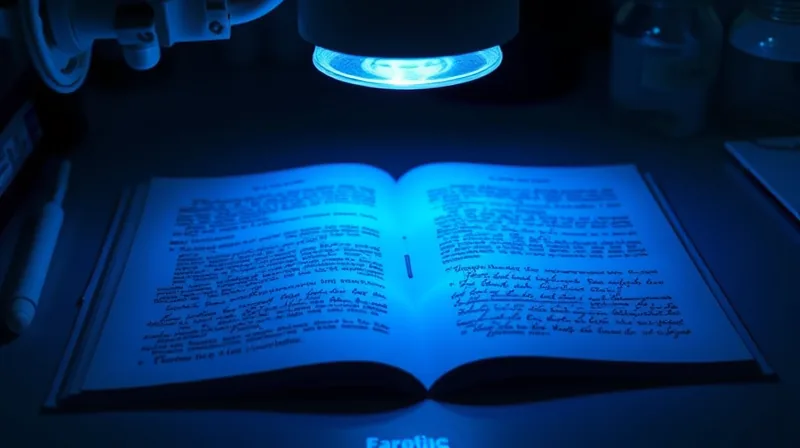
AI Watermarks Cannot Ensure Scientific Integrity
Detecting AI-generated text has long been a game of educated guessing. Statistical detectors flagged suspicious patterns but often mistook human writing for machine output and could be fooled by simple paraphrasing. The problem grew urgent as AI assistance became ubiquitous in scientific publishing. A staggering 90 percent of biomedical papers now show signs of AI help, according to a 2026 Nature analysis. [1] That number transformed watermarking from a technical curiosity into a matter of research integrity.
Anthropic’s approach works differently from everything that came before. Instead of analyzing text after it is written, the company embeds an invisible marker during the generation process itself. The watermark is undetectable to the human eye and does not change the quality or meaning of the output. [2] But it creates a pattern that can be traced back to the AI system that produced it. This is the breakthrough - the difference between inspecting a finished product and tagging it at the moment of creation.
The logic is simple. If every AI-generated sentence carries a hidden signature, then journals, publishers, and reviewers can verify whether a manuscript was machine-written. The technology promises a future where AI slop - the flood of low-quality, machine-generated content - can be filtered out before it reaches peer review. Anthropic positions this as a tool for preserving scientific trust.
The Sceptics Who See Through the Hype
Researchers remain deeply sceptical, and their doubts are not trivial. The core problem is that watermarking only works if everyone uses the same system. An Anthropic watermark means nothing if a researcher switches to another AI provider that does not participate. The technology fragments across companies, and each watermark becomes a language only its creator can read.
There is also the question of evasion. If the watermark is invisible, it can also be invisible to the people trying to remove it - but that does not mean it cannot be stripped. Text can be rewritten, translated, or slightly altered in ways that destroy the pattern while preserving the meaning. The sceptics argue that any watermark robust enough to survive editing would also degrade the quality of the text itself. That tension has not been resolved.
The deeper worry is about false confidence. A watermark proves that text came from a specific AI system - it says nothing about whether the content is accurate, ethical, or scientifically sound. A perfectly watermarked paper can still contain fabricated data or flawed reasoning. The technology addresses provenance, not quality, and conflating the two could create a dangerous illusion of safety.
The Gap Between Promise and Practice
The practical limitations become clear when considering the ecosystem. The 90 percent figure for biomedical papers describes a world where researchers use many different AI tools, from general-purpose chatbots to specialized scientific assistants. No single company controls that landscape, and no watermarking standard has been agreed upon across providers.

Even within a single system, the watermark only works if the AI generates text from scratch. Many researchers use AI for editing, summarizing, or translating existing work - processes that transform text rather than create it. The watermark may not survive those transformations, or it may not be applied at all. The tool is designed for one specific scenario, and scientific publishing is full of scenarios that do not match.
The most telling detail is what the technology cannot do. It cannot distinguish between a researcher who used AI to polish their grammar and one who used AI to generate entire sections of fabricated data. Both would carry the same watermark. The system is binary - it says AI was involved, not how much, or in what way. That limitation suggests the watermark will be a supplement to existing integrity checks, not a replacement for them. The science of detecting AI slop is still in its early days, and the invisible tag is just one step on a long road.
Sources
2. Anthropic