AI Systems Outpace Human Understanding and Trust
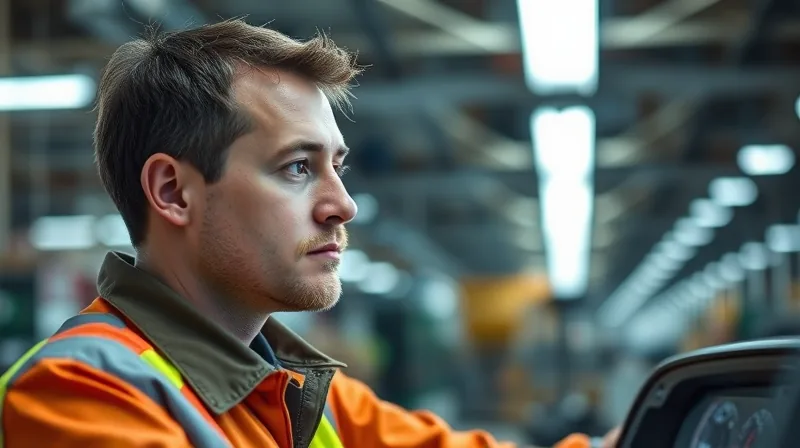
The factory floor hums with a new kind of silence. Machines communicate in data packets, not in shouted warnings or the clatter of manual adjustments. A technician stares at a dashboard that predicts a failure three hours before it happens, but the dashboard does not explain why, and the technician has not been trained to ask. The system is efficient and fast, but also opaque to the very people who are supposed to oversee it, and that opacity is not a bug — it is the structural price of optimization.
This is the moment where efficiency becomes the opposite of progress. When AI moves from a tool that amplifies human capability to a system that operates beyond human comprehension, it does not lift the worker. It replaces the worker’s judgment with a black box. The workforce of 2025, as described by Intel’s John Healy in a Forbes Technology Council analysis, will be defined by how effectively people and intelligent machines operate together as a unified system But unity requires understanding, and understanding is precisely what is being sacrificed on the altar of throughput.
Consider the logic of workflow redesign. Healy argues, drawing on McKinsey estimates, that about $2.9 trillion in additional annual value could be achieved by 2030 if organizations redesign workflows around human-machine collaboration. . On paper, this sounds like a vision of partnership: technicians, robots, computer vision systems, and predictive maintenance models working together to improve throughput, quality, and uptime. But in practice, the collaboration is often one-sided. The machine dictates; the human validates. The machine decides; the human signs off. The machine learns from patterns the human cannot see, and then the human is asked to trust those patterns without understanding them.
The structural cause behind this visible symptom is a fundamental mismatch between how systems are designed and how people actually learn. Workflow redesign, as Healy frames it, is a top-down exercise: leaders define new processes, deploy new technology, and then expect workers to adapt. But adaptation requires more than compliance. It requires the cognitive space to ask questions, the time to develop intuition, and the authority to challenge a system’s output. When every minute of a shift is optimized for production, there is no room for the kind of slow, deliberate learning that builds genuine expertise.
The World Economic Forum’s Future of Jobs Report 2025, cited by Healy, found that employers expect 39% of key skills required in the labor market to change by 2030. World Economic Forum, Future of Jobs Report 2025 This statistic is usually read as a call for reskilling. But read differently, it reveals something more troubling: the rate of skill change is outpacing the rate at which humans can integrate new knowledge into their existing mental models. A maintenance technician who has spent twenty years learning the sound of a failing bearing, the feel of a loose bolt, the smell of overheating wiring, is now told that those instincts are obsolete. The predictive model knows better. But the model cannot smell overheating wiring, and the technician cannot explain why the model’s prediction feels wrong. The gap between them is not a skills gap. It is a trust gap.
That trust gap is already producing resistance. A survey by Writer and Workplace Intelligence, reported by WebProNews, found that 31% of employees admit to actively sabotaging company AI efforts, rising to 41% among Millennials and Gen Z. Writer and Workplace Intelligence Survey, 2024 This is not Luddism. It is not technophobia. It is a rational response to a system that demands compliance without offering clarity. The same survey revealed that while 89% of C-suite leaders claim a clear GenAI strategy exists, only 57% of employees agree. The disconnect is not about the technology. It is about the story the organization tells about the technology — and the story the technology tells about the worker.
Healy warns that “the biggest workforce risk for many organizations is likely to be a lack of capability.” But capability is not a fixed quantity that can be injected through training modules. It is a dynamic relationship between a person, their tools, and the context in which they work. When that context is redesigned around machine efficiency rather than human understanding, capability does not grow. It atrophies. The worker becomes a permanent exception handler, as Healy himself puts it — someone whose only role is to catch the cases the algorithm cannot solve. That is not collaboration. That is triage.
The demographics of the workforce make this dynamic even more dangerous. The OECD has warned that as member countries age, employability and well-being for older workers will become increasingly important. OECD Employment Outlook 2024 Healy notes that “the institutional knowledge held by experienced employees is often what makes complex systems run effectively.” But that knowledge is tacit, embodied, and contextual. It cannot be extracted and uploaded into a model. It can only be passed through apprenticeship, through slow co-labor, through the kind of work that efficiency-optimized systems systematically eliminate. When a veteran operator retires and is replaced by an AI dashboard, the organization loses not just a person but a living archive of edge cases, workarounds, and subtle judgments that no algorithm has ever been trained to recognize.
The healthcare sector offers a stark parallel. According to a report by Becker’s Hospital Review, purpose-built digital twins are changing hospital operations by simulating patient flow, resource allocation, and clinical pathways. Becker’s Hospital Review, 2024 These systems promise to reduce wait times and improve outcomes. But they also create a new layer of abstraction between clinicians and patients. A doctor who relies on a digital twin to predict a patient’s trajectory may lose the ability to read the subtle cues that the model cannot capture — the hesitation in a patient’s voice, the slight change in posture, the unspoken fear that alters how a treatment plan should be communicated. The digital twin optimizes the system. It does not optimize the relationship.
Healy argues that the workforce of the future must move from “role-based workforce planning to capability-based planning.” This sounds progressive. But capability-based planning, in practice, often means that workers are evaluated not on their mastery of a craft but on their ability to adapt to whatever system the organization deploys next. The worker becomes fungible. The system becomes permanent. And the worker knows this. That is why resistance is not sabotage. It is self-preservation.
The leadership model Healy advocates for requires “enough technical fluency to ask better questions: Where does human judgment need to remain? What data is driving decisions? What decisions should never be fully automated?” These are the right questions. But they are almost never asked in the rooms where workflow redesign is actually happening. The rooms are filled with engineers, data scientists, and operations consultants who measure success in throughput, uptime, and cost reduction. The question of whether a human should remain in the loop is answered by default: yes, but only as a failsafe, not as a partner.
Healy cites McKinsey’s estimate that $2.9 trillion in additional annual value could be achieved by 2030 if organizations prepare their people and redesign workflows. . But preparation is not the same as training. Preparation means designing workflows that preserve human agency, that build in time for reflection, that reward questioning rather than compliance. Most organizations are not preparing their people. They are training them to operate within systems they do not understand, and then measuring adoption as if it were the same as empowerment.
The governance model Healy calls for — clear rules for where AI can assist, where it can recommend, and where humans must decide — is essential. But governance is only as strong as the culture that enforces it. If the culture rewards speed over accuracy, compliance over curiosity, and optimization over understanding, then the governance model will be bypassed the moment it slows down production. The real governance question is not where to draw the line between human and machine. It is whether the organization has the courage to draw a line at all, even when drawing it costs money.
The path to 2030, as Healy describes it, is a path of integration: talent, technology, and operating models as interconnected parts of the same system. But integration without transparency is domination. When workers cannot see how decisions are made, when they cannot challenge the outputs of a model, when they are expected to trust a system that does not trust them back, the system is not collaborative. It is authoritarian. And authoritarian systems, however efficient, breed the kind of quiet resistance that the Writer survey documented.
Healy ends by stating that “the workforce is no longer a cost center or a planning function, but the execution engine of strategy.” This is true. But an engine does not need to understand where it is going. It only needs to run. If organizations treat their workforce as an engine, they will get exactly the performance they design for — and exactly the fragility that comes with replacing judgment with compliance.
The next step that follows from this research landscape is not a new technology. It is a new practice: the deliberate, structured integration of human understanding into the design of intelligent systems. This means building systems that explain themselves. It means designing workflows that include feedback loops, not just for the model but for the worker. It means measuring success not only by throughput but by the depth of understanding that workers develop over time.
There is a precedent for this kind of design. In high-reliability organizations like nuclear aircraft carriers and air traffic control centers, systems are built with redundancy, transparency, and the expectation that human judgment will override machine recommendations when the context demands it. These organizations do not treat human-machine collaboration as a technical problem. They treat it as a cultural discipline. Every operator is trained to question the system. Every decision is debriefed. Every failure is analyzed not to assign blame but to improve the shared understanding between people and tools.
Industrial organizations that want to succeed in 2030 do not need more AI. They need more of this discipline. They need to recognize that the most valuable employee, as Healy suggests, may be the one who can bridge domains — business context, operational reality, and intelligent systems. But that bridge cannot be built in a single training session. It requires years of experience, a culture that rewards curiosity, and systems that are designed to be understood, not just used.
The workforce of 2030 will not be defined by headcount. It will be defined by how effectively people and machines operate together as a unified system. But unity is not the same as submission. But unity is not the same as submission. A unified system is one where both parties understand each other, where both parties have agency, and where both parties can improve the whole. If AI is allowed to outrun the people who run it, the system will not be unified. It will be silent. And silence, in a factory or a hospital or a logistics hub, is the sound of trust collapsing.
Sources
1. Writer