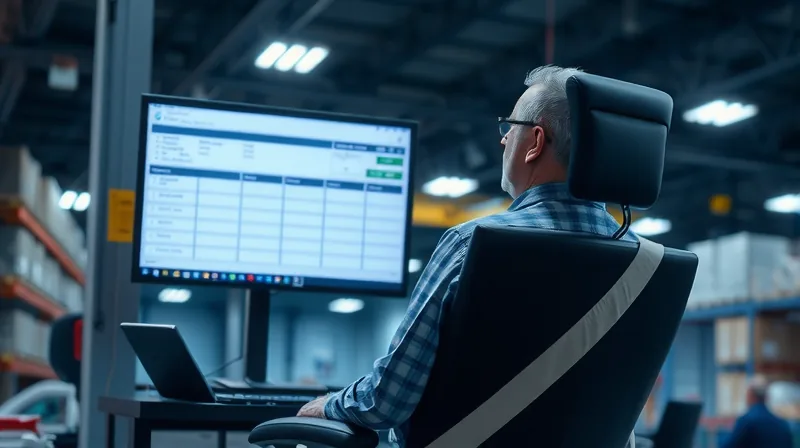
AI quietly making human judgment optional
Meta commentary - no external expert source; basis: Techcrunch (2026-09-23). #MetaSynapsis
The first time a logistics manager approved a routing decision she did not understand, nothing broke. The trucks arrived. The packages got delivered. The spreadsheet balanced. That is the moment efficiency becomes the opposite of progress — not when the system fails, but when it succeeds so smoothly that no one notices the human has already been subtracted from the equation.
The Pilot That Never Ends
Enterprise AI has a strange pathology. Some companies extract measurable value within months. Others run pilots for a year and a half, then run them again. The difference rarely comes down to model quality or compute budget. It comes down to whether anyone can articulate what the human still does that the machine cannot.
When an AI system handles a workflow end to end, the person who used to own that workflow does not disappear. They become a supervisor of something they no longer control. They approve outputs they did not generate. They sign off on decisions whose logic lives in weights they will never inspect. The role survives. The skill does not.
This is not a failure mode anyone planned for. It is a success mode nobody examined.
Permission Without Understanding
An agent that can take action inherits every permission its human counterpart once held. It reads the database. It sends the email. It moves the money. The security conversation around agentic AI tends to focus on what an agent should be allowed to do. The harder question is what happens to the person who used to decide whether it should.
Application-level permissions assume a human at the end of the chain. When the agent acts, the human becomes a notification recipient. They see what happened after it happened. Their judgment — the thing that justified their salary — arrives too late to matter.
The infrastructure problem is real. The architectural problem is real. But underneath both sits a quieter displacement: the person whose expertise was knowing when not to act.
The Correlation Trap

AI systems excel at finding patterns. They are less reliable at distinguishing a pattern that predicts an outcome from a pattern that merely accompanies it. A model trained on historical loan approvals will learn which applicants got approved. It will not learn why. It will reproduce the reasoning of the past without understanding the reasoning at all.
When a human loan officer overrides the model, they bring context the training data never captured — a local recession, a policy change, a borrower’s unusual circumstances. When the override rate drops because the model is “usually right,” that context stops entering the system. The model becomes more confident. The organization becomes less capable of knowing when it is wrong.
The judgment was not automated. It was abandoned.
When the Stakes Leave the Screen
Physical AI raises the cost of this abandonment. A recommendation engine that makes a bad call produces a bad recommendation. A robot that makes a bad call produces a collision. An autonomous vehicle that misreads a situation produces consequences that cannot be rolled back with a patch.
Companies working on defense systems, industrial robotics, and autonomous transport have developed safety cultures that treat human oversight as a non-negotiable layer. But oversight is not the same as judgment. A human monitoring a system they cannot fully understand is not exercising authority. They are performing the appearance of authority while the real decisions happen elsewhere.
The safety culture becomes a ritual, the ritual a formality, the formality a liability shield.
The Data Gap Nobody Closes
Robots lack the training data that made language models possible. There is no internet-scale corpus of physical interactions. Every grasp, every step, every recovery from a near-fall has to be generated, simulated, or collected in the real world. This is framed as a technical bottleneck. It is also a human one.
The people who know how to move through unpredictable physical space — warehouse workers, drivers, technicians — hold knowledge that does not transfer to training pipelines. Their expertise lives in their hands, their timing, their ability to feel when something is off. When those roles are automated, the knowledge leaves with them. The robot does not inherit it. The robot inherits a dataset that approximates it.
The approximation works until it does not — and when it does not, the human who could have caught the error is no longer in the building.
The Approval That Means Nothing
Enterprise procurement has learned to ask about security, governance, and observability. These are the right questions. They are also questions that can be answered without addressing the human redundancy underneath.
A system can be secure and still make its operators superfluous. It can be governable and still leave no one capable of governing it. It can be observable and still hide the moment when judgment quietly exited the process.
The founders building these systems are not villains; they are solving real problems under real constraints. But the problems they are solving include the problem of the human who used to solve them. That is not a side effect. That is the product.
The Detail That Remains
At a conference session on safety, a speaker describes how to validate an autonomous system before deployment. The audience nods. The slides will be precise. The frameworks will be sound. And somewhere in the room, a founder will be thinking about the person their product is designed to replace — not the job title, but the moment of hesitation before a decision, the thing that made the decision theirs.
That moment is hard to measure. It does not appear in benchmarks. It does not show up in deployment metrics. It cannot be captured in a training set because it is not a pattern. It is a pause.
The systems being built today are very good at eliminating pauses. They are very good at making the next action obvious. What they cannot do is notice when the pause was the point.
The practice remains far from the promise. Not because the technology fails, but because it succeeds at something no one asked it to do: it makes the human optional, then calls that progress. The detail that remains is the one nobody put on the roadmap — the person who used to know when to say no, now reduced to watching a system say yes.