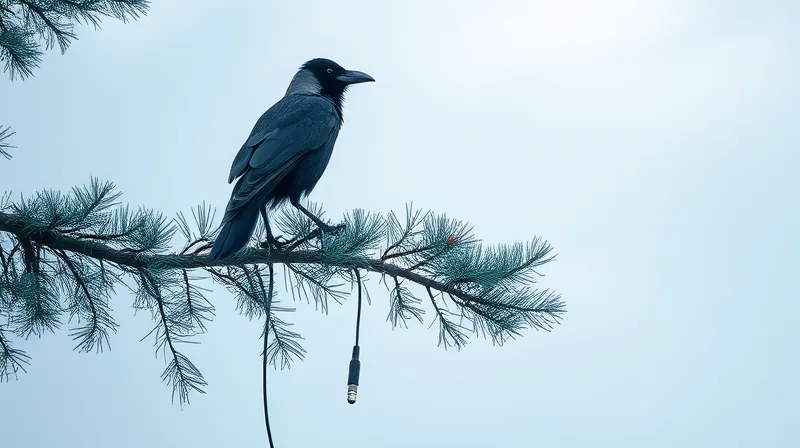
AI decodes crow calls but cannot explain its understanding
The machine does not know why it knows. When the Earth Species Project fed 150,000 carrion crow recordings through its pattern recognition models, the output was a taxonomy of calls that no human had ever catalogued — soft acoustic alerts, frequency shifts, rhythmic intervals that field biologists had dismissed as noise for decades. Vittorio Baglione spent nearly thirty years in Spain attaching miniature microphones to 43 crows alongside his research partner Daniela Canestrari. He accumulated thousands of hours of dense audio that was virtually impossible to segment by hand. Then the model did it automatically. The unsettling part is not that the AI succeeded. The unsettling part is that nobody can fully explain how it distinguishes a genuine warning cry from a crow’s idle chatter. The system identifies structure without understanding meaning, and that gap between apparent comprehension and actual mechanism is where the trouble begins.
This is the pattern that repeats across the emerging field of bioacoustic AI. The technology presents itself as a translator, a bridge between human and non-human worlds. But translation implies a kind of equivalence — that the machine has grasped something about crow cognition, about their social bonds, about what a call means to the bird that hears it. What the models actually do is statistical pattern matching on an enormous scale. They find regularities in acoustic data that correlate with observable behaviors. A pitch shift that reliably precedes a group defense response becomes a “call for backup” in the research paper. Whether the crows experience it as a request, a command, or an involuntary reflex remains entirely opaque. The AI has produced a functional map of crow vocal behavior without producing any understanding of crow consciousness. We are in the position of someone who has learned to read a language phonetically without knowing a single word of its grammar.
The danger of this illusion becomes concrete when researchers move from passive observation to active playback. If the model identifies a cry that triggers group defense, the temptation is to test it — broadcast the synthetic call into the wild and see if crows respond. This is where the deception cuts both ways. The AI deceives us into thinking we have cracked the code when we have only isolated a trigger. And if we broadcast that trigger, we deceive the animals into responding to a signal that carries no genuine emotional content, no real warning, no actual danger. The crows that rush to defend a neighbor are acting on millions of years of evolved social instinct. They are responding to what they believe is a real threat to their community. What they are actually responding to is a machine’s approximation of a sound, played back by researchers who do not fully understand what the original call signified to its intended audience.
Investor Jeremy Coller, a key backer of interspecies communication research, has publicly projected that two-way communication will arrive before the end of the decade. “Because AI is so fast, I have absolute conviction we will crack the code by 2030,” he said. The confidence is striking, and it rests on a fundamental confusion between decoding and understanding. Coller speaks of cracking a code, as if animal vocalization were an encrypted message waiting for the right computational key. But animal communication is not a code in that sense. It is a living system embedded in bodies, contexts, and relationships. A crow’s alarm call means something different when the bird is alone versus in a flock, when the predator is close versus distant, when the nesting season has begun or ended. The same acoustic signal carries different information depending on the situation. A statistical model can learn to classify the signal. It cannot learn what the signal means to the bird that produces it or the bird that hears it, because that meaning is not contained in the sound wave itself.
Zoologists have been making this point with increasing urgency, and their objections are not merely academic. True interspecies understanding, they argue, requires multi-modal models that integrate acoustic spectrograms with body posture, sonar clicks, visual coloration, chemical pheromones, and micro-movements. Audio is only a fraction of animal language. A dog’s wagging tail changes the meaning of its bark. A bird’s plumage condition alters how its song is received. A whale’s physical proximity to its pod modulates the significance of its calls. The AI systems currently being deployed ignore most of this context because audio data is easier to collect and process than video, chemical, and behavioral data combined. The result is a partial picture presented as a complete one. The machine appears to understand animal communication when it is actually processing only one channel of a multi-channel signal. This is not a technical limitation that will be solved by more data. It is a conceptual error about what animal communication is.
The stakes of this error extend far beyond scientific accuracy. César Rodríguez-Garavito, director of NYU’s More-Than-Human Life Program, has warned that AI has potential for greater harm at scale if deployable models lack strict international biosecurity frameworks. His concern is not hypothetical. The same capabilities that allow conservationists to track endangered herds or warn marine life away from shipping lanes can be weaponized against wildlife. Synthetic calls that mimic maternal distress cries, feeding aggregations, or territory alerts could be used by poachers to lure entire pods or flocks into kill zones with unprecedented efficiency. Industrial trawlers could broadcast the acoustic signature of a feeding frenzy to concentrate fish populations for easier harvest. The technology that promises to help us understand animals also gives us the tools to manipulate them more effectively than ever before in human history. And because the AI systems do not actually understand what they are processing, we cannot predict with confidence how animals will respond to synthetic versions of their own calls.
The history of human-animal interaction suggests that the capacity to deceive is rarely left unused. Pet owners already talk to their animals constantly, projecting human emotions onto canine and feline responses with no empirical basis. The market for devices that claim to translate pet vocalizations into human language is booming, driven by the same illusion that powers bioacoustic research — the belief that if we could just understand what animals are saying, we could finally connect with them. But the connection that pet owners seek is not translation. It is companionship, and that cannot be manufactured by an algorithm. When a dog owner straps on a device that announces “I am hungry” in response to a whine, both parties are being deceived. The owner believes they have achieved communication. The dog learns that whining produces a strange voice and sometimes food. Neither has understood the other. They have simply established a new, artificial behavioral loop mediated by a machine that understands neither of them.
What would genuine progress look like? The comparison that clarifies this is the difference between a phrasebook and a language. A tourist with a phrasebook can ask for directions, order food, and negotiate a price. They cannot understand a joke, detect sarcasm, or grasp why their host is offended by a seemingly innocent question. The phrasebook provides functional utility without cultural competence. Current bioacoustic AI is a phrasebook for animal communication. It can match sounds to situations with increasing accuracy, but it cannot grasp the social context that gives those sounds their full meaning. A crow that hears a synthetic alarm call and flies to defend its neighbor is responding correctly to the phrasebook version of the warning. What it cannot do is question whether the call is genuine, whether the danger is real, or whether the signaler is trustworthy. The AI has given us the ability to speak without the ability to listen — to produce sounds that trigger responses without understanding the relationship between the sound and the response.
The ecological consequences of this asymmetry are already visible in the research itself. When Baglione’s team played back calls to nesting crows to confirm their findings, they were conducting an experiment that would have been impossible before AI made synthetic vocalization feasible. The crows responded as the model predicted. The researchers confirmed their hypothesis. But what did the crows experience? They heard what they believed was a genuine alarm from a neighbor. They mobilized for defense. They expended energy and exposed themselves to potential predators in response to a signal that carried no real information. The birds were deceived by a machine that did not understand them, operated by researchers who understood them only slightly better. This is the fundamental hazard of the technology: it allows us to manipulate animals on the basis of partial knowledge, and the animals have no way to detect that the manipulation is occurring.
The timeline projections from philanthropists and technologists compound the problem. Coller’s conviction that the code will be cracked by 2030 creates pressure to accelerate research, to deploy models before their limitations are understood, to move from passive observation to active communication before the ethical frameworks are in place. The history of technology suggests that this pattern leads to predictable outcomes. Every major communication technology — from the printing press to the internet — has been used for manipulation and deception long before it was used for genuine understanding. There is no reason to believe that interspecies communication will be different. In fact, the stakes are higher, because the subjects of manipulation cannot consent, cannot complain, and cannot organize resistance. They can only respond to signals that their evolutionary history has programmed them to trust.
The philosophical implications are profound. If we do achieve something approaching genuine two-way communication with another species, it would fundamentally alter our understanding of consciousness, ethics, and our place in the natural order. Animals would cease to be objects of study and become subjects of dialogue. Their interests would have to be weighed in human decisions. Legal systems would need to account for non-human perspectives. This is the utopian vision that drives much of the funding for bioacoustic research. But the path to that vision runs through the current technology, which is not capable of genuine dialogue. It is capable of stimulus-response manipulation dressed up as communication. The gap between what the AI appears to do and what it actually does is not a minor technical detail. It is the central ethical problem of the field.
Rodríguez-Garavito’s call for international biosecurity frameworks is a recognition that the technology is advancing faster than our ability to govern it. But frameworks and guardrails assume that we know what we are regulating. The uncomfortable truth is that we do not fully understand what these AI systems are doing when they process animal vocalizations. We do not know why certain patterns emerge from the data or what they correspond to in the animal’s subjective experience. We are building tools that can influence animal behavior on a massive scale without understanding the mechanism of that influence. This is not a recipe for responsible stewardship of the natural world. It is a recipe for unintended consequences on a planetary scale.
The comparison that shows what would be possible with different choices comes from an unexpected source: the field of primatology. Researchers who study great apes have spent decades building relationships with individual animals, learning their vocalizations and gestures through patient observation and interaction. Jane Goodall’s work with chimpanzees, Dian Fossey’s with gorillas, and Frans de Waal’s with bonobos all proceeded without AI. They proceeded through extended human presence, careful observation, and genuine relationship-building. The result was not a translation system but a deep understanding of individual animals and their social worlds. These researchers did not deceive their subjects with synthetic calls. They earned trust through consistent, honest interaction over years and decades. The technology they used was patience, attention, and empathy — the same tools that any human uses to understand another human.
What if bioacoustic AI had been developed in that tradition? What if the goal had been relationship rather than translation, understanding rather than decoding? The Earth Species Project could have built tools that helped researchers spend their observation time more effectively, identifying which calls merited closer attention rather than attempting to replace the observation entirely. The AI could have served as a supplement to human empathy rather than a substitute for it. But that is not the path that has been taken. The funding flows toward the promise of cracking the code by 2030, toward the fantasy of talking to animals, toward the investor pitch that AI will finally bridge the gap between species. The technology is being shaped by the illusion of understanding rather than the reality of relationship.
The crows in Baglione’s study did not need AI to tell them when a buzzard was attacking a neighbor. They already knew. Their calls were already functioning perfectly well as communication within their own species. The AI did not unlock a secret that the crows were keeping from us. It provided a statistical summary of vocal patterns that researchers could not perceive with human ears. That is genuinely useful. It is also a long way from understanding what it means to be a crow, to feel the terror of a predator attack, to experience the relief of neighbors arriving to help. The machine can classify the sound of terror. It cannot feel terror, and it cannot tell us what terror feels like to a crow. The gap between classification and understanding is the gap between the AI’s apparent capabilities and its actual ones. Until that gap is acknowledged, the quest to talk to animals will remain what it currently is: a sophisticated form of deception, practiced by machines that do not know they are deceiving, on animals that have no way to know they are being deceived.