Reading Heat Where Dust Hides the Light
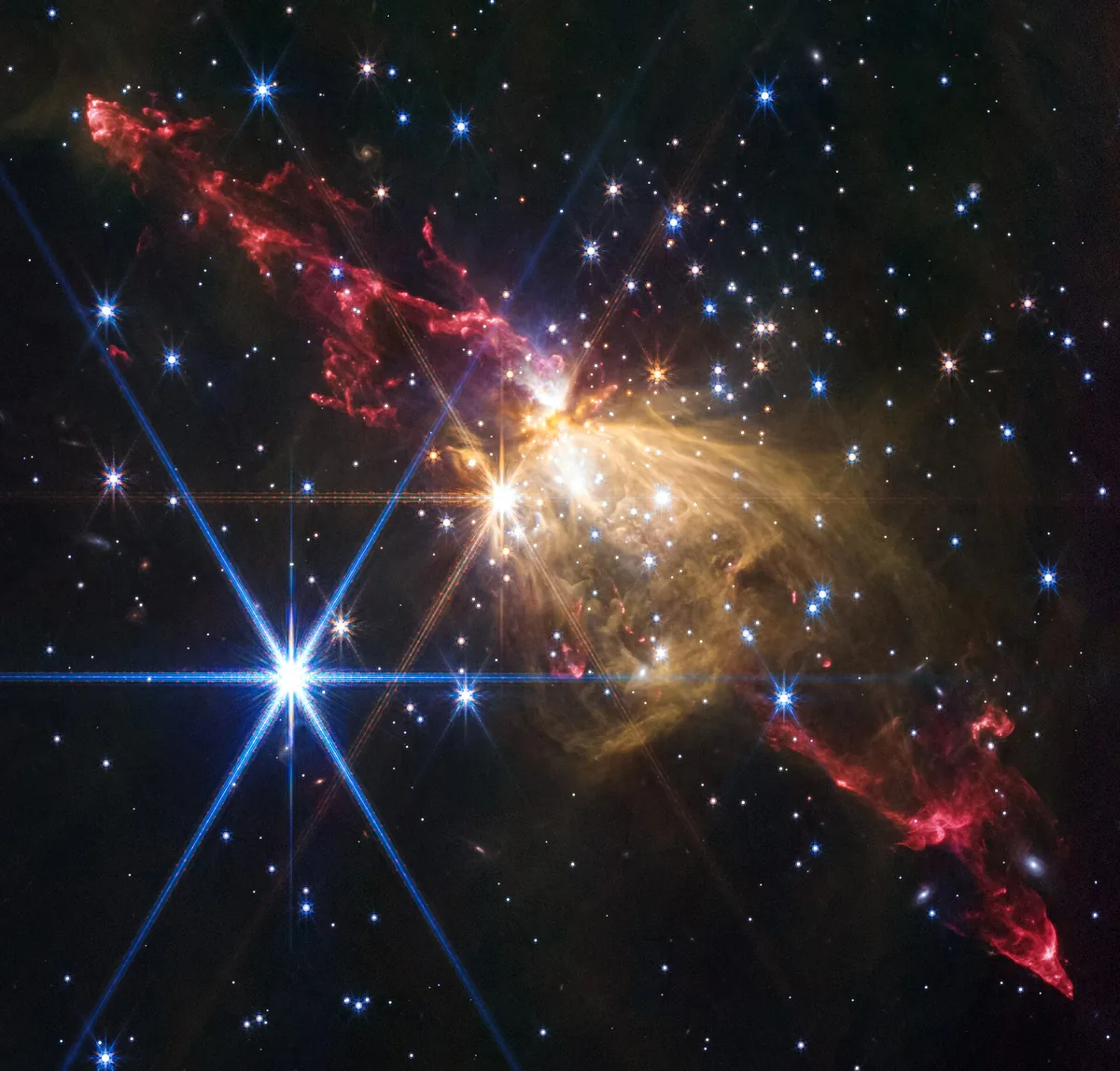
Infrared detectors on the James Webb Space Telescope have now produced a detailed portrait of the star-forming region NGC 7129, and the method matters as much as the picture. [1] Visible light cannot pass through the cold, opaque dust that gathers around newborn stars. That dust forms in the cool outer layers of stars and, once it spreads out, it blocks the view that ordinary telescopes depend on. Infrared light slips past much of that screen, so Webb’s camera registers what the eye cannot. This is direct observation of a process that, for most of astronomy’s history, had to be inferred from aftereffects — the smoke read instead of the fire.
The image shows many stars in the act of forming, and it shows them at different ages within a single frame. On the left, the young stars sit inside gold-colored gas and are typically further along in their development. [1] On the right, in a red region, the stars are younger. [1] One picture, two stages of the same biography — like a family photograph in which a grandparent and a newborn share the couch.
Gravity pulls large amounts of gas together until a star condenses. Stars that formed earlier begin to throw off powerful jets and winds, and some of them later explode. The nursery is not quiet. The first-born children start rearranging the furniture while the younger ones are still arriving.
The Sculptors Are the Newborns Themselves
The red-colored gas in the image has a filamentary, thread-like texture, and jets and winds are the likely cause, according to the NASA explanation. This is the reversal worth pausing on. A cloud collapses to make stars, and those same stars then carve the cloud into strands. The product of the process becomes a tool that reshapes the raw material for the next round. It is less a factory than a workshop where each finished piece turns around and sands the next block.
That gives the region its value as a study object: it holds multiple developmental stages side by side, from the gold gas on the left to the red on the right. The same principle drives other surveys of star-forming regions, where teams compare many young stars at once to sort out which processes dominate at which age. Comparing stars at different points in their growth strengthens understanding of which physical processes matter most, and when they matter. The question is not only what makes a star, but which forces dominate at which moment — gravity early, stellar outflows later, disruption at the end.
The dust that hides all this from visible-light cameras is the same dust that forms in the cool atmospheres of stars and, once dispersed, blocks the view ordinary telescopes depend on. So the obscuring material and the revealing material are one and the same. Webb’s infrared view turns the obstacle into the subject, and the picture becomes a record of stars caught mid-formation.