The Motor That Shed Its Wings
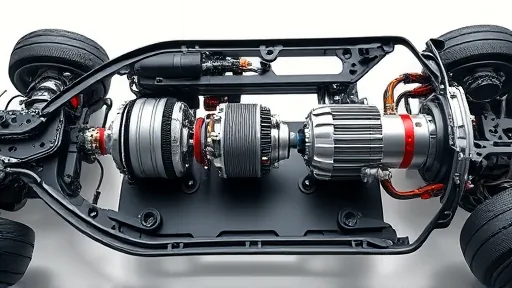
Axial flux electric motors did not begin life as a car part. The design — a disc-shaped stator sandwiched between two rotors, with magnetic flux running along the axis of rotation rather than across it — was long the province of weight-sensitive, space-starved applications where every millimeter and every gram counted. It is the difference between a stack of coins and a stack of plates: the conventional radial motor is the coin tower, tall and narrow; the axial flux motor is the plate stack, wide and flat. Flat is what you want when the machine you are powering has no room to grow upward.
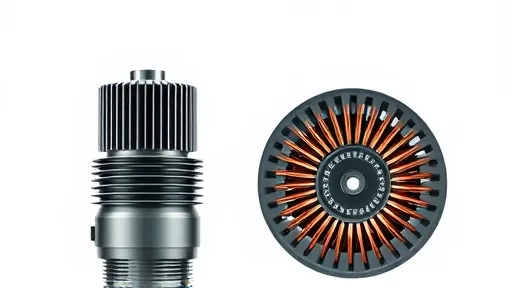
Mercedes bought the British motor specialist Yasa in 2021, and the 2027 AMG GT 4-Door Coupe is where that acquisition finally reaches a showroom. [1] The package is startlingly thin. Each rear motor measures 79 mm across; the single front motor measures 89 mm. Three of them sit in the car: two in back, one in front. In the GT 63, that trio produces a peak of 1,153 hp (860 kW), a nominal 711 hp (530 kW), and 2,000 Nm of torque. The GT 55 runs the same three-motor layout at a peak of 805 hp (634 kW), a nominal 557 hp (415 kW), and 1,860 Nm. Nominal is the number you can lean on without end; peak is the number you get in bursts.
The bursts are the party trick, and they are named with a wink. Pulling both steering-wheel paddles delivers full output for 63 seconds in the GT 63; the GT 55 delivers 55. The naming is a joke with a stopwatch behind it. Mercedes claims 0 to 60 mph (97 km/h) in about 2.3 seconds for the 63 and 2.7 seconds for the 55, with a top speed of 186 mph when the AMG Performance package is specified. Zero to 124 mph (200 km/h) arrives in roughly 6.8 seconds.
What separates this from a one-shot party trick is the reset. When the timer runs out, pulling the paddles again returns full power. There is no cooldown queue and no forced wait before you may re-enter the fast lane - unlike the Porsche Taycan Turbo GT, which makes drivers wait four seconds before Attack mode can be used again. Eight consecutive fast laps around a 2.7-mile configuration of Spain’s Ascari circuit ended with more than 60 percent of the battery still in reserve. The rehearsal is repeatable, and that is the point.
An Oil Bath That Pays Twice
Every performance electric car fights the same physics: batteries are heavy, and mass in motion wants to stay in motion. Mercedes attacked the problem from the thermal side, and the solution is a closely guarded detail on the car. All 2,660 cylindrical cells in the 106 kWh pack are fully bathed in a non-conductive oil. The fluid first flows past the cell connectors, then circles back past the center of the battery, then returns to be cooled. Mercedes CTO Jörg Butzer declined at a roundtable to name the technical partner or describe the properties of the proprietary fluid. [1] The contrast with the rest of the industry is the tell. Some makers cool cells from the top or the bottom of the pack — GM, Lucid and Rivian among them. Others, Tesla and BMW M included, thread serpentine cooling strips between individual cells. Mercedes submerged the whole population. It is the difference between air-conditioning a house room by room and dropping the house in a cool lake.
The payoff shows up in two places at once, which is the elegant part. A pack that sheds heat quickly can discharge quickly, which is why the Boost mode can be re-armed indefinitely. The same pack can also accept charge quickly. The car runs an 800-volt architecture and is rated to DC fast-charge at up to 600 kW. In a demonstration, a track GT 63 peaked at 637 kW. At 60 percent state of charge it was still drawing about 400 kW; at 79 percent it held 252 kW. The run from 17 to 80 percent took roughly ten minutes — about twice as fast as the current state of the charging art. Mercedes says at least one of its 1,000-kW mega chargers will be installed at every one of its dealers. [1] The hardware on the car is the limit, not the plug.
Mercedes has not shared a range target for the 106 kWh pack. A car this quick, this heavy — 5,501 pounds — and this thirsty has an obvious question hanging over it, and the answer is not yet on the table.
The V8 in the Speakers and the Chassis Underneath
An electric AMG that plays a recording of the previous-generation GT R’s V8 through the speakers and fires actuators in the seats should be a gimmick, a pacifier for people who cannot let go. It is not. The growl greets you as you walk up and as the car wakes. It vanishes in Comfort, Sport and Race, returns in Sport+, and swells when Boost engages. It does not sound real. It sounds close to real — the gap between a cassette of a favorite band and the band live, most audible down low. The tape is still enjoyable. The placement in the cabin even re-creates a mid-engine location for the brain, which is a strange and effective piece of psychological engineering.
Underneath, the chassis does the serious work. AMG’s dedicated sports-car architecture, AMG.EA, continuously adjusts power delivery across the three motors while directing the Active Ride Control suspension, the steering — including rear-axle steering of up to 6 degrees — and active aerodynamics. The optional hydraulically interconnected damper system, paired with multilink suspension front and rear, forged aluminum components on the front axle and those six degrees of rear steer, produces a ride in Comfort that feels like a regular Mercedes rather than an AMG product. On sweepers the front end begs for more speed. At points it is almost too confidence-inspiring: the chassis writes checks that 5,501 pounds and Continental SportContact 7 summer tires struggle to cash on steep downhill slaloms. The optional carbon-ceramics hold up to abuse, though the pedal feel is mushy and inconsistent through the stroke.
The brakes themselves are a hybrid of philosophies: regenerative braking plus hydraulic brake-by-wire friction brakes, carbon ceramic discs at the front and steel at the rear. When a tight left-hander arrived far too late and over a crest, the deceleration held. For drivers who want to tune the machine rather than merely drive it, the AMG race engineer control system — standard on the 63, optional on the 55 — puts three dials in the center console: Response, Agility, Traction. Each goes to nine. At one, the settings are for drivers who should not be in this car. At nine, everything is at the limit, and the day is spent melting tires. On track, the setting was seven: rear end loosened, throttle response sharpened, traction easily broken at the rear.
The interior carries the usual Mercedes luxury: quilted door panels, comfortable seats, an array of materials, and screens — including the passenger screen. That screen finally has a use. It can display the vehicle’s technical data, down to how many Newton-meters a given motor is producing at that instant. It is a nerd’s instrument panel, and it is the only reason to look at that screen. The seats adjust lumbar support and side bolsters on-screen, which is usually annoying but here offers fine-tuning worth the detour. At 6 feet 3 inches, a driver fits comfortably in the back seat, and the trunk is large enough for four people heading out for a weekend — or for collecting the kids from soccer practice.
The price is the sobering footnote. The AMG GT 55 starts at $145,000, with a $1,550 destination charge, and arrives by the end of the year. The AMG GT 63 starts at $175,000 and arrives in early 2027. Whether that squelches the “all EVs drive the same” argument is a matter of taste. What is not in doubt is the engineering: three flat motors, a secret oil bath, and a chassis that turns a 5,501-pound coupe into something that can get very, very sideways.
Sources