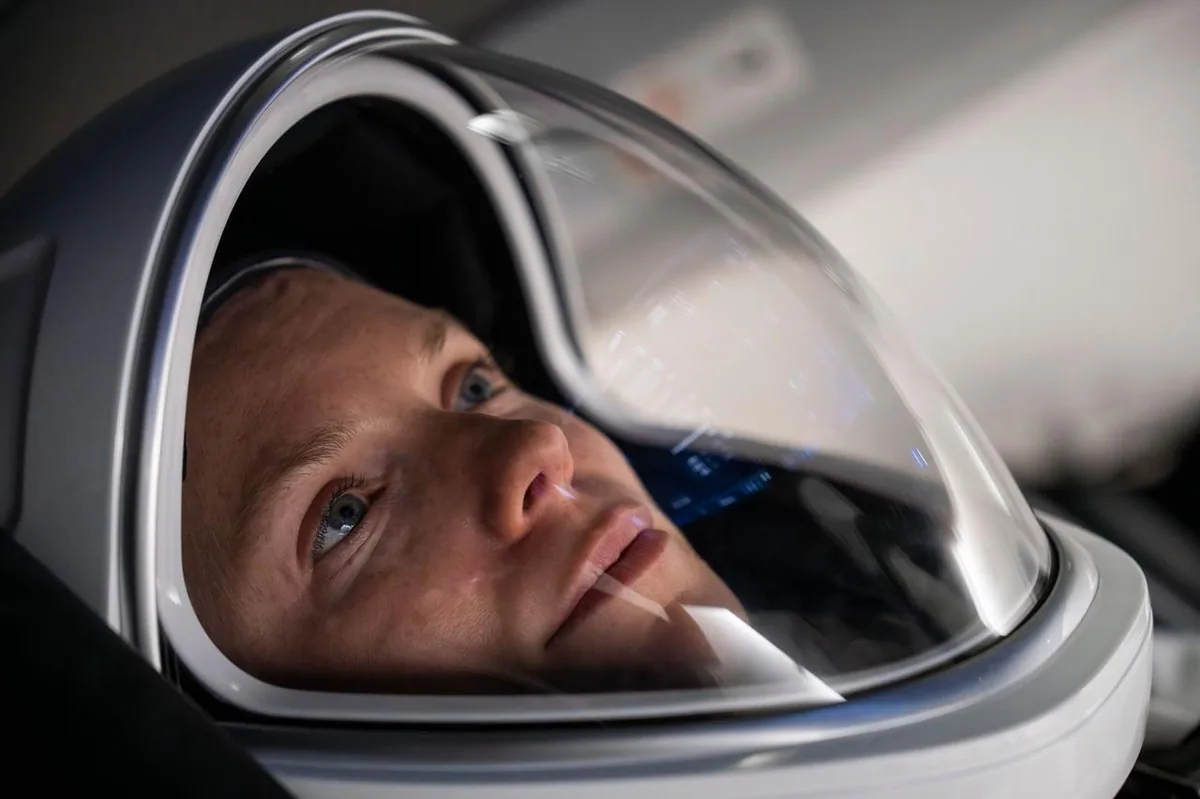
SpaceX Crew-13 Mission for Deep-Space Medicine
Four Flyers, One Dragon Named Grace
The experiments run a few hundred kilometres up - barely out of the atmosphere. The questions behind them are aimed much farther out. Crew-13 is the rehearsal, not the voyage.NASA astronauts Jessica Watkins and Luke Delaney will fly as spacecraft commander and pilot on SpaceX Crew-13, bound for the International Space Station. CSA astronaut Joshua Kutryk and Roscosmos cosmonaut Sergey Teteryatnikov join them as mission specialists. Liftoff is targeted for no earlier than 11:10 a.m. EDT on Thursday, Oct. 1, from Space Launch Complex 40 at Cape Canaveral Space Force Station. Their ride is a Dragon capsule named Grace. [1]
A crew list is a quiet political document. One American geologist, one Navy test pilot, one Canadian fighter pilot and one Russian naval engineer - four careers with almost nothing in common except the training that is supposed to make any of them useful in any seat.
Watkins is the veteran. Selected in 2017, the Colorado-born geologist studied the Martian surface with the Curiosity rover team at JPL before spending 170 days aboard Crew-4 in 2022. With Crew-13 she becomes the first NASA astronaut to launch twice on a Dragon - a line that reads like trivia and is not: it measures how ordinary private spacecraft have become. Delaney, selected in 2021, flew naval missions from the Asia-Pacific to Operation Enduring Freedom before evaluating developmental aircraft as a test pilot; this is his first spaceflight. Kutryk, also on his first flight, flew CF-18s for NATO and NORAD before testing aircraft at Cold Lake, Alberta. Teteryatnikov graduated from the naval academy in St. Petersburg in 2011, ran engine rooms and undersea vessels, and joined the cosmonaut corps in 2021.Stem Cells, Crops, and Blood Flow in Orbit
The science has one plain purpose: keep people alive farther from home. The crew will work with stem-cell-derived tissues aimed at heart disease and Parkinson’s, run crop experiments for longer flights, study the blood-flow abnormalities that appear in weightlessness, and test diagnostic gear built to watch a crew’s health without a hospital behind it.
That last point is where the mission’s title earns its keep - and strains it. All of this happens in low Earth orbit, where a medical emergency is measured in hours to a day from help. These are deep-space medicine’s rehearsal, not its performance: the conditions are milder, and so are the stakes: those of a rehearsal. The honest version of the claim is that low Earth orbit is the only laboratory we have for questions we will one day have to answer far away.

Countdown, Docking, and the Handover
The mission has moved through its reviews and its hardware in the open - which is why the date on this story is worth stating precisely. NASA and SpaceX passed the Flight Readiness Review on Sept. 25 and polled “go”. The crew reached Kennedy Space Center in Florida on Sept. 26. The Falcon 9 and Dragon rolled out to Space Launch Complex 40 on Sept. 27 and were raised to vertical, waiting on the pad for a launch no earlier than Oct. 1.
After liftoff, Falcon 9 will push Dragon to roughly 17,500 mph. Once in orbit, the crew and mission control will walk the spacecraft through a series of burns toward the forward port of the station’s Harmony module; Dragon is built to dock autonomously, with the crew able to take manual control if needed. Aboard the station, Crew-12 is preparing to come home after a brief handover, and the seven-member Expedition 75 crew will welcome the newcomers. Later this fall the outpost expects a SpaceX cargo run and a Northrop Grumman resupply flight. The spacecraft Grace previously flew the private Axiom Mission 4.
Sources
1. NASA - What You Need to Know About NASA’s SpaceX Crew-13 Mission
2. NASA blog - NASA, SpaceX Proceed Toward Crew-13 Launch (Sept. 25, 2026)
3. NASA blog - NASA’s SpaceX Crew-13 Rocket Arrives at Launch Pad (Sept. 28, 2026)
Mentioned organisations (context, not sources)
- European Space Agency — Organisation (homepage)
- SpaceX — Organisation (homepage)
- CSA — Organisation (homepage)
- Roscosmos — Organisation (homepage)
- Stanford University — Organisation (homepage)
- University of California, Los Angeles — Organisation (homepage)
- NASA’s Jet Propulsion Laboratory — Organisation (homepage)