Quantum Industry Shifts from Software to Manufacturing
The Assumption That Software Would Carry the Day
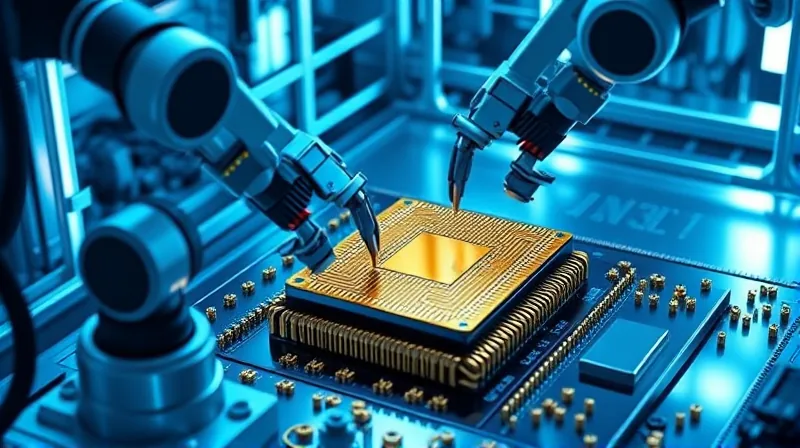
For years, the pitch for quantum computing rested on an assumption so foundational that few questioned it: the hardware would arrive, and the value would be unlocked in software. Algorithms, error correction, applications — that was where the race would be won. The US Commerce Department has now placed a $300 million bet that this assumption is backwards. The real bottleneck, in its judgment, is manufacturing. The department is directing $100 million each to D-Wave Quantum, Rigetti Computing, and Quantinuum through CHIPS Act research and development funding. In each case, the government takes a minority ownership stake, giving it a direct financial interest in the outcome. This is not a grant program for ideas. It is an equity position in the machinery of production.
The awards are explicitly aimed at practical engineering work rather than quantum software. The three companies are focused on building and manufacturing the components that larger, more reliable quantum systems require: processors, cryogenic equipment, semiconductor devices, lasers, and optical hardware. The distinction matters. A software-first strategy assumes the physical substrate is someone else’s problem. The Commerce Department’s structure treats the physical substrate as the problem. Supply chains for advanced semiconductors and related technologies are named as a national objective, not a market externality. The government is not funding demonstrations. It is funding the capacity to build.
From Lab Bench to Factory Floor
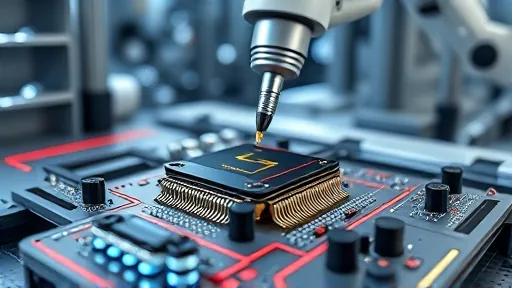
Rigetti will use its $100 million to confront the challenges of scaling superconducting quantum processors. The company said it plans to expand its cryogenic capacity and accelerate production at its specialized manufacturing facilities. It will also address technical issues that have made it difficult to build larger superconducting systems. The phrase “difficult to build larger” is doing quiet work here. Superconducting qubits operate at temperatures colder than deep space, and every additional qubit adds wiring, cooling load, and failure points. Scaling is not a software update. It is a manufacturing problem measured in dilution refrigerators and fabrication yields.
D-Wave, based in British Columbia, said its funding will support microelectronics research and development, including advanced semiconductor prototypes for quantum technology. The company framed the work as supporting scalable, high-performance quantum hardware. Note the word “prototypes.” This is not yet production. It is the stage where a design becomes a repeatable physical object. Quantinuum’s project is centered on integrated photonics, which combines optical components and electronics in compact systems. The company said it will work with GlobalFoundries to fabricate next-generation ion traps and other electronic components. It also plans to work with Monarch Quantum on integrated lasers and optical components for its systems Three companies, three different physical approaches — superconducting circuits, semiconductor-based quantum annealing, trapped ions with photonic interconnects — but one shared bottleneck: the ability to manufacture at scale.
GlobalFoundries finalized a separate $375 million agreement with the government to expand domestic quantum manufacturing. Under the five-year deal, the chipmaker will receive milestone-based research and development funding from the Commerce Department. The company said the funding will help quantum hardware developers move from lab prototypes to commercial-scale manufacturing. It is intended to support the technologies needed to build scalable quantum processing units in the United States. This is the bridge between the three company awards and the broader industrial base. GlobalFoundries has already received federal support for related work. In July, the government said it would take a 1% stake in GlobalFoundries and provide $300 million for silicon photonics development for data centers
The Factory as the Next Frontier
The latest grants show how federal quantum funding is shifting toward the hardware and manufacturing challenges facing the industry. Quantum companies still need to prove they can build systems at scale, rather than simply demonstrate advances in the lab. The next stage is not a better algorithm. It is a factory that can produce the components those algorithms will eventually run on. The bet is not on any single qubit design. It is on the ability to make many of them, reliably, on American soil.

Sources
3. Quantinuum