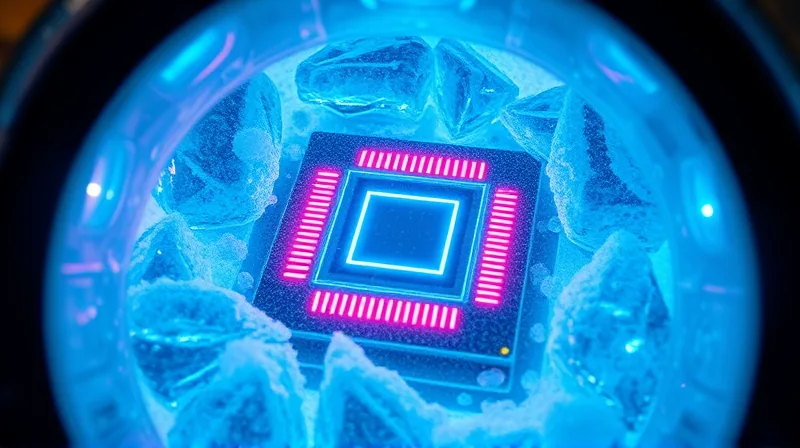
Quantum Computing Inc Bets on Room Temperature Entropy
The Noise That Refused to Stay Quiet
For decades, the central problem in quantum computing was not building a qubit. It was keeping one alive. A quantum bit stores information in a fragile superposition, and the slightest interaction with its surroundings — a stray vibration, a wandering photon, a whisper of heat — collapses that superposition into ordinary classical noise. The entire field organized itself around this enemy. Engineers built dilution refrigerators that cool circuits to temperatures colder than deep space. They shielded chips from electromagnetic interference. They layered on error-correction codes so elaborate that thousands of physical qubits are needed to make a single reliable logical one. The assumption was bedrock: decoherence is the adversary, and the only path forward is to suppress it.
Quantum Computing Inc., which trades under the ticker QUBT, has built its strategy on inverting that assumption. Its approach, which the company calls Entropy Quantum Computing, or EQC, treats quantum entropy and decoherence not as failures to be eliminated but as computational resources to be harnessed. [1] The shift is a genuine philosophical break from the mainstream. Where conventional systems fight the environment, EQC recruits it. The approach could reduce the need for cryogenic cooling and for the extreme isolation that conventional quantum systems demand. It also opens the door to integrated photonic systems — circuits that route and manipulate light rather than electrons — designed for greater scalability and operational flexibility.
The unresolved puzzle at the heart of this shift is simple. If decoherence really can be converted from bug to feature, then the decades-long race toward colder and quieter machines was solving only one version of the problem. The question that follows is whether a system that embraces noise can also be precise enough to be useful.
The Machine That Runs at Room Temperature
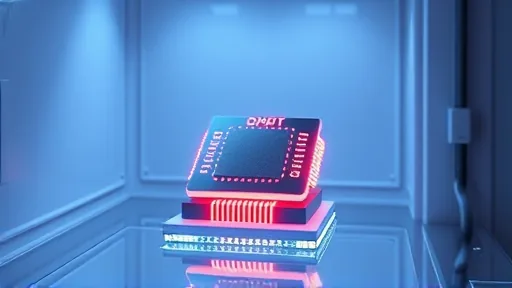
The concrete embodiment of this philosophy is a platform QCi calls Dirac-3. It is a third-generation system, rack-mountable, and designed to solve complex, real-world optimization problems at room temperature — the feature that separates it from nearly every competing architecture. No dilution refrigerator. No car-sized vacuum chamber. Just a rack.
The target workload is optimization: finding the best or near-best configuration among an astronomically large number of possibilities. This is the class of problem that shows up in logistics routing, portfolio construction, network design, and scheduling. It is also precisely the class where classical computers hit a wall, because the number of candidate solutions grows exponentially with the number of variables. QCi applies EQC to these practical computing applications without relying on the highly controlled environments that conventional quantum systems typically require.
Two peers illustrate how differently the rest of the field approaches the same goal. IonQ’s commercialization thesis remains tied to technical milestones that move it from prototype systems toward repeatable semiconductor-based deployments. By the second quarter of 2025, IonQ had progressed through three rounds of tape-outs for its first semiconductor quantum chip and had received 256-qubit prototypes that met the critical quality metrics required for production-grade systems. [2] IonQ also reported key elements of its walking-cat architecture and quantum error-correction work on a Tempo engineering system. Rigetti takes a third path: its superconducting qubit platform is built around an in-house modular chiplet design, intended to scale systems without relying on ever-larger monolithic processors. Its 36-qubit Cepheus system uses four 9-qubit chiplets, while Cepheus-1-108Q uses 12 interconnected 9-qubit chiplets and became generally available in April 2025. [3]
Those numbers define the bar. The 108-qubit Rigetti system is currently operating at about 99.1% median two-qubit gate fidelity and 99.9% median single-qubit fidelity, with gate speeds near 60 nanoseconds. [3] Smaller systems continue to provide a development path toward higher fidelity: the 36-qubit system reached 99.6% median two-qubit fidelity, while the 9-qubit system reached 99.8% at 40-nanosecond gate speeds using its adiabatic CZ gate scheme. These are the precision figures superconducting hardware can now deliver, and they belong to a domain where QCi’s room-temperature, entropy-based approach does not compete on the same metric. A fidelity number for a gate-based superconducting qubit and a solution-quality number for an optimization machine are not the same measurement. Until the field agrees on a common yardstick, comparing Dirac-3 to Cepheus is comparing a thermometer to a barometer.
A Three-Year Bet in the Gulf
The clearest external signal of QCi’s direction is not a benchmark but a contract. QCi signed a three-year Framework Agreement with Hamad Bin Khalifa University in Qatar. [4] Under the terms, QCi will provide HBKU with cloud-based access to the Dirac-3 system, along with an installation in Qatar. The purpose is to support the country’s quantum ecosystem and its regional leadership ambitions.

The commitment is verifiable and has a clock on it. A three-year framework is long enough to generate published results and short enough to be judged. It also places a room-temperature optimization machine inside a national research institution, where the absence of cryogenic infrastructure is an advantage rather than a compromise. HBKU does not need to build a dilution refrigerator wing to use Dirac-3. That lowers the barrier to entry in a way that superconducting and trapped-ion systems cannot match.
What the agreement does not yet resolve is the scalability question the entire EQC thesis rests on. Its photonic approach is designed for greater scalability and operational flexibility, but designed for is not the same as demonstrated at. The open question is whether an architecture that treats decoherence as a resource can hold its computational advantage as problem sizes grow — or whether the resource itself becomes unmanageable at scale. The installation in Qatar will begin to answer that question over the next three years.
Sources
2. IonQ
3. Rigetti