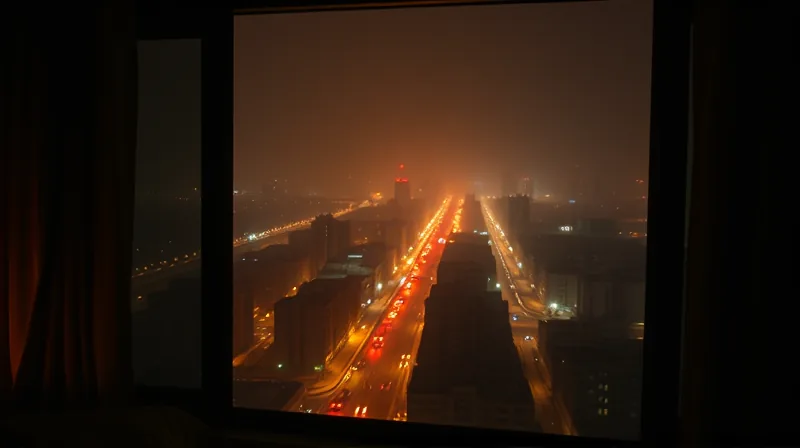
Night Heat Costs Urban Dwellers 56 Hours of Sleep Yearly
The world measures heat by its daytime peaks. Thermometers climb, records fall, and cities brace for the afternoon assault. But a quieter crisis unfolds after sunset. Night-time temperatures are rising faster than daytime ones in many regions, and the human body has no escape. Sleep becomes fragmented, shallow, and insufficient. The consequences ripple far beyond fatigue, touching public health systems and mortality statistics in ways that scientists are only beginning to quantify.
A team at Shanghai Jiao Tong University has spent years tracking this phenomenon. Their work spans architecture, urban governance, and clinical medicine, bringing together disciplines that rarely share a lab bench. The team includes Pixin Gong, Li Lan, Ruiqi Guo, Shu Jiang, and Zisheng Huang from the Department of Architecture, alongside Zhentao Wang, Yanbing Lin, and Hui Xu from the Shanghai Ninth People’s Hospital. Their collaboration marks a shift in how heat research is conducted - no longer confined to weather stations and climate models, but grounded in the lived reality of urban populations.
What makes their approach different is the measurement itself. Previous studies relied on calculated estimates, statistical projections of how heat might affect sleep based on laboratory conditions or self-reported surveys. The Shanghai team instead draws on direct observation across more than 1,300 cities, tracking actual sleep patterns against real temperature data. [2] For the first time, researchers can see the immediate, measurable impact of a hot night on a sleeping population. The numbers are stark: during 2020-25, each urban resident lost nearly 56 hours of sleep per year to night-time heat. [2]
When Nightfall Brings No Relief
The scale of the problem becomes clear when looking at specific events. In May, Delhi recorded an overnight minimum temperature of 32.4 degrees Celsius. That is not a daytime high - it is the coolest moment of the entire day. Other parts of India remained 3-5 degrees Celsius above normal after dark. Western Europe experienced its hottest June on record, with France registering an overnight low of 22 degrees Celsius. East Saxony, Germany, sweltered at a historic 29.4 degrees Celsius. In July, record night-time warmth exceeding 27 degrees Celsius added to the mugginess of cities on the US Gulf and Atlantic coasts.
These numbers translate directly into human suffering. Two-thirds of respondents to a UK survey said they struggled to sleep during the June heatwave. Almost half lost at least three hours of sleep each night. The pattern repeats across continents and cultures. A hot night is not merely uncomfortable - it is physiologically disruptive, preventing the body from entering the deep sleep stages necessary for physical recovery and memory consolidation.
The health consequences extend beyond tiredness. Across 28 East Asian cities, intense heatwaves at night were associated with a 3 percent increase in deaths, excluding those from injuries and other external causes. [2] This is not a marginal finding. It represents thousands of excess deaths each year, most of them preventable. In Hong Kong, long, hot nights - around 30 degrees Celsius for 12 hours - were linked to a 3.1 percent rise in emergency hospital admissions. Among older and poorer people, that figure reached 5.3 percent.
The Body’s Fragile Cooling System
Understanding why hot nights are so dangerous requires looking at human physiology. The body cools itself through a precise mechanism: blood vessels near the skin dilate, allowing heat to radiate away, while sweating provides evaporative cooling. This system works efficiently during the day, when the body expects to be active. At night, however, the core temperature must drop by roughly one degree Celsius to initiate and maintain sleep. A warm environment disrupts this natural decline, leaving the body in a state of heightened alertness.
The Shanghai team’s research suggests that urban environments amplify this problem. Buildings absorb heat during the day and release it slowly at night, creating what urban planners call the heat island effect. Densely packed cities with limited green space and poor ventilation retain warmth long after sunset. The researchers have begun mapping these microclimates, identifying which neighborhoods suffer most and why. Their findings point toward architectural solutions - better insulation, reflective surfaces, natural ventilation corridors - that could mitigate the worst effects.
The next step is to understand how the body’s recovery processes fail under sustained night-time heat Sleep is when the brain clears metabolic waste, when the immune system resets, when muscles repair. If that restoration is interrupted night after night, the cumulative damage becomes systemic. The team is now investigating biomarkers that could indicate early signs of heat-related stress, potentially allowing doctors to identify at-risk patients before they require emergency care.
Replication in a Clinical Setting
The team is now preparing to test whether the results can be replicated in a clinical setting. Their plan involves monitoring patients admitted during heatwaves, tracking sleep quality, recovery times, and complication rates against those admitted during cooler periods. The statistician Hui Xu has designed the study to account for variables like age, pre-existing conditions, and medication use.
This replication effort matters because the stakes are high. If night-time heat truly increases mortality by 3 percent in East Asian cities, then climate adaptation strategies must prioritize nocturnal cooling, not just daytime shade. Urban planners need data on which interventions actually work - whether cool roofs, green spaces, or improved ventilation make a measurable difference in sleep quality and health outcomes. The clinical trial at Shanghai Ninth People’s Hospital will provide some of the first direct evidence.
The broader implications extend to public health policy. Heat warning systems currently focus on daytime temperatures, but the Shanghai team’s data suggests that nighttime conditions deserve equal attention. A day that reaches 35 degrees Celsius might be tolerable if the night drops to 20 degrees, allowing the body to recover. But a day that reaches 32 degrees followed by a night at 28 degrees could be far more dangerous, because the body never gets the cooling it needs. The researchers argue that heat alerts should incorporate both daytime highs and overnight minimums.
The collaboration between architects and physicians at Shanghai Jiao Tong University represents a new model for climate research. By combining expertise in building design, urban governance, and clinical medicine, the team can trace the full chain from atmospheric conditions to individual health outcomes. Their work has already influenced building codes in several Chinese cities, which now require better insulation and ventilation in new residential developments. As global temperatures continue to rise, their methods and findings will become increasingly relevant to cities worldwide.