A Test That Strips Away the Training
For decades, monkeys have served as stand-ins for human vision. Their eyes and brains resemble ours closely enough that researchers have long assumed the resemblance extends to perception itself. A new study challenges that assumption.
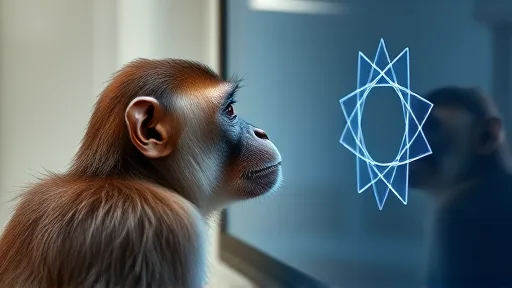
S. P. Arun at the Indian Institute of Science in Bengaluru and his colleagues built their comparison around a single task: the oddball search. [1] A subject faces a screen filled with near-identical pictures. One picture differs. The subject touches it. That is the entire procedure.
When the odd one out looks very much like its neighbors, finding it takes longer. When it stands apart clearly, the search is quick. No verbal report, no introspection, no guesswork about inner experience.
Past comparisons between human and monkey vision often demanded long training regimens. The worry, in his words, becomes whether perception itself changed because of all that training. [1] A task learned over months may measure expertise rather than sight. The oddball search needs only enough training to teach the touch response, which the team secured with juice as a reward for three monkeys. Twenty-four people completed the same task.
Three monkeys is a narrow sample, and the study’s conclusions rest on it. Rufin Vogels at KU Leuven in Belgium calls the differences striking, while cautioning that attention, not just perception, could be shaping the results.
Where Two Species Agree
On several fronts, the monkeys and the people behaved like close cousins. Both groups sorted inanimate objects — a mushroom, a leaf — as more alike than animate ones such as a bird or a cat, and both obeyed the same brightness rule.
The team demonstrated this with brightness. The brighter a spot, the larger a shift in brightness had to be before either monkeys or humans noticed it.
The researchers also tested how both species handled large shapes built from smaller units, a comparison that produced one of the study’s clearest splits.
Finding that a monkey obeys the same brightness rule as a person is not trivia. It is the kind of result that keeps animal models honest: it shows the model tracks the target on ground that can be measured.
Two Fractures in the Mirror
Then the picture splits. Humans show a well-known quirk called mirror confusion. We struggle more to tell apart images flipped left-to-right than images flipped top-to-bottom. The classic illustration is a young child mixing up the letters “b” and “d.” The proposed reason is lived experience: we encounter trees and chairs from many angles around a vertical axis, so left-right flips feel interchangeable. We rarely meet them upside down, so top-bottom flips look more distinct and are easier to separate. The source presents this as a hypothesis, not a settled finding.
The human volunteers reproduced this pattern. They took longer to spot the oddball when images were flipped around the vertical axis than the horizontal one. The monkeys did not. Their performance stayed level whichever way the image turned. Arun’s explanation is behavioral: these are agile animals, swinging across branches and sometimes hanging upside down, so a familiar object seen from an unusual angle is nothing new.
The second fracture concerns scale. The team showed subjects large shapes — a diamond, a circle, an X — built from smaller units. People find it easier to notice when the overall shape changes than when the small pieces do. Arun’s phrase for it: you see the forest before the trees. The monkeys inverted the pattern. They locked onto the fine details and gained no speed when the global shape shifted. Why remains unresolved, by Arun’s own account.
Rufin Vogels at KU Leuven in Belgium calls the differences striking. [1] He adds a caution worth holding onto: attention, not just perception, could be shaping the results.

Monkeys are routinely used as models for human vision, and Arun puts the caution plainly: it may not be OK to assume they see everything the way we do.
Arun’s team is now turning the same simple task toward children of different ages, including those with ADHD and autism, to learn how their view of the world might differ from an adult’s. The oddball search is simple enough that, in Arun’s view, even birds and bees could be trained to do it, extending the comparison beyond primates entirely.