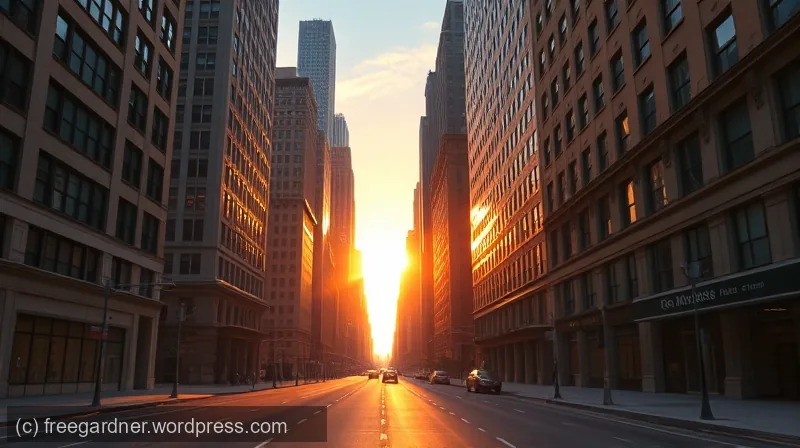
The sun does not know it is supposed to be a symbol. It rises. It sets. It burns hydrogen into helium at a steady, indifferent rate. And yet, twice a year, it becomes something else entirely in New York City. It becomes a question mark made of light.
Manhattanhenge sits in a strange place. It is not an eclipse, where the moon steps in front of the sun and steals its fire. It is not a solstice, where the earth tilts to its extreme and the day holds its breath. Manhattanhenge is something quieter. The sun does not disappear. It does not pause. It simply lines up. And in that alignment, something shifts.
The name came from Neil deGrasse Tyson in 1997. He was an astrophysicist at the American Museum of Natural History when he noticed the pattern. The streets of Manhattan, laid out in the 1811 Commissioners’ Plan, run on a grid that tilts 29 degrees east of true north. Tyson realized that twice a year, at sunset, the sun would slip perfectly into the slot between the buildings. He called it Manhattanhenge, a nod to Stonehenge in England, where standing stones frame the solstice sun in a similar way.
But Stonehenge was built by people who chose the alignment. Manhattan was built by people who chose the grid. The sun simply adapted.
In 2026, the first Manhattanhenge happened on May 28 — a partial view, with the sun half-hidden behind the horizon’s haze. The full sun appeared on May 29. The next chance comes on July 11, when the full disk will again sit between the skyscrapers, and then July 12, when it will be partially obscured. The best streets to watch from are 14th, 23rd, 34th, 42nd, and 57th — wide east-to-west corridors where the view opens up like a canyon pointing at the sky.
The Unwritten Contract
Here is the strange part. Thousands of people gather for this. They block traffic. They stand in the middle of the street. They hold up phones and cameras. They do not know each other. They did not plan together. And yet, at the same moment, they all stop.
This is not common. Most of the time, a city works because people ignore each other. You walk past a thousand faces a day and do not meet a single pair of eyes. That is the deal. The city gives you anonymity, and you give the city your attention. You look at the sidewalk, the subway map, the screen in your hand. You do not look up.
Manhattanhenge breaks that contract. For a few minutes, everyone looks at the same thing. The sun becomes a shared object. It does not belong to anyone. It does not belong to the tourists or the photographers or the astrophysicist who named it. It belongs to the moment, and the moment belongs to everyone who shows up.
There is a word for this in psychology. It is called collective effervescence. The term was coined by the French sociologist Émile Durkheim in 1912, after he studied religious rituals in Indigenous Australian communities. He noticed that when people gather for a shared experience, something happens that is more than the sum of their individual feelings. A kind of electricity passes through the crowd. People feel connected to each other and to something larger than themselves. Durkheim thought this was the origin of religion. But it might also be the origin of why we stop in the middle of a Manhattan street to watch a sunset.
Researchers at University of California, Irvine have studied this phenomenon in modern contexts [1]. In 2020, a team led by Dr. Paul Piff published a paper in the Journal of Personality and Social Psychology showing that experiences of awe — the feeling you get when you see something vast and beautiful — actually make people more generous and less focused on themselves [1]. Participants who watched awe-inspiring videos were more likely to help a stranger who dropped a pen [1]. They reported feeling less entitled and more connected to others [1].
Manhattanhenge is awe, but it is also something else. It is awe that happens in a place where awe is not supposed to exist. Manhattan is a grid of money and schedules and ambition. It is not a place for wonder. And yet, twice a year, the grid itself becomes the frame for wonder.
The Door That Opens
There is a deeper question here. It is not about the sun. It is about the grid.
The 1811 Commissioners’ Plan was designed for efficiency. It divided Manhattan into 12 avenues running north-south and 155 streets running east-west. It was a machine for real estate, for traffic, for the orderly flow of commerce. It was not designed to point at the sun. And yet, because of the 29-degree tilt, it does.
This is not unique to Manhattan. Other cities have their own versions of this alignment. In Chicago, the sun aligns with the grid on March 20 and September 25, a phenomenon sometimes called Chicagohenge. In Toronto, it happens around February 16 and October 25. In Montreal, it is called Montrealhenge, and it occurs near March 21 and September 21. In London, the sun aligns with the east-west streets of the city’s financial district in February and October, though no one has given it a catchy name yet.
What these cities share is a grid. What they share is the accident of geometry. The sun does not care about the grid. But the grid, by chance, cares about the sun.
This is where the metaphor deepens. The grid was built for one purpose, but it serves another. The streets were made for cars, but twice a year they become theaters. The buildings were made for offices, but twice a year they become wings of a stage. The city was made for work, but twice a year it invites its inhabitants to stop working and look up.
There is a lesson in this. The things we build are never only what we build them for. A road is also a line of sight. A window is also a frame. A city is also a sundial.
Dr. Jackie Faherty, an astrophysicist at the American Museum of Natural History, has studied Manhattanhenge in detail. In a 2019 interview with the museum’s blog, she explained that the alignment is not just about the sun. It is about the relationship between the built environment and the natural world. “We live in a city that is so constructed,” she said, “that we forget we are on a planet that moves.”
That is the real gift of Manhattanhenge. It reminds you that you are on a planet. It reminds you that the planet is moving. It reminds you that the sun is not just a source of light for your phone screen. It is a star. And twice a year, that star lines up with a grid that was drawn two centuries ago by people who never saw a skyscraper.
The Next Question
The sun sets. The crowd disperses. The traffic returns. The city goes back to being a city.
But something has changed. Not in the city. In the people who watched. They have seen that the grid is not just a grid. It is a pointer. It points at the sun. And if the grid can point at the sun, what else can it point at?
This is the door that Manhattanhenge opens. It is not a door to a new discovery. It is a door to a new way of seeing. Once you know that the streets align with the sunset, you start to wonder what else aligns. Do the shadows at noon on certain days point to something? Do the reflections in certain windows reveal something about the position of the moon? Is there a Manhattanhenge for the moon?
The answer is yes. It is called Manhattan Moonhenge, and it happens when the full moon aligns with the grid. It is rarer than the sun version, because the moon’s orbit is tilted relative to the sun’s path. But it happens. And when it does, the same streets fill with the same people, looking at the same slot between the buildings, waiting for the same moment of alignment.
The next scientific question is not about the sun or the moon. It is about us. Why do we stop? Why does alignment matter? Why does a line of light between two buildings make thousands of people forget where they are going?
The answer might be simpler than we think. We stop because the sun does not stop. We gather because the sun does not gather. We look up because the sun does not look down. And in that moment of looking, we are not just watching the sun. We are watching ourselves watch the sun. And that is the rarest thing of all.
The next Manhattanhenge is July 11. The sun will set at 8:20 PM Eastern Time. The best view will be from 42nd Street, looking west. Bring nothing. Expect everything. The sun will not wait. But it will be there. And so will everyone else.