Jupiter’s Clouds: A Color Puzzle Juno Keeps Photographing but Cannot Yet Solve
Hydrogen and helium make up the bulk of Jupiter’s thick atmosphere. At the frigid temperatures found at the cloud tops, both gases are colorless. An atmosphere built almost entirely from those two elements should therefore read as a blank, pale shell. It does not. Jupiter is one of the most vividly banded objects in the solar system, and the pigments responsible have never been positively identified. The planet is, in effect, a colorless gas giant whose colors no one can yet explain.
That gap between what the atmosphere is made of and what it looks like is the central puzzle. Which trace molecules supply the color remains an open research topic. One leading candidate is ammonium hydrosulfide, present in small amounts.
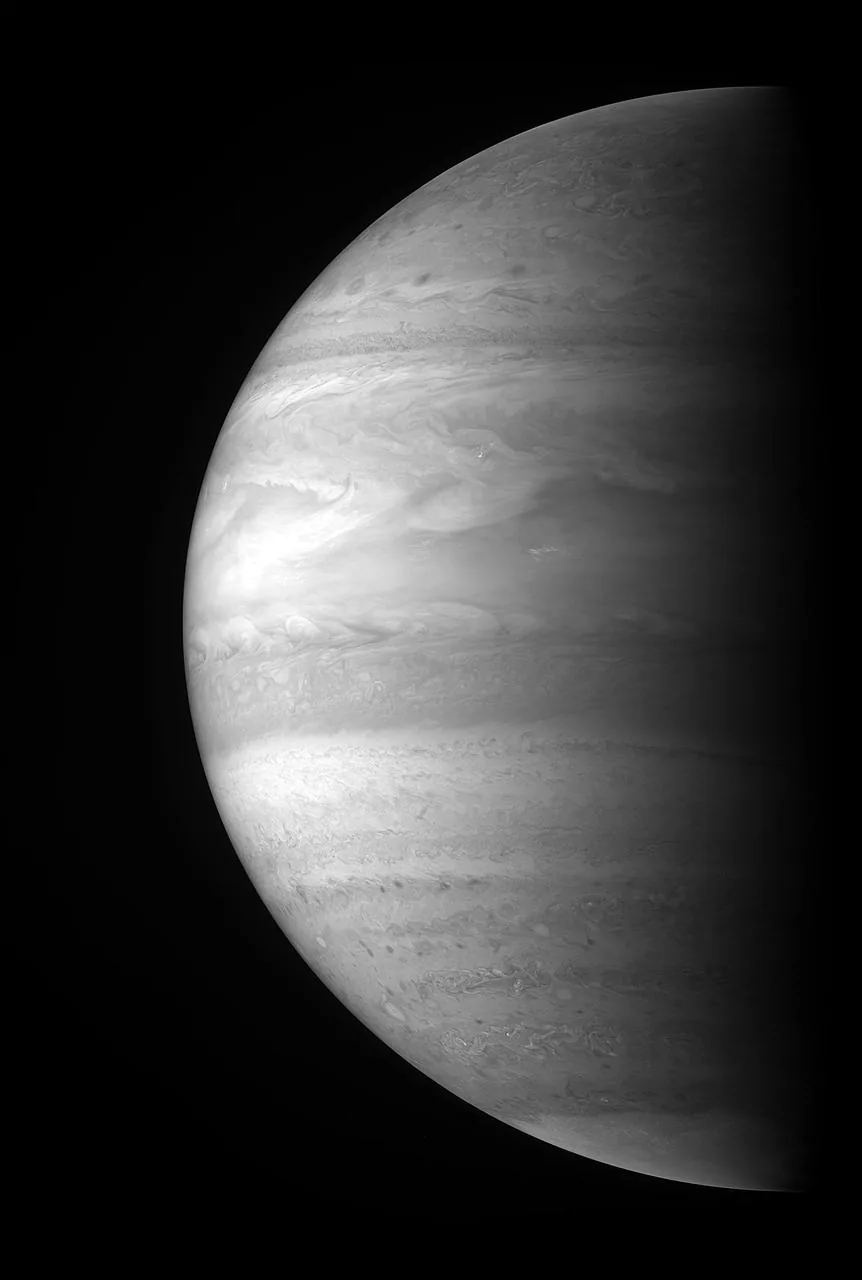
What the images do make clear is a matter of depth, not chemistry. Lighter clouds are typically higher up in the atmosphere than darker ones. That relationship holds across many images, not just one.
The Storm That Wraps Around a Red Patch
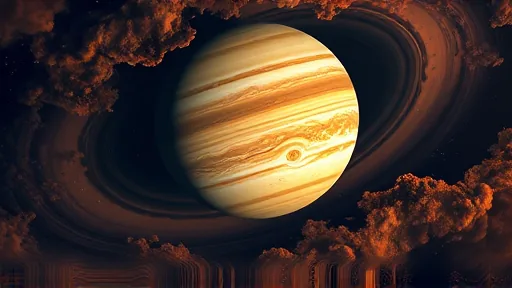
In the lower right of the frame, pale clouds curl around reddish regions. Toward the upper right, those same light clouds appear to drape over darker domains. The bright-over-dark rule is visible in the geometry of the swirls themselves.
The Juno spacecraft captured this view in 2018, during its 14th low pass over Jupiter. [1] Juno does not orbit like a satellite parked above one spot. It follows a looping elliptical path, diving close to the giant planet once every 33 days and examining a slightly different sector on each circuit. [1] That cadence matters for the color question. Each pass returns a single lighting angle, a single altitude range, a single slice of atmosphere, and the puzzle only yields when many such slices are stacked together.