
Guimaraes proves green living needs no sacrifice
The simplest explanation for why we cannot save the planet is that sacrifice is required. It feels intuitive: if everyone consumed less, the Earth would suffer less. But the city of Guimarães in northern Portugal has built its entire green transition on the opposite premise. Its elected officials, working with sustainability scientists, argue that the real problem is not consumption itself, but where it happens and for whom. The city’s approach, led by biologist Carlos Ribeiro at the Landscape Laboratory, treats social justice and planetary health as the same goal. [1] “Social justice and the principle of leaving no one behind are truly central to our approach,” Ribeiro says. The assumption that environmental protection must come at the cost of human well-being is, in this view, the wrong starting point entirely.
Behind this claim lies a decade of hard data. In 2015, sustainability scientist Sara Pires at the University of Aveiro conducted a pivotal analysis of Guimarães’s ecological footprint. The assessment found that if everyone on Earth lived like the city’s residents, humanity would need the resources of nearly 2.3 planets. That is significantly above the global average of 1.7 Earths. The city’s leaders did not respond by calling for belt-tightening. Instead, they set a target to become a “One Planet City” by 2050 — an official designation from the sustainability consultancy Bioregional and the World Wildlife Fund. Since then, the city council has baked sufficiency into every decision. “They really have an impressive capacity to change,” Pires says. [1]
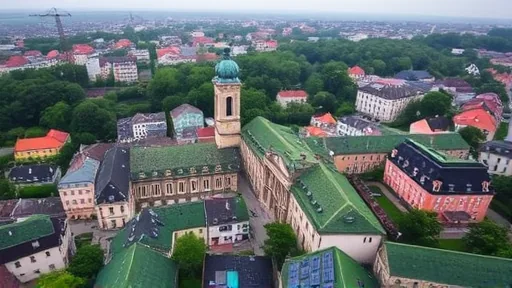
The Landscape Laboratory, housed in an old textile factory beside a restored stream, now conducts research that seeks to improve quality of life while shrinking the city’s footprint. The lab has already helped restore 95 hectares of green space since 2012. The lawn around Guimarães Castle, built in the 10th century, is now a rain-fed meadow. A network of greenways connects far-flung parts of the city. A 2020 study led by environmental psychologist Yannick Joye at Vilnius University found that when people’s attention was directed toward nature, they attached less importance to materialistic values. The green spaces also cool the city, reducing the need for air conditioning. They encourage walking and cycling, which further cuts resource use. The city is not asking people to give up comfort. It is redesigning comfort itself.
Where Growth Happens in the Wrong Direction
The next step the researchers themselves name is a global accounting of where consumption actually grows. Sustainability scientist Joel Millward-Hopkins at the University of Lausanne in Switzerland led a 2025 study that analyzed national trends in energy and material use worldwide. The team divided countries into two groups: those that have enough energy and resources to provide “decent living standards” — a basic floor for well-being based on access to nutrition, housing, and a buffer for inequality — and those that have more than enough. The finding was stark. High-income countries already consume far more than low-income nations. But the growth rate of consumption was four times higher in the countries that already had surplus. The consumption that could lift people out of poverty is not happening where it is needed. It is accelerating where it is not.
This pattern creates a double trap. If current trends continue, decent living standards will not be fully achieved in lower-income countries until the end of this century. Meanwhile, environmental pressures from overconsumption will keep intensifying. “We risk breaking the planet,” Millward-Hopkins says. The researchers argue that above a certain level — when essential needs are met and you have enough to live comfortably — additional wealth has little impact on well-being. They call this “useless overconsumption.” The solution they propose is a “consumption corridor”: a floor below which no one should fall, and a ceiling above which no one needs to go. The corridor keeps everyone within planetary boundaries while ensuring a basic quality of life for all.
The concept of planetary boundaries itself was first described in a landmark 2009 paper by Earth system scientist Johan Rockström at the University of Potsdam in Germany and his colleagues. [6] They identified nine boundaries — limits on climate change, ocean acidification, land-system change, and six other phenomena — that define a safe operating space for humanity. Breach these limits, and the stable conditions that have allowed human civilization to flourish for 12,000 years could collapse. Humanity has now crossed seven of those nine boundaries. Total domestic water use has increased sixfold over the past 50 years, a rate faster than in agriculture or industry. Overall extraction of natural resources and energy use have tripled over a similar period. The boundaries were designed to warn us. The consumption corridor is designed to show us how to stay within them.
The Unresolved Contradiction of Enough
The contradiction that has not yet been resolved is who decides how much is enough. Guimarães has demonstrated that a city can reduce its resource use while improving quality of life. The city’s waste circularity index — a measure of how effectively an economy reuses, recycles, and recovers materials — is now 2.5 times the average for Portugal. Recycling-collection trucks adorned with the words “recycling saves money” trundle down cobblestone streets, part of a “pay-as-you-throw” system that charges residents per kilogram of refuse. Regular repair fairs encourage people to extend the life of electronics and other goods. The city is also developing a circular economy around its historic textile industry, which dates back to the Middle Ages but declined in recent decades due to overseas competition. Companies like RDD Textiles and Zouri Shoes now use recycled materials and natural dyes to produce quality products that some consumers are willing to pay more for Each year, more than 20 tonnes of textiles are recovered across the city through this approach.
But these local successes do not answer the global question. The consumption corridor requires a ceiling on resource use in wealthy nations. That ceiling would be set by science — the planetary boundaries — and by fairness — the decent living standard floor. But science cannot tell us where luxuries end and necessities begin. It cannot resolve whether a second car, a larger house, or international air travel is essential or excess. The researchers themselves do not name a mechanism for making that choice. They identify the problem and the corridor, but they do not say who draws the line.
The question lingers because it touches on personal freedom. Can a city or a nation set limits on what its citizens consume without eroding the very well-being it aims to protect? Guimarães’s answer so far has been to make sufficiency attractive rather than mandatory. The greenways, the meadows, the restored stream with its Iberian chub and northern straight-mouth nase — these are not restrictions They are alternatives. But the city also knows that its experiment is not yet complete. The target is 2050. The boundaries are already breached. The contradiction between freedom and limits remains unresolved — not because the science is uncertain, but because the decision is political. The researchers have shown the corridor exists. The question of who walks through it, and who decides, has not yet been answered.
Sources
2. Bioregional