
Gravity Holography and the Boundary of Space
The Box That Forgets Its Own Volume
A sealed crate cannot be opened, drilled, or filmed from within. Yet photographing only its six outer faces — nothing more — would, in principle, reveal exactly how many marbles rattle inside, where each one sits, and how fast each one spins. That is roughly the claim the holographic principle makes about any region of space, and it is the reason a string of four letters — AdS/CFT — has haunted physics for the better part of three decades.
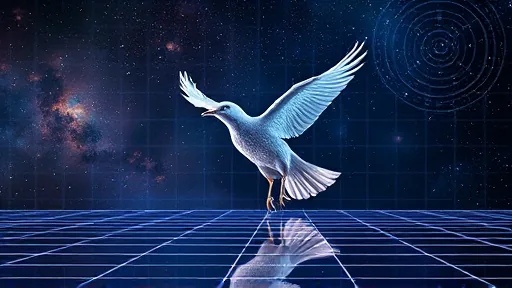
The principle states that the entire contents of a bounded region of space-time can be deciphered purely by repeatedly measuring points on its boundary. The interior, in this telling, is redundant. The amount of stuff that fills a box equals the amount of paint that covers it — a claim that erases the categorical difference between square meters and cubic meters. It is as if a hologram’s flat surface did not merely resemble a bird but was the bird, feather for feather.
Bartek Czech, a theorist at Tsinghua University in China, captures the force of this idea with a medical comparison. [1] A CT scan of a brain fires X-rays through the organ and reconstructs every fold, vessel, and neuron in three dimensions from hundreds to thousands of cross-sectional images. Holography implies that the same reconstruction could be performed without ever looking inside — simply by photographing the brain’s surface. Why would any serious person entertain this? The answer traces to one force, which Czech calls “a miracle of gravity.”
Gravity differs from electromagnetism in a way that makes the boundary trick possible. A box filled with electric charges presents an ambiguity: positive and negative charges can cancel, so radically different interior arrangements produce identical fields at the surface. With no field observed, an empty box and a perfectly balanced one are indistinguishable. With gravity, mass plays the role of charge — and mass is always positive. There is no negative mass to cancel anything, so the warping of space-time at the box’s surface reveals the one true arrangement within. Laurent Freidel, a physicist studying quantum gravity at the Perimeter Institute for Theoretical Physics in Waterloo, Canada, puts it plainly: “Intuitively, this is why holography is plausible.” [1]
Roads Converging at the Edge
The first hard clue arrived in the 1970s, when Jacob Bekenstein and Stephen Hawking calculated the entropy of black holes — normally a measure of how much fits inside an object. Using quantum theory to predict how a black hole grows as it swallows particles, they found something perplexing: entropy grew in lockstep with surface area, not volume. Leonard Susskind of Stanford University built on that result in the 1990s, proposing that a black hole is literally a hologram — everything inside observable from outside, the interior superfluous. “I thought it was a little bit crazy,” Susskind said, “but I thought it was the least crazy of all the possibilities.” [1] Gerard ‘t Hooft, a Nobel laureate, and Charles Thorn of the University of Florida in Gainesville reached similar conclusions around the same time.
The black hole argument carries a rock-solid universality. Any patch of space can become a black hole if you pack in enough mass, so black holes are representative examples of space rather than exotic outliers — they simply bring space’s stranger properties to the fore. “It’s completely general,” Susskind said.

Not everyone reads the entropy result the same way. Latham Boyle, a physicist at the Higgs Center for Theoretical Physics at the University of Edinburgh, questions the holographic interpretation without disputing the Bekenstein-Hawking findings. Enclosing a region with a surface, he suspects, creates two distinct entropies: one counting how many particles fit inside, which genuinely depends on volume, and a second “entanglement” entropy from quantum connections crossing the boundary, which depends on area. They are not the same thing. “That seems like a less mystical, more down-to-earth interpretation of what’s going on,” Boyle said.
A second, more conceptually airtight pillar stands beside the black hole argument: AdS/CFT. Picture a universe whose infinite expanse curves so that it fits inside a finite snow globe — a geometry mathematicians and mathematically minded artists such as M.C. Escher handle comfortably. This is anti-de Sitter space. Its interior resembles our universe, filled with electrons and atoms, and it ripples in response to that matter, producing gravity. The snow globe’s surface is itself a universe of quantum particles, but it is rigid and cannot react — no gravity. It obeys a conformal field theory, in which the rules of physics do not change with the scale of observation. A blockbuster trilogy of papers in the late 1990s showed that these two theoretical worlds are mathematically the same. Unlike the black hole argument, AdS/CFT admits no alternative interpretation. Even skeptics find it genuinely surprising. “I don’t know of any mundane way to explain it,” Boyle said.
The message is that, at least inside this special snow globe, the rules of gravity and the rules of quantum mechanics secretly describe the same game. “Far from being opposed, they’re actually intertwined,” said Brian Swingle, a physicist at Brandeis University. “One emerges from the other.” Sebastian Mizera, a physicist at Columbia University who studies the mathematical structure of quantum theories, was asked whether the correspondence resembles converting any checkers move into a valid chess move. His verdict: the analogy is not dramatic enough. “It’s more like checkers and basketball.”
What the Ant Cannot See
Does the snow globe’s holographic nature say anything about our reality? Here physicists part ways. Skeptics stress that our universe is the snow globe’s opposite: accelerating cosmic expansion implies a space curving outward, a de Sitter space with no boundary surface on which to project a hologram. On that reading, AdS/CFT has little to do with the real world. The most dedicated holographers take a ground-level view instead. An ant deep inside the snow globe cannot easily detect curvature and cannot distinguish anti-de Sitter from de Sitter space — so perhaps what holds for one space roughly holds for the other.
Both arguments have merit, yet the circumstantial black hole evidence plus the near-guarantee that anti-de Sitter space — the space physicists understand best — is holographic make it hard to bet against a holographic universe. Our cosmos absolutely could work differently. It just seems unlikely.
What would it mean, then, to live inside a hologram? Most physicists hesitate to connect holography to ontology — the capital-T truth about what is real. “I don’t try to answer that question,” Susskind said. “That’s beyond my pay grade.” That reticence is prudent. Physics does not aim to explain what is real; it seeks a few simple rules that predict what instruments will read. Holography’s contribution to fundamental research is exactly that: a boundary description that reproduces the interior, a mathematical fact about gravity and quantum mechanics that no one has explained away, and a standing invitation to ask what space itself is made of.
Sources
1. Quantamagazine — Quote source (original article)
Mentioned organisations (context, not sources)
- Tsinghua University — Organisation (homepage)
- Perimeter Institute for Theoretical Physics — Organisation (homepage)
- Stanford University — Organisation (homepage)
- University of Florida — Organisation (homepage)
- University of Edinburgh — Organisation (homepage)