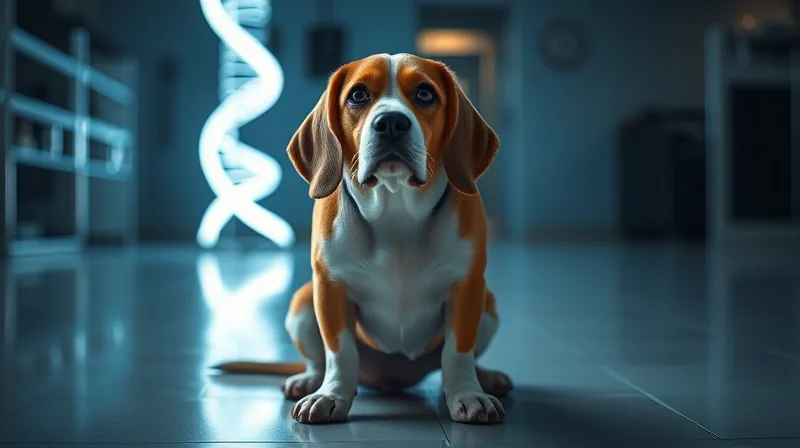
Gene-edited beagles offer hope for dog allergy sufferers
For millions of people, the choice has always been painful: live with a dog and suffer the sneezing, the itching, the watery eyes — or give up on canine companionship entirely. Allergy shots help some, but they are not a cure. Medications mask symptoms but do not remove the source of the problem. The source, it turns out, is a single protein found in dog saliva and hair. And now, for the first time, scientists have found a way to remove it before a dog is even born.
The breakthrough comes from Matt Walker and his team at Kindred Companion Sciences. They used a Nobel Prize-winning technique called CRISPR to edit the genes of two beagles, named Bailey and Alfie. CRISPR works like a pair of molecular scissors, allowing scientists to cut and change specific parts of DNA. In this case, they targeted the gene responsible for producing the allergy-causing protein. The result: two healthy, hypoallergenic beagles whose presence does not trigger allergic reactions in sensitive people. .
Walker has personal stakes in this work. He suffers from dog allergies himself, yet he can now play fetch with Bailey in Central Park without any symptoms. “The feeling right now is sort of a mix of relief and awe and gratitude that it worked,” he said. But he is quick to caution that this does not mean all dog-related allergies have been eliminated. The protein they removed is the main culprit, but not the only one.

To understand why this matters, it helps to look at what came before. Previous attempts to create hypoallergenic pets relied heavily on cloning. Those efforts often produced genetically similar animals with health problems, making them poor candidates for widespread use. Two years ago, researchers used CRISPR to lower levels of an allergy-causing protein in a cat named Alsik. That was a promising step, but its safety for other cats remains untested. The beagle research, published in. The CRISPR Journal, is the first successful application of this method to dogs. [1]
The genetic edit used in Bailey and Alfie is rare but does occur naturally in some dogs. That is important because it reduces the risk of adverse effects from the modification. The scientists did not introduce something foreign; they essentially accelerated a change that nature sometimes makes on its own. This natural precedent offers some reassurance about the long-term health of these animals, though the full picture is still emerging.
Not everyone is convinced this is purely good news. Bioethicist Arthur Caplan from NYU’s Grossman School of Medicine has raised a significant concern. [1] He worries that the existence of gene-edited hypoallergenic dogs could discourage people from adopting shelter animals. Why take home a stray that might trigger your allergies when you could get a guaranteed allergy-free puppy? Caplan put it plainly: “On the negative side, it may discourage people from trying to use strays and unwanted animals that are not engineered to be allergy-free.” [1]
This is a real tension. Shelters are already overcrowded, and millions of dogs are euthanized each year simply because there are not enough homes. If the technology becomes commercially available, it could widen the gap between engineered pets and the animals waiting for adoption. The very innovation that helps allergy sufferers could inadvertently hurt the dogs that need homes the most.

There is also the question of long-term health effects. The genetic modification has been successful in two dogs, but that is a very small sample. Scientists do not yet know how these edits will affect the dogs as they age, or whether the change could have unintended consequences in future generations. These are questions that can only be answered with time and careful study. .
The next step, according to the research, is to test these gene-edited dogs on more people with pet allergies. Two successful cases are not enough to prove the technique works for a wide range of individuals with different sensitivities. Walker hopes to expand the approach beyond beagles, testing it on other dog breeds and even service animals. Service dogs, in particular, could benefit people who need canine assistance but cannot tolerate the allergens. .
Before any of this becomes widely available, scientists must find ways to make the technique commercially viable. Gene editing is not cheap, and scaling it up from a laboratory experiment to a practical product will require significant investment and refinement. The path from two beagles in a lab to a world where allergy sufferers can choose their dog based on personality rather than protein levels is still long. But for the first time, that path exists. .