GABAergic neurons found to brake glioma brain tumours
The Wrong Turn That Found a Brake
Sometimes the most useful discovery arrives while looking for something else entirely. A team probing how nerve cells and cancer cells talk to one another stumbled onto a weakness in gliomas — tumours that arise from glial cells, the support and insulation cells of the brain and spinal cord. These tumours can be aggressive and lethal. The investigation was not designed to hunt for a therapy. It was designed to understand a conversation.
That conversation matters because gliomas do not grow in isolation. They sit inside electrically active tissue, surrounded by neurons that fire constantly. The researchers, led by N. Uesaka, asked a narrow question: what happens when those neurons signal to the tumour? The answer, published in Neuron, was not neutral. Some neurons push the tumour forward. Others apply a brake.
The brake comes from GABAergic neurons — nerve cells that release GABA, short for gamma-aminobutyric acid, the brain’s main inhibitory messenger. When these neurons signal to the glioma, the tumour’s growth slows. The finding reframes the tumour not as a lone invader but as a listener tuned to the electrical weather around it.
Listening Through the Tumour’s Own Chemistry
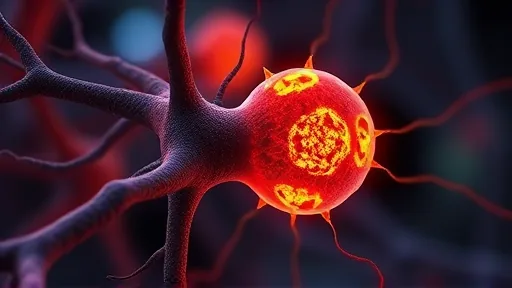
To see this, the team needed a way to read the tumour’s response in living tissue. The tool was the glioma cell itself. The effect was not marginal. In mice, drugs that imitate GABA’s action slowed the tumours
This is where the work earns its weight. Mimicking a natural brake with a drug is a different thing from describing a brake in a dish. The mouse experiments showed that the principle survives inside a living animal, where blood flow, immune cells and a hundred other variables are in play. The tumours responded.
The result also cuts against a simple story: not every neuron in the tumour’s neighbourhood is an ally. Some drive the cancer forward, while the GABAergic neurons sit on the brake side of that ledger.
The Question the Brake Leaves Open
What remains unresolved is whether this brake can be pulled hard enough, and selectively enough, in people. The mouse data establish a principle. They do not establish a treatment. A drug that mimics GABA must act on the tumour without silencing the normal brain circuits that depend on the same molecule.
The finding also raises a deeper question about timing. If GABAergic signalling slows gliomas, does the tumour eventually find a way around it? Cancers can adapt to the pressures placed on them. Whether glioma cells can downregulate their response to GABA, or recruit other neurons to compensate, remains to be determined.
For now, the study delivers a clear and testable idea: a nervous-system cancer may be vulnerable to the very inhibition that keeps healthy brain activity in check. That idea now needs to survive the jump from mice to humans — the step where so many promising brakes have failed before. The next experiment is already implied by the finding itself: test whether a GABA-mimicking drug can slow a human glioma without switching off the healthy circuits that rely on the same signal.
Sources
1. DOI: 10.1016/j.neuron.2026.08.008
2. DOI: 10.1038/d41586-026-02834-5
3. N. Uesaka
4. Neuron