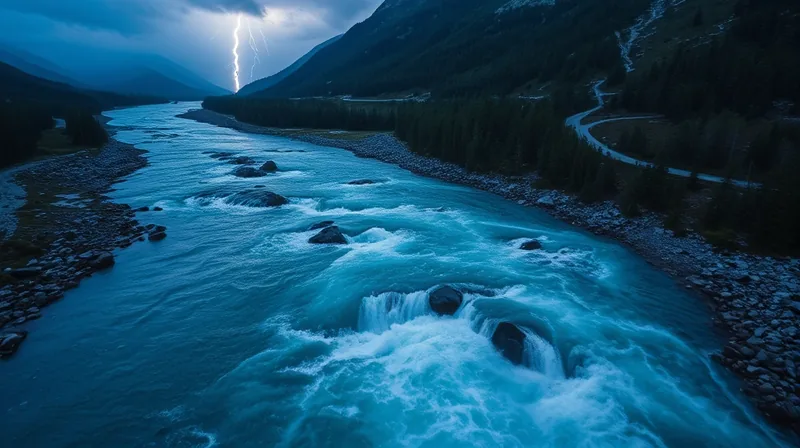
Alpine flood risk rises faster than models predicted
An Unintended Discovery in the Data Stream
The researchers were not originally looking for a new way to measure flood risk. They were studying how heavy rain patterns change with warming in the Alps. Their goal was to refine existing models of river behavior. What they found instead was a mismatch between what models predicted and what the data showed.
The team from the WSL Institute for Snow and Avalanche Research SLF used hourly data from 384 rivers across the Alpine region. Most previous flood studies relied on daily averages. That approach missed the short, intense bursts of rain that actually cause flooding. The hourly data revealed a different picture entirely.
Every degree the Earth warms makes heavy precipitation more intense. This is not a new finding by itself. What is new is how quickly that intensification translates into flood risk. The SLF researchers modeled how flooding will change by the end of the century. Their projections are significantly bleaker than earlier ones.
The study was published in the journal Science Advances. The researchers found that what is now considered a 100-year flood could arrive every 45 to 80 years by 2100. That is a dramatic compression of the time between extreme events. The number matters because infrastructure is built around these return periods.
A Parallel Team Reaches the Same Conclusion
The same question was being asked by a different group of researchers. They worked at a separate institution but were looking at the same problem. Their approach used different data but arrived at a similar conclusion. The convergence of findings made the result more robust.
The parallel team did not simply confirm the SLF results. They added a layer of detail about how different types of rivers respond. Some rivers with large catchments buffer the impact of hourly rainfall. Others, especially those fed by small mountain streams, respond almost instantly.
Both groups found that the timing of floods is shifting. It is not just that floods become more frequent. They also become more concentrated in time. A river that used to rise slowly over days now rises in hours. That changes how warning systems must operate.
The SLF study specifically used data from the Alps. This region is a natural laboratory for studying climate effects. The mountains force air upward, which intensifies rainfall. The steep slopes mean water runs off quickly. The combination makes Alpine rivers especially sensitive to warming.
Where Hydrology Meets Atmospheric Science
The intersection of two scientific disciplines is now opening new questions. Hydrology studies how water moves across the land. Atmospheric physics studies how weather systems form. The SLF findings force these fields to talk to each other more directly.
The key question is what happens inside the clouds. The hourly data shows that the most intense rainfall comes from specific storm types. These storms are becoming more frequent as the atmosphere warms. The physics of why that happens is not fully understood.
The researchers point to a known mechanism. Warmer air holds more moisture. For every degree of warming, the atmosphere can hold about 7 percent more water vapor. That extra moisture can fall as rain in a shorter period. But the exact pathway from that simple fact to a changed flood frequency still needs explanation.
The SLF study provides the hydrological numbers. The atmospheric side of the equation is now the next step. Scientists need to understand how storm structures change with warming. Only then can flood projections become truly reliable. The data shows the timeline is shorter than anyone expected