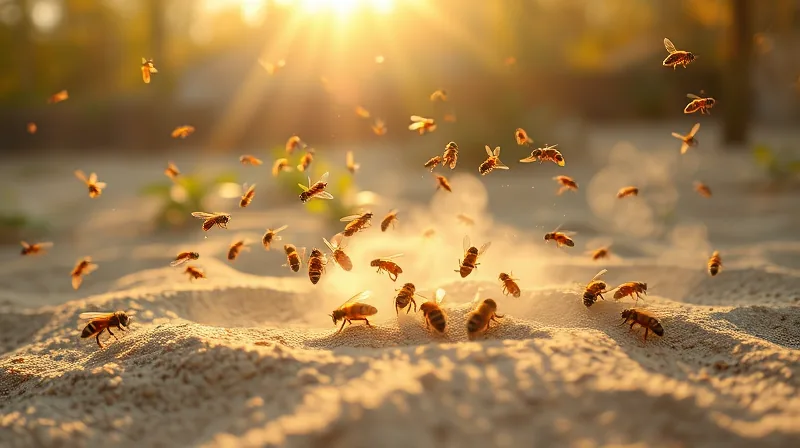
5.5 million bees found in cemetery lawn
The border was invisible. It ran along the edge of a lawn in Ithaca, New York, where the grass of East Lawn Cemetery met the gravel of a parking lot. Rachel Fordyce crossed it every morning in the spring of 2022. She did not know she was stepping into one of the largest bee cities on Earth.
Fordyce worked at a Cornell University entomology lab [1]. To save money on parking, she parked at East Hill Plaza and walked through the cemetery. The path was pleasant. Old trees lined the graves. The ground was sandy and soft under her shoes. One morning, she noticed something strange. The air hummed. Bees were everywhere. They rose from the soil like smoke. They landed on dandelions and clover. They moved with a purpose that seemed too organized for insects she had been taught were solitary, though large aggregations are normal for many solitary bee species.
She caught some in a jar. She brought them to her supervisor, Bryan Danforth, a professor of entomology at Cornell’s College of Agriculture and Life Sciences [2]. Danforth looked at the jar. He looked at Fordyce. He had studied bees for decades. He knew the species immediately. They were Andrena regularis, the regular mining bee. What he did not know was how many there were.
Fordyce said, “These are all over the cemetery.”
Danforth did not yet understand what that meant. No one did.
The Challenge of the Invisible City
The research team faced a specific problem. They knew bees were nesting in the cemetery. They did not know how many. They did not know how deep the nests went. They did not know how old the population was. They did not know if this was a normal aggregation or something extraordinary.
Steve Hoge was an undergraduate researcher in Danforth’s lab. He took on the challenge. He began reading everything he could find about Andrena regularis. The scientific literature was thin. The most detailed study he found was from 1978. That study was written by a researcher named E. E. Leppik at the University of California, Berkeley. Linsley had described the basic biology of the species. He had noted that females dig tunnels in sandy soil. He had observed that they line their brood cells with a waterproof secretion. He had watched them collect pollen from early-blooming flowers. But Linsley had never attempted to count them. He had never imagined a population of millions.
Hoge realized something important. The 1978 study was 45 years old. In those five decades, agriculture had changed. Pesticides had become more widespread. Habitat had been lost. Climate had warmed. No one had checked whether Andrena regularis was still thriving. No one had looked for large aggregations. The species had become invisible.
The team needed a new method. They could not dig up the cemetery. They could not count every nest. They needed a way to sample the population without destroying it.
The Insight That Changed Everything
Danforth remembered a technique he had seen used for other ground-nesting insects. It was called an emergence trap. The trap was simple: a small mesh tent that covered less than a square meter of ground. The tent had a funnel at the top. When insects emerged from the soil, they flew upward toward the light. The funnel directed them into a glass jar. The trap caught everything that came out of the ground.
Danforth thought the traps might work for bees. He was not sure. No one had used them for Andrena regularis before. The team decided to try.
Between March 30 and May 16, 2023, they placed 10 emergence traps throughout the cemetery. They chose locations that seemed to have high bee activity. They set the traps in the morning. They checked them every day. They collected the jars. They brought them back to the lab. They counted every insect.
The results were staggering. The traps captured 3,251 insects. They represented 16 species of bees, beetles, and flies. But one species dominated everything. Andrena regularis made up the vast majority of the samples. The traps caught so many that the researchers had to stop counting individual bees and switch to weight-based estimates. The density was hundreds of bees per square meter.
Hoge did the math. He multiplied the density by the area of the cemetery where the bees were nesting. The area was about 6,000 square meters, or roughly 1.5 acres. The calculation gave a range. The low estimate was 3 million bees. The high estimate was 8 million bees. The average was 5.5 million.
That number was hard to comprehend. It was more than the human population of Manhattan multiplied by three. It was equivalent to 200 honeybee hives. It was one of the largest bee aggregations ever documented in the world.
The Moment of Discovery
Hoge was in the lab when he first saw the numbers. He checked his calculations twice. He checked them a third time. He called Danforth. He said, “I think we have millions of bees.”
Danforth came to the lab. He looked at the data. He looked at the traps. He looked at the maps of the cemetery. He said, “This is real.”
The team realized they had found something extraordinary. They had discovered a bee city that had been hidden in plain sight. The bees had been there all along. No one had noticed because no one had looked.
The discovery raised a new question. How long had the bees been there? The team checked historical records. They found that Andrena regularis had been collected at East Lawn Cemetery as early as 1900. The cemetery itself had been established in 1878. The bees had likely been nesting there for more than 100 years. They had survived two world wars. They had survived the Great Depression. They had survived the rise of industrial agriculture. They had survived the introduction of pesticides. They had survived the construction of the parking lot that Fordyce used every day.
The bees had been there before the cars. They had been there before the pavement. They had been there before the lab where Fordyce worked. They had been there the entire time.
Why the Cemetery Became a Sanctuary
The team asked another question. Why here? Why this cemetery?
The answer was in the soil. East Lawn Cemetery sits on a sandy loam deposit. The soil drains well. It is easy to dig. It is warm in the spring. Female Andrena regularis need sandy soil to build their nests. They dig tunnels that can be 30 centimeters deep. They create brood cells at the bottom. They fill the cells with pollen and nectar. They lay a single egg in each cell. The larvae develop underground. They emerge as adults the following spring.
The cemetery provided another advantage. It was undisturbed. The ground was not plowed. It was not tilled. It was not sprayed with pesticides. The grass was mowed, but the mowing was shallow. The mower blades did not reach the nests. The bees were safe.
Keven Morse was the superintendent of East Lawn Cemetery. His family had helped manage the cemetery for 46 years. He knew the bees were there. He had seen them every spring. He had never been stung. He said, “I just felt bad having to mow in certain areas. There’s probably three or four sections where they really migrate heavy, there’s a lot of them.”
Morse did not know how many bees there were. He did not know they were one of the largest aggregations in the world. He just knew they were there, and he tried not to disturb them.
The team realized that cemeteries were important refuges for biodiversity. Older cemeteries, especially in cities, already sheltered uncommon plants, insects, birds, and mammals. They provided undisturbed habitat in a world where most natural areas had been converted to agriculture or development. They were islands of stability in a sea of change.
The Biology of the Hidden Millions
The team studied the bees in detail. They learned that Andrena regularis was a solitary ground-nesting bee. That meant each female built her own nest. She did not live in a colony. She did not have a queen. She did not have workers. She was alone.
But the bees were not truly solitary. They nested in aggregations. Thousands of females dug their tunnels close together. The tunnels did not connect. The bees did not cooperate. But they tolerated each other. They shared the same soil. They shared the same flowers. They emerged at the same time.
The timing was critical. The bees emerged in April, when daytime temperatures reached about 70 degrees Fahrenheit. They emerged early because they overwintered as adults. That was rare for bees. Most bee species overwinter as larvae or pupae. Andrena regularis was different. The adults spent the winter underground. They emerged in the spring ready to mate.
The males emerged first. They waited for the females. Hoge explained, “The males come out first and wait for the females, so that they have the best opportunities to mate and pass on their genes.”
The females emerged a few days later. They mated immediately. They began digging nests. They collected pollen from early-blooming flowers. They visited apple trees, cherry trees, and wildflowers. They were important pollinators for New York’s apple orchards.
Cornell Orchards was located about one-third of a mile from the cemetery. The orchards provided abundant spring flowers. The bees flew back and forth. They pollinated the apples. The apples became fruit. The fruit became the $300 million apple industry that New York depended on.
The team realized that the bees were not just a curiosity. They were an economic asset. They were pollinating crops worth millions of dollars. They were doing it for free. They were doing it without any management. They were doing it without any recognition.
The Parasites That Lived Among Them
The team also discovered that the bees had enemies. They found nomad bees, also called cuckoo bees. The species was Nomada imbricata. These bees were parasites. They did not build their own nests. They did not collect their own pollen. They waited until a female Andrena regularis had prepared a brood cell. Then they sneaked in. They laid their own egg inside the cell. When the cuckoo bee larva hatched, it killed the host larva. It ate the pollen and nectar that the host mother had collected.
The cuckoo bees were part of the ecosystem. They kept the population in check. They prevented the mining bees from becoming too numerous. They were a natural control.
The team documented the relationship. They found that about 5 percent of the brood cells were parasitized. That was a normal rate. It was not a threat to the population. The mining bees could sustain that level of parasitism.
But the team worried about other threats. The population was concentrated in a small area. If that area was disturbed, the entire population could collapse. If someone paved over the cemetery, the bees would die. If someone sprayed pesticides, the bees would die. If someone built a parking lot, the bees would die.
Danforth said, “These populations are huge, and they need protection. If we don’t preserve nest sites, and someone paves over them, we could lose in an instant 5.5 million bees that are important pollinators.”
The Global Search for Hidden Cities
The team realized that East Lawn Cemetery was probably not unique. There were likely other large aggregations around the world. They had not been found because no one had looked.
Danforth and his colleagues launched a global citizen science initiative. They asked people to report ground-nesting bee aggregations they encountered. They created a website. They created a smartphone app. They asked people to take photos. They asked people to collect samples. They asked people to describe the soil.
The initiative was called Ground Nest Watch. It was modeled after other citizen science projects, like eBird for birds and iNaturalist for all species. The goal was to map the distribution of ground-nesting bees. The goal was to find other large aggregations. The goal was to protect them.
The team knew that most people did not think about ground-nesting bees. Most people thought of honeybees when they heard the word “bee.” Honeybees lived in hives. Honeybees made honey. Honeybees were managed by beekeepers. But honeybees were not native to North America. They had been brought by European settlers in the 1600s. They were an introduced species.
Ground-nesting bees were native. They had been in North America for millions of years. They had evolved with the native plants. They were adapted to the local climate. They were more efficient pollinators for many crops. They deserved attention.
The team published their findings in the journal Apidologie on April 13, 2026. The lead author was Steven T. Hoge, the undergraduate researcher who had done the counting. The co-authors included Jordan Kueneman and Katherine Odanaka, both postdoctoral researchers. They included Cassidy Dobler, another undergraduate student. They included Rachel Fordyce, the lab technician who had taken the walk that started everything.
The funding came from the Cornell Atkinson Center for Sustainability [3], the National Science Foundation [4], and the Federal Capacity Funds program.
The Door That Just Opened
The discovery of 5.5 million bees in a small cemetery opened a new question. How many other large aggregations exist? Where are they? Are they also pollinating crops? Are they also at risk?
The team planned to expand their search. They wanted to survey other cemeteries in New York. They wanted to survey cemeteries in other states. They wanted to survey cemeteries in other countries. They wanted to find the largest aggregations in the world.
They also wanted to understand the genetics of the population. Were the bees in East Lawn Cemetery a single population? Had they been isolated for 100 years? Were they interbreeding with other populations? Did they have unique genetic adaptations?
Danforth said, “I’m sure there are other large bee aggregations that exist around the world that we just haven’t identified, but in terms of what is in the literature, this is one of the largest.”
The team had crossed a border. The border was between seeing and not seeing. Between noticing and ignoring. Between a casual walk and a scientific discovery.
The border was invisible. But once crossed, it could not be uncrossed.
The bees were still there. They were still emerging in April. They were still pollinating the apples. They were still digging their tunnels in the sandy soil. They were still waiting for the females. They were still fighting off the cuckoo bees. They were still living their hidden lives beneath the grass.
And now, for the first time, people were watching.
The Legacy of a Single Walk
Rachel Fordyce did not know she was making a discovery when she walked through the cemetery. She was just trying to save money on parking. She was just trying to get to work. She was just trying to start her day.
But she noticed something. She paid attention. She collected a jar of bees. She brought them to her supervisor. She said, “These are all over the cemetery.”
That simple act changed everything. It led to the discovery of one of the largest bee aggregations in the world. It led to a new method for counting ground-nesting bees. It led to a global citizen science initiative. It led to a scientific paper.
It also led to a new understanding. The bees were not just insects. They were not just pollinators. They were a population that had survived for more than a century. They were a community that had adapted to a changing world. They were a resource that needed protection.
The team hoped that their discovery would inspire others to look. To notice. To pay attention. To collect a jar of bees and bring it to a scientist.
Because the next discovery was waiting. The next border was waiting to be crossed.
And somewhere, right now, someone was walking through a cemetery, not knowing that they were about to find something extraordinary.
Sources
2. Cornell University College of Agriculture and Life Sciences