A Street Stall That Never Became a Brand
Not many firms had built a carbonated beverage brand around the flavour. Cumin was a flavour India drank and a flavour India did not buy.
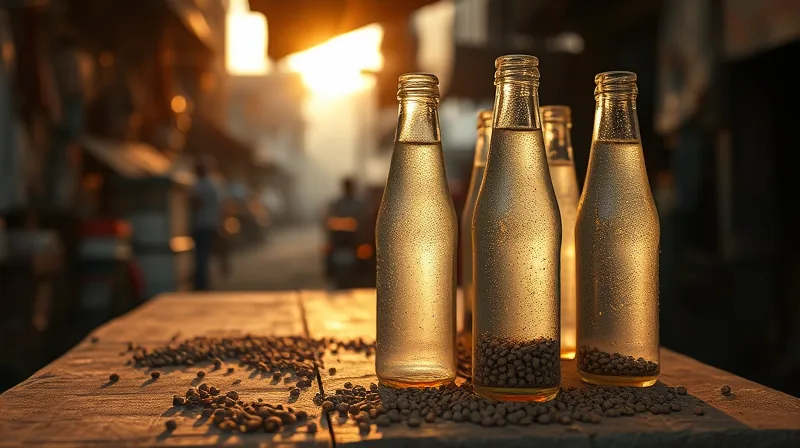
Nothing about that arrangement was inevitable, and three cousins in India’s north-western Punjab state proved it by accident. Saurabh Munjal, Nikhil Doda and Saurabh Bhutna were messing about at home after dinner one evening when Doda casually brewed a tangy, cumin-flavoured fizzy soda out of regular pantry ingredients. Cumin is a warm, earthy spice used across Indian cooking, so the raw material was already in the kitchen. The three enjoyed its earthy, piquant taste enough to explore selling it commercially. They persuaded their families to invest some capital and launched Lahori Zeera in 2017 — zeera being the Hindi word for cumin.
Almost a decade on, the drink will close this year with revenue of $115-120m. Within India it has become something of a sensation rather than a niche curiosity. The product is fizzy, cheap and cumin-forward — three things a cola is not, and the mass-market ten-rupee category is where most of the volume sits. The market it entered was less open than it looked. Coca-Cola and PepsiCo operated as a duopoly — two sellers holding almost the entire category between them — and together they had held what amounted to an entrenched monopoly. For decades the colas had a dominant presence in India, selling themselves as lifestyle products aimed at the aspirational part of the population.
The market is large and expanding. India’s non-alcoholic beverages market was valued at $32bn in 2024 and is projected to double by 2033. A report from Kotak Mutual Fund earlier this year found that Lahori Zeera, Campa and smaller challengers — now grouped as India’s “ethnic beverages market” — collectively doubled their share of the carbonated soft-drinks market — the market for fizzy, non-alcoholic drinks — to around 15% by September last year. Over the same stretch, the combined share of Coca-Cola and PepsiCo fell from roughly 93% to 85%.
The Ten-Rupee Bottle and Its Crowd
Lahori Zeera is one of several cumin-flavoured soda brands that have mushroomed across India over the past decade. The roster includes Jeeru from Mumbai-based Xotik Frujus and Campa Jeera from the Campa Cola brand owned by billionaire Mukesh Ambani. At least half a dozen regional players sell variants too, among them Fizz Jeera Masala from House of Bindu. Every one of them is selling a taste that Indian kitchens already know, and online orders for these fizzy drinks were up 900% this summer, according to a report from one of India’s online delivery companies.
House of Bindu is the case that shows how long the demand sat dormant. The company launched its cumin soda nearly 25 years ago, and sales stayed flat until some years ago. It got there first and got nowhere for two decades. Megha Shankar, a director with the company, describes the reversal this way: “Now it is the fastest growing category among carbonated beverages.” [1] Her arithmetic for the shift: “Its contribution to our revenues has doubled from 20% to 40% in the last five years.” [1] Soaring demand pushed a firm that had been largely based in southern India for over two decades to widen its footprint across the country.
Parle Agro, one of India’s oldest consumer brands, reached the same conclusion by the opposite route. It sold Dhishoom, its own cumin soda, exclusively in rural markets from 2012 and rolled the brand out nationally last year.
Demand has outrun capacity at Lahori Zeera. Saurabh Munjal, chief executive of Archian Foods, which manufactures Lahori Zeera, describes a company that has never had slack: it has “always been in a situation where we are sold out each year.” [1] Capacity was doubled to 1.2 million bottles per day last year, and output still falls short of what the market asks for.
The pitch is the inverse of the cola pitch. For decades, according to Munjal, the global brands sold a western idea of hydration to India, spending millions of dollars on billboards, Bollywood stars and cricket championships. The challengers counter with smart distribution, attractive pricing and a turn toward nostalgic Indian flavours such as cumin, raw mango, kokum fruit and tamarind. Lahori Zeera’s tagline is “apna desi thanda”, meaning India’s own cold drink. Munjal’s account of the strategy is that consumer brands in India have tended either to westernise Indian products or to “Indianise” western products, and that he wants to break the habit. The popularity also tracks something in the buyer: a growing preference for distinctly Indian flavours and for drinks perceived to be more healthy. House of Bindu has answered the second half of that preference with a zero-sugar version of its cumin soda, aimed at the growing market for healthier non-cola drinks.
The Benchmark That Calls This a Disruption
The
Kotak analysis treats the swing as a change of structure rather than one bad quarter for the incumbents, and it borrows a reference case from Indian telecoms to make the point. Reliance-owned Jio Telecom entered India’s telecoms market in 2016, crashed data prices and cost the established operators market share — the slice of total category sales held by one seller. Jio’s arrival is the reference case in India for what a price shock does to a market that looked settled. The parallel is drawn tightly: “This is a “Jio moment” for beverages. Just as telecom incumbents bled market share when data prices crashed, beverage incumbents are bleeding volume.” Its yardstick — duopolies being markets in which two sellers control nearly all the business — is blunt: “In global markets, established duopolies rarely lose more than 1-2% share annually; an 8% swing in less than a year is a structural disruption.” On that measure, the Indian numbers sit outside the normal range of competition between two dominant sellers. What makes the figure telling is the base it moves from: a company holding almost an entire market has only one direction in which its share can go.
The incumbents are not idle, and the threat of bigger, deep-pocketed players entering the category remains. Coca-Cola acquired the cumin-flavoured Rimzim brand in the 1990s and is strengthening its play in this category; it reportedly doubled production last year. That threat is structural: a large player can absorb thin margins that would sink a challenger.
Rajiv Agarwal, a professor at Mumbai-based SP Jain Institute of Management who advises family businesses on strategies to succeed against multinational corporations, is blunt about the contest: “Competition is extremely aggressive.” The established global players are better organised in systems, processes, distribution channels and bottling arrangements — contracts under which a brand’s drink is filled into bottles by third-party plants. Those are the parts of a drinks business that a customer never sees.
The ten-rupee ($0.11; £0.078) price that built the category is also the constraint on it. That price point accounts for the bulk of sales volumes in India’s cumin-flavoured carbonated drinks market. Volume here means bottles sold. Margins — what is left of a sale once raw material, packaging and distribution are paid for — are already very thin at that level. The soaring cost of plastic, packaging, sugar and other raw materials amid the global energy shock can start to eat into them. Raising the price would put volumes at risk, which leaves shrinking the bottle — the route the cola companies took a few years ago.
Agarwal frames the ceiling as a question rather than a verdict: “The million-dollar question is how big can the cumin-flavoured drink market become. And I suspect it won’t become as big as the colas.” Munjal’s ambition points outward rather than sideways. “Indian flavours need to find a global spotlight,” he says, and the plan is to tap the global market in the coming years. The pressures have not deterred him: he is looking to tap the global market in the coming years. He frames the wager generationally: “For generations, we’ve grown up drinking colas of the world, but I hope the next generations will drink the zeeras of India.”