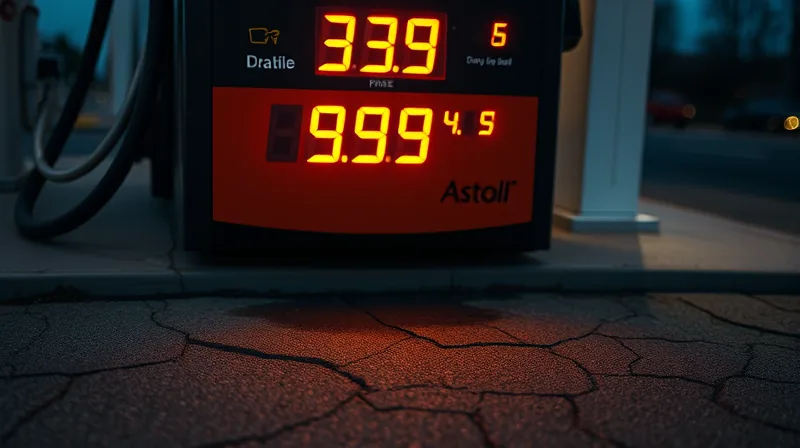
The memory that was central to this election was not a speech but a number on a sign above a filling station pump. Soaring fuel prices were one of the concerns — alongside data centers, tariffs (taxes on imported goods) and mounting debt — that turned the 2026 midterms into a crushing defeat for President Donald Trump’s Republicans. When the ballots were counted, the economy stood above every other issue on the voters’ list.
The Democratic capture of both the Senate and the House of Representatives is a defeat for Trump’s party, but it does not hand the Democrats the power to legislate. The message voters sent was economic, the majorities are comfortable, and Trump remains in the White House with two years of his term still to run.
A Mandate That Stops at the Veto
The first market reading was subtraction rather than panic. Global stocks fell slightly after the results, and the dollar followed them lower. The reaction was muted but trending negative.
The arithmetic explains the restraint. Democrats hold comfortable majorities in both chambers, but not a supermajority that would let legislation pass. Trump holds the power to refuse to sign a bill into law, which means a bill that survived the Senate could still die at his desk. Stephen Brown, chief North America economist with Capital Economics, noted that the magnitude of the Democratic gains does not change much for the near-term policy outlook, for exactly those two reasons. Trump has already given his own role in that arrangement a name: “Mr Veto.” Jacob Funk Kirkegaard, a nonresident senior fellow with the Peterson Institute for International Economics and a senior fellow at Bruegel, compressed the two-year horizon into a single line: “I think we are looking at two years of complete 100% gridlock.” [1] He added: “Nothing will get done of any kind.” The prediction rests on mechanics: a bill needs a filibuster-proof supermajority in the Senate and a presidential signature at the end.
Corruption was another issue vital to voters, bound up with the belief that the administration had engaged in personal enrichment while in office. That gives the new Congress a lever that does not require a presidential signature: investigation, and the threat of impeachment. Kirkegaard’s version of the question: “Can you find 10 or 12 Republican senators who, in the face of overwhelming corruption, would be willing to vote for articles of impeachment? I wouldn’t rule it out.” From there he draws a consequence that runs straight into economic policy: “And that’s a scenario in which Trump might suddenly be much more accommodating to, for instance, abandoning most of his tariffs.”
The Server Farm on the Ballot
In several races the decisive local question was not Washington but a warehouse full of servers. Rising opposition among large majorities of the American population to data centers — the facilities that sit behind artificial intelligence — helped secure victories for many Democratic candidates. A dispute about data centers as AI infrastructure became an electoral one, and it arrived in Congress wearing a party label.

Kirkegaard read the result as a measurement of how deep that opposition runs. Even without federal regulation, local resistance makes data centers harder to build, and that can hit the valuations of the large technology firms that have benefited from the AI boom. His formulation: “This election shows that the political underpinning of the rapid, aggressive AI growth story is shaky.” He went further: “It doesn’t mean it’s going to stop or be made illegal, but the dynamic of the growth story has shifted.” The pressure he describes runs through local planning fights rather than federal rules.
Some investors appear worried about that regulatory risk, especially if Democrats also take the White House in 2028. Brown’s assessment of that horizon: a Democratic presidency on top of these majorities would be perfectly placed to make major policy changes, including potential tax increases on corporations and high-income individuals and regulation that could delay the build-out and deployment of artificial-intelligence systems. Two years of gridlock, in other words, would not settle the question — it would only postpone it.
The Tariff the Voters Felt
The Pew Research Center’s polling in early October 2026 put a number on the mood: 56% of Americans expected Trump’s tariff policies to have mostly negative effects on the country, against 20% who expected mostly positive ones. [1] That sentiment travelled with voters into the results, particularly in states where tariffs have hit hardest. Texas, Michigan, Iowa and Illinois combine export-dependent industries exposed to retaliatory tariffs with heavy trade volumes across the Canadian border. Where a retaliatory tax on exports lands on a local employer, a national trade policy becomes a household budget line.
Congress, however, is not the tariff authority it once was in practice. The Constitution gives the legislative branch the power to collect and organize tariffs, but laws passed over the years have handed presidents the ability to impose them on cited grounds such as national security or economic emergency. Trump has used those avenues and can keep using them, legal rebukes notwithstanding. Deborah Elms, head of trade policy at the Hinrich Foundation in Singapore, described the durability of that approach in an earlier assessment this year: “Trump will not be moderated.” [1] She added: “Expect him to continue his trade disruption and tariff policies for as long as he remains in the Oval Office.” What the new majority can do is litigate. It cannot necessarily force an end to tariffs already in place, but it can take further legal action designed to prevent greater escalation. Kirkegaard’s reading is that the size of the defeat might also push Trump toward less erratic policymaking, whether on the trade war with Canada or on Iran. Trump’s own post-election language pointed at cooperation: he would “work with” the Democrats. Whether that survives contact with a hostile Congress is the open question of the next two years.
The price voters felt most directly, fuel, depends less on Congress than on a deal with Iran. In the run-up to the vote, Trump indicated to the Financial Times that he was unlikely to escalate the war in Iran, and an agreement could let energy prices fall. Kirkegaard’s reading of the political calendar: “You’ve got to get a deal with Iran, and you’ve got to bring down gas prices.” Then, more bluntly: “From a political point of view, that’s the most important thing now.” George Saravelos, an analyst with Deutsche Bank FX Research, sees the market turning more optimistic on that front: “With oil flows through the Middle East having materially recovered, the market is pricing a large imminent risk premium of re-escalation and energy supply disruption.”
Sources
Mentioned organisations (context, not sources)
- United States Senate — Organisation (homepage)
- United States House of Representatives — Organisation (homepage)
- United States Congress — Organisation (homepage)
- Peterson Institute for International Economics — Organisation (homepage)
- Bruegel — Organisation (homepage)
- Pew Research Center — Organisation (homepage)
- Financial Times — Organisation (homepage)
- Deutsche Bank — Organisation (homepage)