Tennessee Halts Executions After Failed Lethal Injection
The Line the Needle Could Not Cross
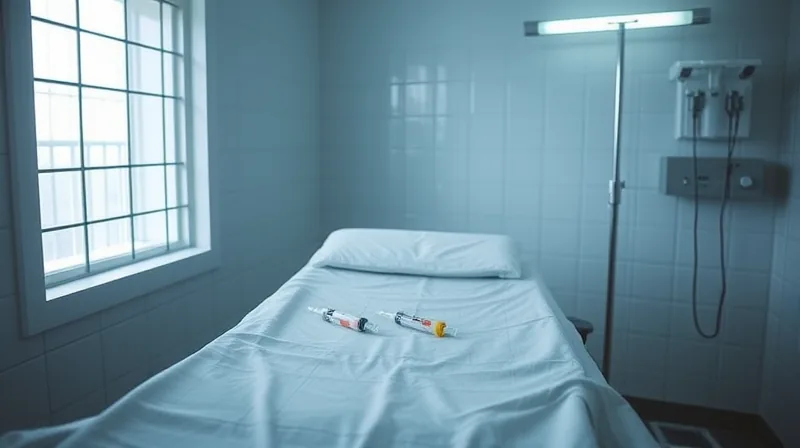
Christa Pike, 50, had been sentenced to death in 1996 for the murder of 19-year-old Colleen Slemmer, an attack carried out alongside her then-boyfriend, Tadaryl Shipp. She was scheduled to be put to death on Wednesday evening, local time. The injections were allowed by the US Supreme Court at the eleventh hour, after a legal battle that had already made the case a public one. Two syringes of the drug pentobarbital went in. Her legal team’s account: the doses did not stop her heartbeat, and she could still be heard snoring. The Tennessee Department of Correction moved her to an off-site medical facility. One of her lawyers said she was “being provided life-saving measures” in hospital. Her health status was unclear as of Thursday morning. Joel Zivot, a professor at the Emory University School of Medicine whom Pike’s legal team retained as a medical expert, offered a theory of the failure that turns on concentration rather than intent. In his account, Pike probably never achieved a sufficient blood level of pentobarbital to cause her breath to stop or her heart to fail. Zivot put the slower risk this way: “It’s very possible that as a consequence of the delay of the beginning of resuscitation she will have a brain injury.” [2] That leaves a state that tried to end a life, a hospital working to save the same person, and a prisoner whose condition the authorities had not described. The case has raised a number of questions: what went wrong, what happens next, and — for opponents of the death penalty — fresh concerns about the suffering of an inmate when an execution does not go to plan.
The department’s own account of the night was narrow. Its position: “the protocol does not allow for additional procedures beyond what was carried out this evening.” [1] Once the second syringe had emptied, the written procedure had nothing more to say. The state protocol does not clearly specify what should happen if an inmate remains alive after a second dose. Authorities have not explained why the dosage given to Pike proved non-fatal. Medical experts have offered theories of their own. Looked at afterwards, the sequence ran out of written steps before it produced a death. Governor Bill Lee ordered a review into what happened. He also halted executions in Tennessee for the rest of the year. The failed execution, in his description, was “a tragedy,” and the standard he set for the inquiry is that Tennesseans deserve answers about what occurred. The state has not yet selected an independent investigator. The review will take as long as necessary to determine what happened. The pause has a near-term consequence: it could affect any additional attempt by the state to execute Pike, if she does regain consciousness. Robin M. Maher, executive director of the Death Penalty Information Center, called the incident “unparalleled.” The case that brought Pike to that chamber is three decades old. Slemmer was 19 when she was killed in 1995. Shipp was her co-defendant in the attack. Pike is 50, and the gap between her 1996 sentence and the attempt on her life is 30 years. One of the two defendants in the killing of Colleen Slemmer is serving a prison sentence; the other went from a death chamber to a hospital bed.
A Drug Nobody Wants to Sell
Pentobarbital is a potent sedative that slows the body, including the nervous system. Doctors sometimes use it as a treatment for certain conditions. In high doses it can also be used as a lethal injection to cause death. Some manufacturers have explicitly said they will no longer produce pentobarbital or will restrict their use in executions. The absence of a written procedure for the moment the procedure runs out is itself part of the problem.

Statistics give that sentence something to push against. Between 1890 and 2010 there were 8,776 executions in the United States and 276 of them were botched, an overall botched rate of 3.15 percent. Lethal injection carried the highest botch rate of any method, at 7.20 percent. Lethal gas came in at 5.4 percent, hanging at 3.12 percent and electrocution at 1.92 percent. The only method with no reported botched incidents was the firing squad. A 2024 report classified 73 of 1,407 lethal injection executions or attempted executions between 1977 and December 2023 as botched, a rate of about 5.2 percent. [2] In 2022, more than a third of executions in the United States were botched or highly problematic. The term itself is broad: a botched execution covers any execution in which something goes wrong. It can mean delays, procedural failures, equipment malfunctions, problems administering the method, a prolonged dying, or other complications that cause unnecessary suffering or reflect serious errors by officials. Depending on the method, it has involved difficulty establishing IV lines, improperly administered drugs, malfunctioning electric chairs, problems with gas chambers and other departures from established protocols.
Maya Foa, chief executive of the international legal organization Reprieve, described the limit that places on any account: “We cannot know exactly what went wrong, because so much happened behind a curtain — lethal injection relies on secrecy at every stage, to hide the violence of the state taking a human life.” Blaire Andres, who heads US death penalty case work for Reprieve, described what the curtain conceals: “I think many people believe the line that the state has sold, which is that the person will just slip off into sleep — like putting your favorite pet to sleep. So I think cases like Pike’s really pull back that curtain.” Her reading of the frequency is blunt: “While this is probably one of the worst executions in American history, what we saw last night is not unusual. Botched executions by lethal injection are unfortunately not unusual. They happen quite a lot.” [2] For critics in Tennessee, the pattern itself was the argument.”
When the State Tries Again
If the review concludes and the courts clear the way, Tennessee will face a question that has been answered before, and not in the direction opponents of the death penalty would choose. Historically, the US Supreme Court has not halted second attempts at executions. In 2024, it allowed the state of Alabama to proceed with a second execution of Kenneth Eugene Smith, after an attempt to execute him by lethal injection failed two years earlier. That first Alabama attempt was itself a lethal injection. Alabama used an experimental oxygen deprivation method to put Smith to death. An older case carries the same logic further back. A Supreme Court case from 1947 allowed the state of Louisiana to attempt a second electrocution of Willie Smith, a black teenager whose first execution attempt failed when he was 17 years old. The first attempt in that case was an electrocution that did not kill him. The court found that a second execution would not violate the Constitution’s prohibitions against double jeopardy or cruel and unusual punishment. Double jeopardy is the principle that the state may not punish a person twice for the same offence. Willie Smith was executed at 18. John Mills, an attorney who works with inmates sentenced to death, answered the practical version of the question: “If the question is, is it likely the federal courts would intervene in a second attempt? I’m afraid the answer is a resounding no.” Pike’s lawyers have already filed a motion to stay her execution. A stay is a court order that pauses an execution while other questions are resolved. Mills set out what he would do in their position. He would ask the federal courts to reconsider their views on a second attempt. He would also look at the Tennessee constitution and ask the Tennessee courts to reconsider. And he would approach Governor Lee, who has powers to issue stays of executions and exercise clemency. Clemency is the governor’s power to reduce or set aside a sentence. Authority over the next step is split four ways: the state correction department, the state courts, the federal courts and the governor’s office. Authorities have yet to say whether they will try again to execute Pike.
Sources

- Tennessee Department of Correction — Quote source (original article)
- BBC — Quote source (original article)