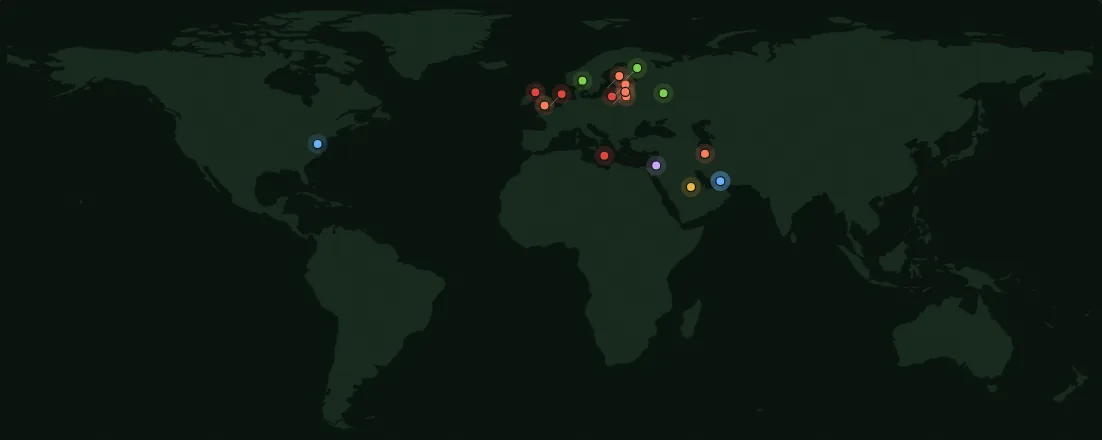
A video clip stitched reports from four countries into a single warning. We checked each claim: two held, one moved, one pointed the wrong way. This is the page that keeps checking.
The page itself is at Signalmap — our own page, and the reason this text exists.
The clip is from the TikTok account @owen164813, video 7701589160888536343. At the time we captured it on 28 October it showed 744 likes and 56 comments, and it is the object of this check, not its authority [17].
On 28 October a German-language clip circulated with an opening that leaves no room for doubt: “Leute, Leute, Leute, gerade überschlagen sich die Ereignisse.” Four claims followed. British submarines had put to sea. The Americans had issued an emergency warning to their population. Iran was preparing for a nuclear attack, according to state media. And two NATO members had placed an emergency call to Vladimir Putin.
Each of those sentences has a real report underneath it. What the clip does is align them, so that four separate things read as one thing. We took them apart, one by one, and then built what we think a reader actually needs: a page that lists such reports with date, place and source, counts them, and marks the ones nobody has checked yet.
What held
Three of Britain’s four nuclear-armed submarines are at sea at the same time. Sky News and The Times reported it first [18]; the Mirror carried the detail on 27 October: HMS Vanguard, Vigilant and Vengeance are out, HMS Victorious is in dry dock at Devonport, and at least one boat is on an armed patrol. A navy source called the state of the fleet “unusual”; the Ministry of Defence confirmed no deployments at all [1].
The phrase that matters is the one the clip skips. “At sea” is not “on patrol”. Three boats can be out because one is handing over to another and the third is working up after maintenance. What the Royal Navy itself says about its rhythm — an availability of two boats at any one time, called “2BA”, and a patrol of 205 days completed this year — is in the same report [1]. A submarine leaving harbour is a signal. It is not automatically a deployment.
What moved
The American “emergency warning to the population” is the second real report, moved to a different address. On 23 October the State Department ordered the departure of family members from Saudi Arabia and put four embassies — Jordan, the UAE, Qatar and Lebanon — into restricted operations. An unclassified memo of the same day says US intelligence found Iranian efforts against US personnel “have reached advanced stages” in the Middle East and in some other countries [3].
That is a warning to Americans in a region, not to the American population. The only nationwide alert in the calendar is the routine test of the Emergency Alert System on 17 November, announced in September [19]. And on the British side the Foreign Office did update its travel warning on 27 October, naming Israel, Iran, Saudi Arabia, the UAE, Qatar, Iraq, Jordan and Yemen and expecting flight cancellations [2]. A reader who only sees the clip will look for a siren that never sounded and miss the one that did.
What was wrong
“Iran is preparing for a nuclear attack, according to state media.” The state media part is verifiable and unspectacular. Press TV reported in September on a civil-defence directive covering 26 October to 2 November — an annual programme, not an answer to the clip — with drills for three scenarios: normal conditions, a ceasefire, and full-scale war. The exercises address what the directive calls hostile threats [5]. Separately, the Wall Street Journal reported that Iran is hardening sensitive sites, including nuclear facilities, and preparing its population for possible renewed US strikes [4].
Both are preparation for being attacked. Neither says Iran is preparing a nuclear strike. The sentence in the clip turns the direction of the threat around, and that single turn is what makes the rest feel like a countdown.
The fourth call
Two NATO members did call the Kremlin — on 27 October, and about a different war. Finland’s president Alexander Stubb and Norway’s prime minister Jonas Gahr Støre spoke with Putin to urge an end to the war in Ukraine, and afterwards with Volodymyr Zelenskyy, according to Reuters. Stubb called the conversation “frank and substantive”. The Kremlin’s readout named no concessions and complained about “the confrontational policies of EU and NATO countries” [6].
It is a real break with the practice of avoiding direct contact with Moscow. It is not an emergency call about Iran, and it was not presented as one.
Two crises, worn as one coat
What the clip actually does is put the Middle East and the Russian border into the same frame.
The two strands are separate in origin and were reported separately; what follows is their chronology, not a common plan.
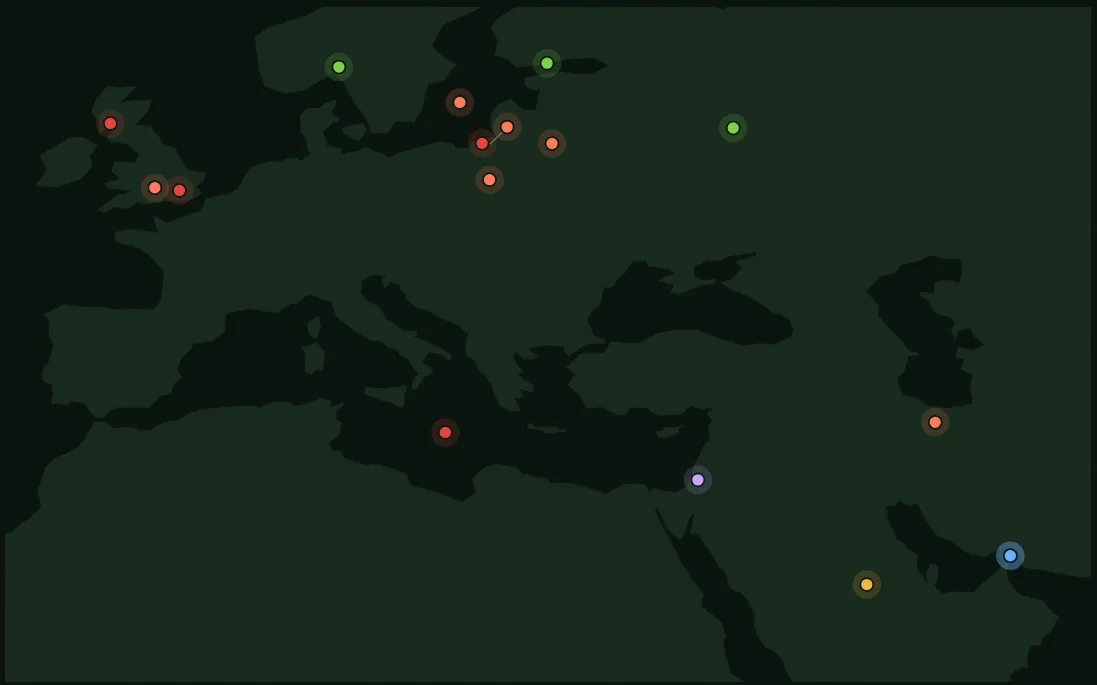
On the Russian side the record is dense. On 30 September Moscow warned it would use its entire arsenal, including nuclear weapons, if Kaliningrad were cut off or attacked [7]. Satellite imagery assessed for the Frankfurter Allgemeine shows three antenna arrays of roughly 490 metres each under construction near Gvardeysk, with a reach of up to about 1,900 miles, and more than twenty signals-intelligence and jamming sites in the exclave [8]. NATO’s commander in Europe, General Alexus Grynkewich, presented a battle plan on 12 October that he summarised as “block, blunt, break”, with the stated aim of destroying “anything and everything” that supports, sustains and controls an attacking force [9].
On the American side, the Pentagon is preparing its own bases for a war that hits infrastructure. The FORTRESS initiative, presented on 30 September, asks major installations in the United States to run for 90 days without civilian power, water, fuel or supply chains. Five pillars, no budget and no timeline are named [10]. Britain, in the same weeks, told households to keep three days of water, food and batteries [11], and British fighters escorted French Rafales through a simulated nuclear strike over the Mediterranean in exercise RUMMY — the first British participation of that kind, with no nuclear weapons involved [12].
The infrastructure is not only what a war would hit. It is also a target. Two Iranian security officials told Reuters that Tehran has detailed plans to hit undersea cables in the Gulf and to prevent repairs, should the United States and Israel attack again [13]. The Gulf is shallow — 50 to 100 metres — which is why specialists consider the threat credible without any high-end submarine capability: divers, a remotely operated vehicle or a dragged anchor are enough [14].
None of these belong to one story. They are five governments preparing for a war that disrupts supply, power and communication, and one war that is already running — the one in the Middle East the clip is talking about.
Why a page, not a warning
The reason we did not write a warning is that a warning cannot be checked. A page can.
Every entry carries a date, a place, a source and a state: verified, or unverified and marked as such. The unverified ones come from a collector that reads the feeds we already fetch for our articles, matches a place in the headline and a concrete term — submarine, warhead, cable, evacuation — and adds nothing else. No model decides what enters; the rules are in the code and they are dull on purpose. The list is corrected in place, never re-published.
The count is not a forecast, and it is not a mood. As of 28 October it reads: 23 reports, 18 places, 45 days. Eight are military movements, four are warnings to a population, three are nuclear deterrence, three supply and infrastructure, three diplomacy, two an election. Two entries are still unverified. It will be a different set of numbers tomorrow, which is exactly why we date them. And it measures our own intake — the feeds we read — not the world.
The election is in the list for a reason. A government’s composition changes what a country does with its army, and the Israeli vote on 27 October is the clearest case in these weeks: projections put Likud at 25 to 27 seats, no bloc near the 61 needed for a majority, and President Herzog holding the decision about who gets the mandate first [16]. That is a signal without a single soldier in it.
A signal has an effect
It would be dishonest to present these reports as if they had no consequence beyond the map. They have one, and it is measurable on a screen most readers look at more often.
Take one balance sheet, reported on 8 August. Rheinmetall, the Düsseldorf defence group, reported first-half revenue up 39 percent to more than five billion euros, an operating result up 74 percent to 786 million, a margin of 15 percent, and an order backlog above 80 billion euros. In the same breath it cut its full-year revenue guidance to 13.7 to 14.2 billion, after the defence ministry stopped the F126 frigate programme; the share traded at 1,146.40 euros, down 0.81 percent [15]. The company’s own explanation for the demand names the war in Ukraine and the conflicts in the Middle East.
That is the honest shape of the effect: the order book booms, the share price does not follow in a straight line. “Defence is booming” is true of production and hiring, and it is not the same sentence as “the stock only goes up”. A page that measures signals should say so in both directions — otherwise it becomes a tip sheet.
What would change the picture
Two things, and both are missing from every clip of this kind. The first is de-escalation: a truce that holds, a call that produces something, an exercise that is cancelled. The second is correction: a claim that turns out to be wrong, named as wrong, on the same page and with the same weight.
This text contains one already, and it is the smallest and most useful kind. “Three submarines at sea” is true. “Three submarines on patrol” is not established by any of the reports, and their own wording — at least one armed boat on patrol, the rest unexplained — is the difference between a signal and a deployment [1].
That correction is worth more than the clip that provoked it. It is also the reason the page exists: not to tell you what to fear, but to show you what a claim is standing on.
Sources
- Daily Mirror: Three of Britain’s four nuclear submarines put to sea with one ‘carrying warheads’ — 27 October 2026
- Daily Mirror: Foreign Office issues urgent warning as UK makes ‘unusual’ nuclear submarine decision — 27 October 2026
- CNN: US discreetly moves diplomats and families from multiple Middle Eastern countries — 23 October 2026
- CNBC: Iran reportedly fortifies nuclear sites as it prepares for possible U.S. strikes after midterms — 13 October 2026
- Dawn: Iran issues civil defence directives for scenarios including full-scale war (Press TV) — 15 September 2026
- Reuters via NBC News: Leaders of Norway, Finland hold rare call with Putin — 27 October 2026
- Al Jazeera: Russia warns NATO of possible nuclear response if Kaliningrad is cut off — 30 September 2026
- Stars and Stripes: Russia builds powerful new radar in Kaliningrad — 21 October 2026
- Stars and Stripes: NATO’s Theory of Victory battle plan — 6 October 2026
- SOFX: Pentagon wants every major U.S. base able to run 90 days without outside help — 15 September 2026
- The Guardian: Every Briton should stockpile water and food, government advises — 22 October 2026
- AeroTime: RAF Typhoons and French Rafales train in first joint nuclear deterrence exercise — 23 October 2026
- Reuters: Iran has detailed plans to hit Gulf undersea cables if war resumes, officials say — 23 October 2026
- The Conversation: Iran’s threat to cut undersea cables in Strait of Hormuz — 15 September 2026
- Börse Express: Rheinmetall senkt Umsatzprognose 2026 auf 13,7–14,2 Milliarden — 8 August 2026
- TikTok: @owen164813, video 7701589160888536343 — 28 October 2026
- Sky News: Three of UK’s four nuclear submarines out at sea — 27 October 2026
- TV Technology: FEMA outlines expectations for national EAS test — 2026
- taz: Vorläufige Wahlergebnisse in Israel — 28 October 2026
All sources were retrieved on 28 October 2026; the counts in this text are the state of the page on that day.